How one public health unit is tackling Ontario’s biggest measles outbreak in decades
Advertisement
Read this article for free:
or
Already have an account? Log in here »
To continue reading, please subscribe:
Digital Subscription
One year of digital access for only $1.44 a week*
- Enjoy unlimited reading on winnipegfreepress.com
- Read the E-Edition, our digital replica newspaper
- Access News Break, our award-winning app
- Play interactive puzzles
*Billed as $5.77 plus GST every four weeks. After 52 weeks, price increases to the regular rate of $19.95 plus GST every four weeks. Offer available to new and qualified returning subscribers only. Cancel any time.
To continue reading, please subscribe:
Add Free Press access to your Brandon Sun subscription for only an additional
$1 for the first 4 weeks*
- Enjoy unlimited reading on winnipegfreepress.com
- Read the E-Edition, our digital replica newspaper
- Access News Break, our award-winning app
- Play interactive puzzles
*Your next Brandon Sun subscription payment will increase by $1.00 and you will be charged $17.95 plus GST for four weeks. After four weeks, your payment will increase to $24.95 plus GST every four weeks.
Read unlimited articles for free today:
or
Already have an account? Log in here »
Hey there, time traveller!
This article was published 06/03/2025 (592 days ago), so information in it may no longer be current.
ST. THOMAS, Ont. – For the second time in five years, some doctors in southwestern Ontario are encountering a virus they’ve never treated before.
But unlike when COVID-19 struck in 2020, this illness is no mystery.
It’s understood so well, in fact, that Canada was able to eliminate it in 1998. Anyone in Ontario who got their medical degree after that is unlikely to have seen measles up close, said Dr. Ninh Tran, medical officer of health for the Southwestern Public Health Unit, where 89 people have come down with the virus since the beginning of 2025.
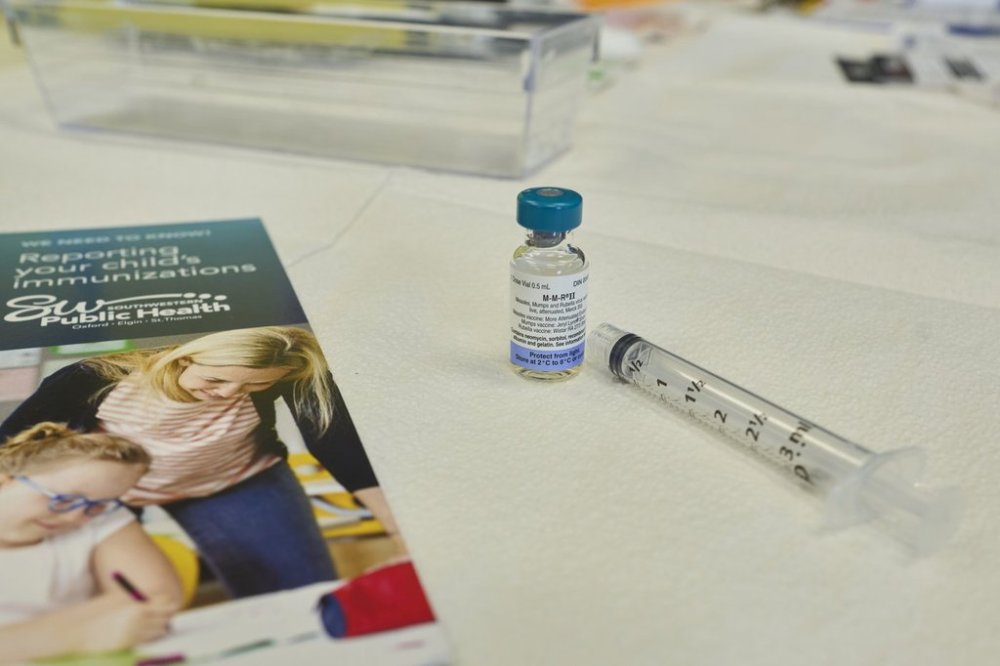
A dose of the measles, mumps, and rubella (MMR) vaccination awaits the next patient during a vaccine clinic at Southwestern Public Health in St. Thomas, Ont. on Tuesday, March 4, 2025.THE CANADIAN PRESS/ Geoff Robins
That’s why measles wasn’t top of mind when last fall people started coming down with respiratory symptoms, nausea and a red, blotchy rash.
“The seriousness of measles, the number of cases, what infection really looks like, the complications, the hospitalizations: People forget if you haven’t seen it around for decades.”
In Tran’s mostly rural region outside London, Ont., and the neighbouring Grand Erie Public Health Unit in and around Brantford, they’ve been reminded.
The communities in southwestern Ontario started seeing kids show up to their doctors’ offices or emergency departments with high fevers and blotchy skin in October. At the time, a travel-related case in New Brunswick led to an outbreak there, expanding to Ontario.
Since Oct. 28, the Southwestern Public Health Unit — which covers St. Thomas, Oxford County and Elgin County — has seen 115 cases, including 26 at the end of 2024.
Ontario hasn’t seen anything like this since the 1990s, though there was a large outbreak in Quebec in 2011, and another in 2015 in British Columbia, with hundreds of people sickened.
Across Ontario, there had been 177 cases associated with the outbreak between Oct. 28, 2024 and Feb. 26, according to the provincial public health agency. Eighteen people have been hospitalized in the province, including one person who was in intensive care. Most of the other cases were in the Grand Erie Public Health Unit.
The latest data suggests there are 30 cases linked to the outbreak in Quebec and five in Manitoba. There are also two cases in British Columbia, but both patients caught the virus overseas.
Most of those sickened across the country were unvaccinated kids and teens.
“We know that the numbers continue to go up, (but) numbers alone don’t tell the whole story,” Tran said at the health unit’s headquarters in St. Thomas, a bright, modern building that supplements the unit’s other branch in Woodstock, 45 minutes away.
ASSESSING A MEASLES CASE
Cara-Lee Coghill, a public health nurse on the infectious diseases team at the health unit, has been spending a lot of time on the phone.
Once a patient talks to their doctor and gets tested for measles, it’s her team’s job to speak with them.
Part of it is about education, and part of it is an investigation: figuring out where patients caught the virus, and who they may have passed it along to.
Staff ask about the early symptoms — the cough, runny nose, nausea, red and watery eyes and fever — and the rash that typically develops a couple days later, starting at the hairline and working its way down the body.
That “telltale” rash is how they figure out when the patient was infectious, Coghill said. It’s red and blotchy and mostly flat, though there are some cases where it’s raised. Most of the time, it isn’t itchy.
“There’s large parts of the population — patients and ourselves, health-care providers — that have actually not seen a measles rash before. It’s pretty unique,” she said. “We’re in a situation now, regionally, where people are very aware of the signs and symptoms.”
CONTACT TRACING
Most of the patients diagnosed with measles are sent home to wait out the symptoms, though some have been hospitalized. Most adults have immunity to the virus — vaccination rates are around 90 per cent among 17-year-olds provincewide, and people born before 1970 are generally thought to have acquired immunity from when the virus was circulating more broadly.
But public health staff still have to figure out who may have been exposed before the diagnosis came in.
“We look at where people have been four days prior to the rash and four days after the rash to see if they could have potentially exposed other people to the measles virus,” she said.
Staff will then reach out to people who spent time with the patient to warn them they may have been exposed, as well as the organizers of community events they may have attended or owners of establishments they may have visited.
Many of the community exposures have been in health-care settings, Coghill said.
“People are felling pretty unwell, so they’ll seek health care,” she said. “Measles is something that can cause pretty severe illness, really high fever. We’re seeing lots of people with vomiting and diarrhea.”
They get scared, she said, so they go to the hospital. At this point though, the public health unit is asking that symptomatic people — whether they are aware of a measles exposure or not — stay home and call them to avoid exposing more people.
WHERE DO WE GO FROM HERE
The lack of familiarity with measles’ severity may have led to vaccine complacency, said Tran, the medical officer. The measles, mumps and rubella vaccine is typically administered at 12 months old, and the booster — which also has protection against chickenpox — is given at four to six years old.
Much of the response to measles in the Southwestern Public Health Unit has been focused on filling in the immunization gaps. If there are 10 unimmunized people in a room with somebody who has measles, nine of them will catch the virus, he said.
“It’s so infectious that any pockets of areas or people who aren’t immunized, it will go right through it,” Tran said, without commenting on the demographics of who remains unvaccinated.
But the vaccine is 99 per cent effective, said Jaime Fletcher, chief nursing officer with the health unit.
Fletcher, who is also the vaccination branch program manager, said there has been huge interest from concerned people in getting booster shots since the outbreak began.
“We have a lot of people seeking additional doses,” she said. “They want to get their most vulnerable loved ones protected and so we’ve seen our calls go up, we’ve seen our bookings go up in clinics and we’ve seen a lot of requests from the public to know more about measles and the power of vaccination.”
Most people who were fully vaccinated as kids don’t need a booster in adulthood. but for those who do — such as people who work in health care — there aren’t any downsides, said Tran. People who don’t know their full vaccination history should talk to their doctors about it, he said.
Historically, vaccination rates were very high.
In the 2013-14 school year, 94 per cent of seven-year-olds across Ontario were immunized against measles. That rate crept down over the years, and there was a precipitous drop during the COVID-19 pandemic to a low of 67.4 per cent. It’s since inched back up to 70.4 per cent, according to Public Health Ontario.
But the numbers in the Southwestern Public Health Unit are far better than the provincial average. It only ever dropped to 80.9 per cent, and it was back up to 87.8 per cent for 2023-24.
The public health unit said the number is likely closer to 95 per cent since the onset of the outbreak.
The immunization rate is even climbing among the youngest residents of the region. The agency launched a measles immunization clinic for six- to 11-month-olds earlier this week. Elsewhere in Canada, babies that age would only receive the MMR vaccine if they were travelling abroad to a location where measles is still endemic.
Though the health unit is highly motivated to get measles under control, Fletcher said it isn’t easy.

“The darker days may be where we feel like we can’t do enough to stop it. Measles is highly, highly contagious, and when it’s in the air, it can linger for two hours,” Fletcher said. “And we know that those who might not be vaccinated or immunocompromised or who have other complicating medical conditions are then not protected. We can’t protect those individuals, and that can sometimes feel helpless for our teams and our case investigators.”
They’re drawing on the lessons they learned during COVID-19 to get through the intense period, she said, but they don’t want to make too many comparisons.
“The reality is that we’re on the heels of the biggest public health crisis that we’ve seen in our lifetimes, being COVID-19, and so there’s a lot of fear related to the unknown,” Fletcher said.
“Measles is not COVID-19. COVID-19 was a novel infection that we hadn’t seen before that changed its shape, changed the vaccination. It required the whole world to shut down. We’re not at that place right now, but it is taking its toll on workload for public health.”
This report by The Canadian Press was first published March 6, 2025.
Related Articles
Former Manitoban serving as media bridge for Texas Mennonite community during measles outbreak
Advertisement Advertise With Us
Advertisement Advertise With Us