Why are clocks set forward in the spring? Thank wars, confusion and a hunger for sunlight
Advertisement
Read this article for free:
or
Already have an account? Log in here »
To continue reading, please subscribe:

Digital Subscription
One year of digital access for only $205*
- Enjoy unlimited reading on winnipegfreepress.com
- Read the E-Edition, our digital replica newspaper
- Access News Break, our award-winning app
- Play interactive puzzles
*First annual payment billed as $205.00 + GST for one year. This annual subscription will automatically renew at $233.00 + GST every 52 weeks (10% off the regular annual price of $259.35). Offer available to new and qualified returning subscribers only. Cancel any time.
To continue reading, please subscribe:
Add Free Press access to your Brandon Sun subscription for only an additional
$1 for the first 4 weeks*
- Enjoy unlimited reading on winnipegfreepress.com
- Read the E-Edition, our digital replica newspaper
- Access News Break, our award-winning app
- Play interactive puzzles
*Your next Brandon Sun subscription payment will increase by $1.00 and you will be charged $17.95 plus GST for four weeks. After four weeks, your payment will increase to $24.95 plus GST every four weeks.
Read unlimited articles for free today:
or
Already have an account? Log in here »
Hey there, time traveller!
This article was published 07/03/2025 (550 days ago), so information in it may no longer be current.
DALLAS (AP) — Once again, most Americans will set their clocks forward by one hour this weekend, losing perhaps a bit of sleep but gaining more glorious sunlight in the evenings as the days warm into summer.
Where did this all come from, though?
How we came to move the clock forward in the spring, and then push it back in the fall, is a tale that spans over more than a century — one that’s driven by two world wars, mass confusion at times and a human desire to bask in the sun for a long as possible.
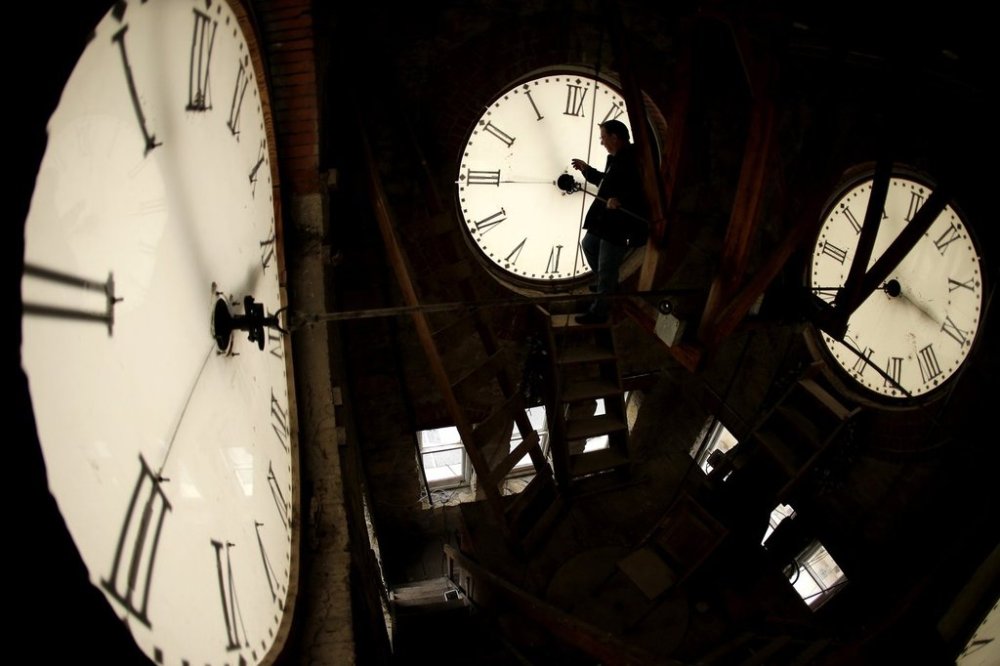
There’s been plenty of debate over the practice, but about 70 countries — about 40% of those across the globe — currently use what Americans call daylight saving time.
While springing the clocks forward “kind of jolts our system,” the extra daylight gets people outdoors, exercising and having fun, says Anne Buckle, web editor at timeanddate.com, which features information on time, time zones and astronomy.
“The really, really awesome advantage is the bright evenings, right?” she says. “It is actually having hours of daylight after you come home from work to spend time with your family or activities. And that is wonderful.”
Here are some things to know so you’ll be conversant about the practice of humans changing time:
How did this all get started?
In the 1890s, George Vernon Hudson, an astronomer and entomologist in New Zealand, proposed a time shift in the spring and fall to increase the daylight. And in the early 1900s, British homebuilder William Willett, troubled that people weren’t up enjoying the morning sunlight, made a similar push. But neither proposal gained enough traction to be implemented.
Germany began using daylight saving time during World War I with the thought that it would save energy. Other countries, including the United States, soon followed suit. During World War II, the U.S. once again instituted what was dubbed “war time” nationwide, this time year-round.
In the United States today, every state except Hawaii and Arizona observes daylight saving time. Around the world, Europe, much of Canada and part of Australia also implement it, while Russia and Asia don’t currently.
Inconsistency and mass confusion
After World War II, a patchwork of timekeeping emerged across the United States, with some areas keeping daylight saving time and others ditching it.
“You might have one town has daylight saving time, the neighboring town might have daylight saving time but start it and end it on different dates and the third neighboring town might not have it at all,” says David Prerau, author of the book “Seize the Daylight: The Curious and Contentious Story of Daylight Saving Time.”
At one point, if riders on a 35-mile (56-kilometer) bus ride from Steubenville, Ohio, to Moundsville, West Virginia, wanted their watches to be accurate, they’d need to change them seven times as they dipped in and out of daylight saving time, Prerau says.
So in 1966, the U.S. Congress passed the Uniform Time Act, which say states can either implement daylight saving time or not, but it has to be statewide. The act also mandates the day that daylight saving time starts and ends across the country.
Confusion over the time change isn’t just something from the past. In the nation of Lebanon last spring, chaos ensued when the government announced a last-minute decision to delay the start of daylight saving time by a month — until the end of the Muslim holy month of Ramadan. Some institutions made the change and others refused as citizens tried to piece together their schedules. Within days, the decision was reversed.
“It really turned into a huge mess where nobody knew what time it was,” Buckle says.
What would it be like if we didn’t change the clocks?
Changing the clocks twice a year leads to a lot of grumbling, and pushes to either use standard time all year, or stick to daylight saving time all year often crop up.
During the 1970s energy crisis, the U.S. started doing daylight saving time all year long, and Americans didn’t like it. With the sun not rising in the winter in some areas till around 9 a.m. or even later, people were waking up in the dark, going to work in the dark and sending their children to school in the dark, Prerau says.
”It became very unpopular very quickly,” Prerau says.
And, he notes, using standard time all year would mean losing that extra hour of daylight for eight months in the evenings in the United States.
A nod to the early adopters
In 1908, the Canadian city of Thunder Bay — then the two cities of Fort William and Port Arthur — changed from the central time zone to the eastern time zone for the summer and fall after a citizen named John Hewitson argued that would afford an extra hour of daylight to enjoy the outdoors, says Michael deJong, curator/archivist at the Thunder Bay Museum.
The next year, though, Port Arthur stayed on eastern time, while Fort William changed back to central time in the fall, which, predictably, “led to all sorts of confusion,” deJong says.
Today, the city of Thunder Bay is on eastern time, and observes daylight saving time, giving the area, “just delightfully warm, long days to enjoy” in the summer, says Paul Pepe, tourism manager for Thunder Bay Community Economic Development Commission.
The city, located on Lake Superior, is far enough north that the sun sets at around 10 p.m. in the summer, Pepe says, and that helps make up for their cold dark winters. Residents, he says, tend to go on vacations in the winter and stay home in the summer: “I think for a lot of folks here, the long days, the warm summer temperatures, it’s a vacation in your backyard.”

Advertisement Advertise With Us
Advertisement Advertise With Us