Lasting and lagging legacies of lockdown

Advertisement
Read this article for free:
or
Already have an account? Log in here »
To continue reading, please subscribe:
Digital Subscription
One year of digital access for only $1.44 a week*
- Enjoy unlimited reading on winnipegfreepress.com
- Read the E-Edition, our digital replica newspaper
- Access News Break, our award-winning app
- Play interactive puzzles
*Billed as $5.77 plus GST every four weeks. After 52 weeks, price increases to the regular rate of $19.95 plus GST every four weeks. Offer available to new and qualified returning subscribers only. Cancel any time.
To continue reading, please subscribe:
Add Free Press access to your Brandon Sun subscription for only an additional
$1 for the first 4 weeks*
- Enjoy unlimited reading on winnipegfreepress.com
- Read the E-Edition, our digital replica newspaper
- Access News Break, our award-winning app
- Play interactive puzzles
*Your next Brandon Sun subscription payment will increase by $1.00 and you will be charged $17.95 plus GST for four weeks. After four weeks, your payment will increase to $24.95 plus GST every four weeks.
Read unlimited articles for free today:
or
Already have an account? Log in here »
Hey there, time traveller!
This article was published 15/03/2025 (585 days ago), so information in it may no longer be current.
Remember when we used to say “nature is healing”?
It was an early pandemic meme about how the natural world was thriving with humans in lockdown. Birdsong in the cities! Fresh air! Dolphins in the canals of Venice! (OK, that last one never happened).
“Nature is healing” became shorthand for a return to the natural order of things. Everything in its place.
MIKE DEAL / FREE PRESS
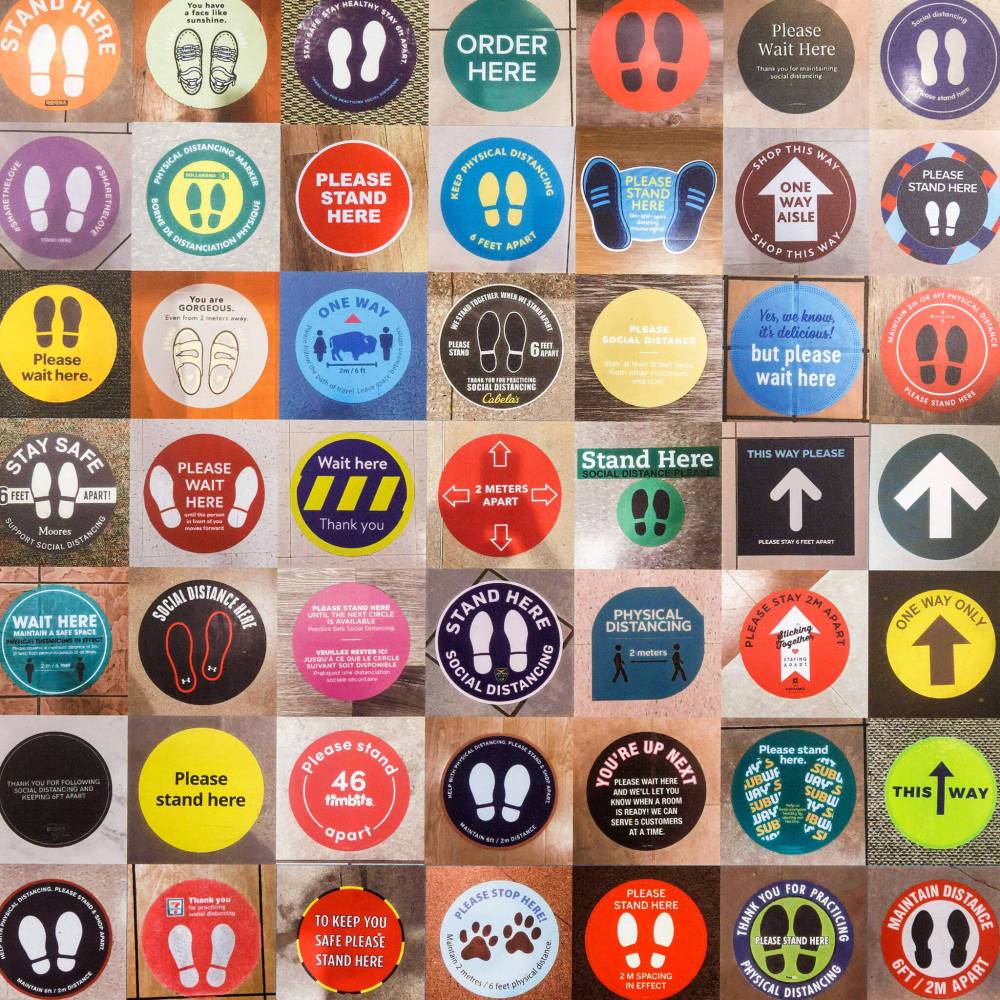
A collage of floor signs promoting social distancing is part of the Manitoba Museum’s collection of COVID-related artifacts collected in the spring of 2021.
Dolphins may never have “returned” to the canals of Venice, but I know nature is healing because Roll Up the Rim cups have returned to Tim Hortons.
The coffee chain took its popular annual contest online in 2020 because the company realized that making staff handle the coffee-and-saliva-moistened rims of disposable coffee cups that have been rolled up by fingernails and possibly teeth of varying degrees of uncleanliness is not only very gross but also possibly a health hazard.
But because the tactile act of rolling up a rim to see if you won a cruller or not is a national pastime fundamental to our identities as Canadians — I love this country — Timmies brought back the cups this year, in addition to the digital contest.
Five years after COVID-19 was declared a pandemic, it’s hard not to see some post-pandemic symbolism in that coffee cup.
The world changed in March 2020, and it’s been fascinating to see what changes have stuck — and what changes have not. No masks in ERs but, by all means, let’s keep QR-code menus.
People blow out birthday candles again. I’ve shaken hands with people despite having vowed not to ever again. A lot of the virtual programming that allowed disabled and immunocompromised people to participate in culture without entering a theatre has fallen by the wayside. We don’t really test for the virus anymore, and vaccine uptake has dropped off.
There have been some small gains on flex and work-from-home policies, with many return-to-office edicts handed down years ago amid scaremongering about “quit quitting” and “the great resignation” and “quitagion” (we did love a portmanteau during the pandemic — quarantini, anyone?).
Curbside pickup is here to stay. So are Zoom meetings. It seems as if the pandemic successfully abolished cash — I have been trying to spend the $20 bill in my wallet for months! — and high heels (a sociologist in Maryland saw the numbers of high-heel related injuries drop precipitously in 2020, and the rise of athleisure has lowered the profiles of shoes).
The pandemic failed to normalize, say, “masking when sick” at the level many people thought it might. But it did put ventilation and air quality at the forefront, and it does seem, anecdotally at least, that people are much more willing to stay home or cancel plans when sick — the cacophony of coughing at the ballet last week notwithstanding.
Generally, five years on, there’s an air of “we don’t have to do this anymore” — an attitude that, troublingly, is bleeding into other spheres of life, such as the rollback of diversity, equality and inclusion initiatives, which became a major focus after the 2020 murder of George Floyd.
I think it’s instructive to not use the acronym DEI, so that we can clearly see what Trump and his coterie of billionaires are opposing and, in Trump’s case, blaming plane crashes on.
Five years is a long time, but it’s also no time at all, really, in the grand scheme. The pandemic changed our relationship to time; I know my memories from its early days are already becoming smudged and blurry. Maybe the lasting legacies of COVID are not yet legible and won’t be until the next one.
I am curious to see how the pandemic will start showing up in art over the next few years and decades, how authors and painters and historians and screenwriters will make sense of it. Of course, it already has shown up in these spaces; in 2022, I wrote a newsletter about the idea of pandemic content or PanCon, and the messy, almost unintentional way COVID-19 was shoehorned into TV shows and books.

I didn’t like PanCon at that time because we were too close to it, too inside it, to be able to take a meaningful appraisal of how it changed our lives, only how it was constantly upending them.
COVID-19 storylines were abandoned in ways we couldn’t abandon them; TV shows could just move on. We couldn’t. Now I’m looking forward to reading the inevitable coronavirus historical fiction and screaming about all they got wrong.
But there are little vestiges of the pandemic everywhere. Faded social-distancing decals. Hand-sanitizer pumps. Tim Hortons staff members don’t touch your cup rim; you show them and then drop it into a box.
We’ve figured out that much.
jen.zoratti@winnipegfreepress.com
Jen Zoratti is a columnist and feature writer working in the Arts & Life department, as well as the author of the weekly newsletter NEXT. A National Newspaper Award finalist for arts and entertainment writing, Jen is a graduate of the Creative Communications program at RRC Polytech and was a music writer before joining the Free Press in 2013. Read more about Jen.
Every piece of reporting Jen produces is reviewed by an editing team before it is posted online or published in print – part of the Free Press‘s tradition, since 1872, of producing reliable independent journalism. Read more about Free Press’s history and mandate, and learn how our newsroom operates.
Our newsroom depends on a growing audience of readers to power our journalism. If you are not a paid reader, please consider becoming a subscriber.
Our newsroom depends on its audience of readers to power our journalism. Thank you for your support.
Jen Zoratti is a columnist and feature writer working in the Arts & Life department, as well as the author of the weekly newsletter NEXT. A National Newspaper Award finalist for arts and entertainment writing, Jen is a graduate of the Creative Communications program at RRC Polytech and was a music writer before joining the Free Press in 2013. Read more about Jen.
Every piece of reporting Jen produces is reviewed by an editing team before it is posted online or published in print – part of the Free Press‘s tradition, since 1872, of producing reliable independent journalism. Read more about Free Press’s history and mandate, and learn how our newsroom operates.
Our newsroom depends on a growing audience of readers to power our journalism. If you are not a paid reader, please consider becoming a subscriber.
Our newsroom depends on its audience of readers to power our journalism. Thank you for your support.
Related Articles
Hybrid work arrangements — once a hard ‘no’ — are now common in civil service


Advertisement Advertise With Us
Advertisement Advertise With Us