In 50-plus years at a cliffside Greek island monastery, one monk keeps faith and community together
Advertisement
Read this article for free:
or
Already have an account? Log in here »
To continue reading, please subscribe:
Digital Subscription
One year of digital access for only $1.44 a week*
- Enjoy unlimited reading on winnipegfreepress.com
- Read the E-Edition, our digital replica newspaper
- Access News Break, our award-winning app
- Play interactive puzzles
*Billed as $5.77 plus GST every four weeks. After 52 weeks, price increases to the regular rate of $19.95 plus GST every four weeks. Offer available to new and qualified returning subscribers only. Cancel any time.
To continue reading, please subscribe:
Add Free Press access to your Brandon Sun subscription for only an additional
$1 for the first 4 weeks*
- Enjoy unlimited reading on winnipegfreepress.com
- Read the E-Edition, our digital replica newspaper
- Access News Break, our award-winning app
- Play interactive puzzles
*Your next Brandon Sun subscription payment will increase by $1.00 and you will be charged $17.95 plus GST for four weeks. After four weeks, your payment will increase to $24.95 plus GST every four weeks.
Read unlimited articles for free today:
or
Already have an account? Log in here »
Hey there, time traveller!
This article was published 08/04/2025 (560 days ago), so information in it may no longer be current.
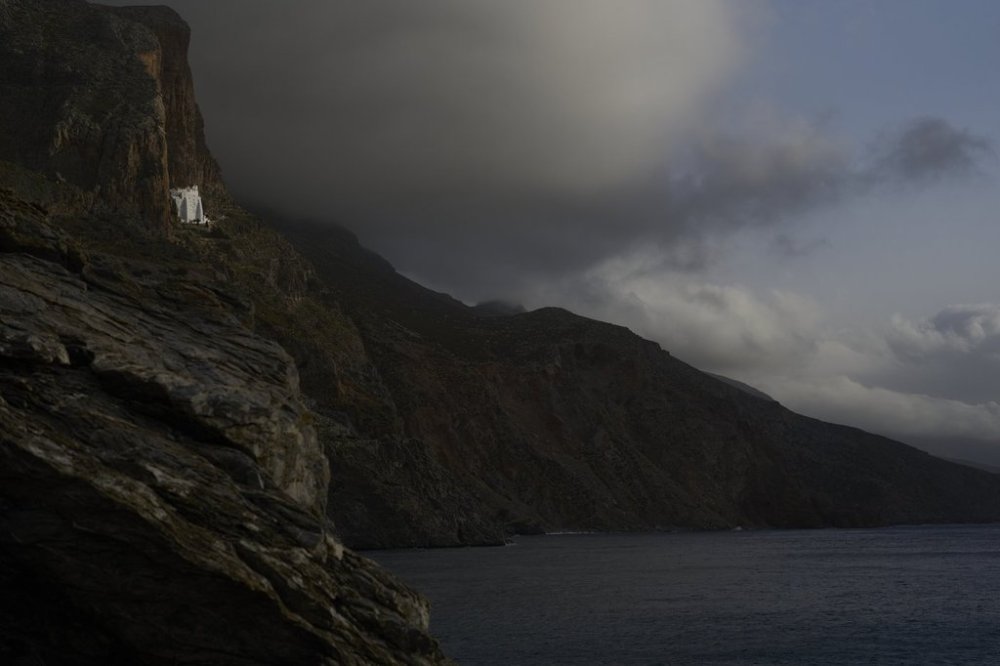
AMORGOS, Greece (AP) — For more than 50 years, Spyridon Denaxas has prayed, worked and welcomed the faithful in an island monastery carved into a seaside cliff that’s little changed since its founding more than a millennium ago.
Greece has rapidly secularized alongside the rest of Europe, and other Aegean islands like nearby Santorini are wrestling with the massive growth of tourism focused far more on beaches than churches.
But a few Orthodox Christian monks remain icons of local life — so much so that when the recent weekslong swarm of near-constant earthquakes caught Father Spyridon, as he’s affectionately known, away for a medical emergency, all he could think about was making his way back to Amorgos.
“I wanted to be here with my community, feel their emotions, because I’m responsible. God put me here to care for them,” he told The Associated Press in Greek at Panagia Hozoviotissa monastery, where he said not even a rock fell during the tremors.
During that brief absence, as well as his longest ever last year — when he spent nearly five months on the mainland for surgeries — the whole island, atheists included, was abuzz with speculation as to when he could return.
“He’s part of the island,” said Mina Mavrou the week that Spyridon was finally scheduled to return via the nearly eight-hour ferry trip from Athens.
Orthodox monk welcomes the world to island monastery
Settled back at his whitewashed monastery perched between sky and sea, the monk was elated.
“I feel spiritual euphoria having met the people of the village again, those who were searching for me and missed me,” he said. “I am overjoyed with the monastic life and my return to my natural environment.”
Tradition holds that Byzantine monks fleeing persecution in the Middle East in the 9th century sailed to this mountainous island with an icon of the Virgin Mary. They were building a shelter in a cave when falling rocks revealed a chisel hanging farther up the cliffside.
Taking it as a sign, they spent the next decades constructing the monastery more than 150 meters (500 feet) above the sea, where both the icon and the chisel are still on view in the small chapel that anchors the complex.
Spyridon, who was born on Amorgos, joined the monastery straight out of high school in 1971, when he was 18. He’s now one of only two monks there, plus an assistant, 35-year-old Constantin Papakonstantinou, who hopes one day to join them. For now, he tells visitors the monastery’s history in the various languages he learned during a previous career in fashion.
Seated at the chapel’s entrance, Spyridon welcomes pilgrims with a smile.
Many are still puffing after climbing up 300 meters (almost 1,000 feet) of stepstones from a parking lot, squeezing through the tiny entrance door, and climbing again a narrow staircase to the dark chapel. There, they pay homage to the icon before stepping into the blinding sunshine of the terrace.
The stunning views of the sea shimmering far below are a major draw for tourists, too, coming from nearby, often overrun destinations in the Cyclades islands.
Whether they’re on a quest to nourish their spiritual life or their Instagram feed, Spyridon is eager to welcome all visitors, offering cold water, sweets and shots of homemade honey-flavored raki liqueur.
“The Virgin Mary extends her hand and pours healing balm into the souls of all people,” he said. “This is an ecumenical monastery, open to the whole world. … Everyone receives something from her grace.”
Island life continues to revolve around beloved monastery
Panagia Hozoviotissa, whose image is on the cover of the current Lonely Planet Greece guide, is far from the only house of worship in Europe that’s also a tourist attraction.
But Amorgos’ monastery serves another function too — a crucial reference point for locals, who seek the monks’ help, both material and spiritual, as Eastern Christians have for nearly 2,000 years.
“People would go seek them out in the desert or caves for wisdom, become attached to them as spiritual guides,” said Ed Siecienski, a Stockton University religion professor. “There is a sense of the monks out there as super-Christian.”
Even when Spyridon was away for knee and dental surgeries, islanders like Mavrou called him often to ask about his recovery and receive his blessing, she said.
Unlike Orthodox parish priests, who often are married, monks remain celibate — a decision that Spyridon pondered as a teen. He has no regrets, he said, viewing his flock as his family.
“Their children would be my children. I would rejoice with everyone, mourn with everyone, and be with them according to their circumstances,” he said.
On “name day” when people celebrate their namesake saints — in traditional Greek culture a bigger feast than birthdays — Spyridon calls with congratulations. If it’s a popular name like Vangelis, celebrated in late March, he makes dozens of calls, starting before dawn to catch those in Australia or the Americas.
He often visits in person, making his way with a gnarled stick to remote chapels in the rock-strewn hillsides and the villages scattered around Amorgos.
After he stopped at a coffee shop recently, the owner said he has three photos on display — portraying his mother, his father and the monastery.
“I want a photograph of Father Spyridon to place next to my father. Because I love him deeply,” Nikolaos Economides said.
Days of work and prayer starting well before dawn
Monks’ days tend to be anchored in busy schedules of worship and work, since the monasteries have to support themselves.
“There is no time for boredom. Nor for melancholy,” Spyridon said. He rises daily at 3 a.m. for the first prayer service and doesn’t go to sleep until after 9 p.m.
Michalis Giannakos left Amorgos after high school 20 years ago, but remembers visiting the monastery as a child and seeing Spyridon hurrying up and down its rocky slopes, tending to animals like the monastery’s donkey and greeting pilgrims.
“Spyridon was there taking care of people, making sure people visiting were happy,” Giannakos said while vacationing on Amorgos.
While many urban Greeks are distanced from or even hostile to the church, “for smaller places, it’s still important. It’s not just about the faith and religion,” he added.
That’s because on an island like Amorgos — population 2,000, divided among a main mountaintop village and smaller hamlets — clergy can be called upon to manage conflicts and provide advice.
The monastery gave some of its land to build a school, Giannakos recalled, and hosts most of the population during its feast days in November.
“Spyridon gives a lot to people,” said Cristina Astrecha, who teaches religion in Amorgos’ school. “That’s spirituality, you can see it from the acts of a person.”
A spirituality that takes in everyone — and creation
For Spyridon, spirituality is all-encompassing.
“God placed man in paradise to tend it and work for it. You know how important nature is — the sea, the mountains, the valleys, and the plains,” he said. “They are meant for human use, but we must respect, preserve and protect them.”
That is why he is so content to remain here, taking care of his “own courtyard” while offering words and prayers to anyone who might need them.

“It is in my DNA, intertwined with the monastery and its existence,” he said.
___
AP photographer Petros Giannakouris in Amorgos contributed to this report.
___
Associated Press religion coverage receives support through the AP’s collaboration with The Conversation US, with funding from Lilly Endowment Inc. The AP is solely responsible for this content.
The Free Press acknowledges the financial support it receives from members of the city’s faith community, which makes our coverage of religion possible.