Your clothes are shedding bits of plastic. Here’s what people are doing about it this Earth Day
Advertisement
Read this article for free:
or
Already have an account? Log in here »
To continue reading, please subscribe:

Digital Subscription
One year of digital access for only $205*
- Enjoy unlimited reading on winnipegfreepress.com
- Read the E-Edition, our digital replica newspaper
- Access News Break, our award-winning app
- Play interactive puzzles
*First annual payment billed as $205.00 + GST for one year. This annual subscription will automatically renew at $233.00 + GST every 52 weeks (10% off the regular annual price of $259.35). Offer available to new and qualified returning subscribers only. Cancel any time.
To continue reading, please subscribe:
Add Free Press access to your Brandon Sun subscription for only an additional
$1 for the first 4 weeks*
- Enjoy unlimited reading on winnipegfreepress.com
- Read the E-Edition, our digital replica newspaper
- Access News Break, our award-winning app
- Play interactive puzzles
*Your next Brandon Sun subscription payment will increase by $1.00 and you will be charged $17.95 plus GST for four weeks. After four weeks, your payment will increase to $24.95 plus GST every four weeks.
Read unlimited articles for free today:
or
Already have an account? Log in here »
Hey there, time traveller!
This article was published 22/04/2025 (537 days ago), so information in it may no longer be current.
Bottles and bags, food wrappers and straws. Piping, packaging, toys and trays. Plastic is everywhere — and yet some people may be surprised at how much they actually wear.
A typical closet is loaded with plastic, woven into polyester activewear, acrylic sweaters, nylon swimsuits and stretchy socks — and it’s shedding into the environment nonstop.
When garments are worn, washed and put through the dryer, they shed plastic fiber fragments. A single load of laundry can release millions that are so tiny wastewater treatment plants can’t capture them all. They wind up in local waterways that connect to the ocean. Marine animals eat them, and that can pass plastic to larger animals and humans.
Even natural fabrics shed fibers and have chemicals that can leach into the environment. But polyester is the most widely used fiber on Earth, and along with other synthetic fibers accounts for about two-thirds of production worldwide.
Tuesday is Earth Day, when people worldwide contemplate ways to reduce their impact on the planet.
“Everyone who wears and launders clothing is part of this problem but everyone who wears and launders clothing can be part of the solutions,” said Rachael Z. Miller, founder of Vermont-based Rozalia Project for a Clean Ocean.
Simple changes like washing clothes less and using cold water instead of hot can help reduce the shedding of fibers. More challenging is that textiles need to be produced and used in a more sustainable way, said Elisa Tonda at the UN Environment Programme. For example, designing clothes that shed fewer microfibers and are high-quality to last longer, said Tonda, who leads the resources and markets branch.
What to do? Start by changing habits
The easiest solution is to wash clothes less often, making for less of the friction that breaks fibers apart, said Anja Brandon, director of plastics policy at Ocean Conservancy.
“They get tumbled and tossed around with a bunch of soaps, really designed to shake things up to get out dirt and stains,” Brandon said.
Miller uses a stain stick to spot-clean. Both say that when clothes are washed, they shed less when put in cold water in full loads to reduce friction, on a shorter cycle, then hung to dry.
Inspired by the way coral filters the ocean, Miller invented the Cora Ball, a laundry ball that can be tossed into the washer to cut down on clothes banging into each other. It also catches microfibers. (A portion of the proceeds goes to the Rozalia Project.) Another option is to put synthetic fabrics in a washing bag that captures fibers.
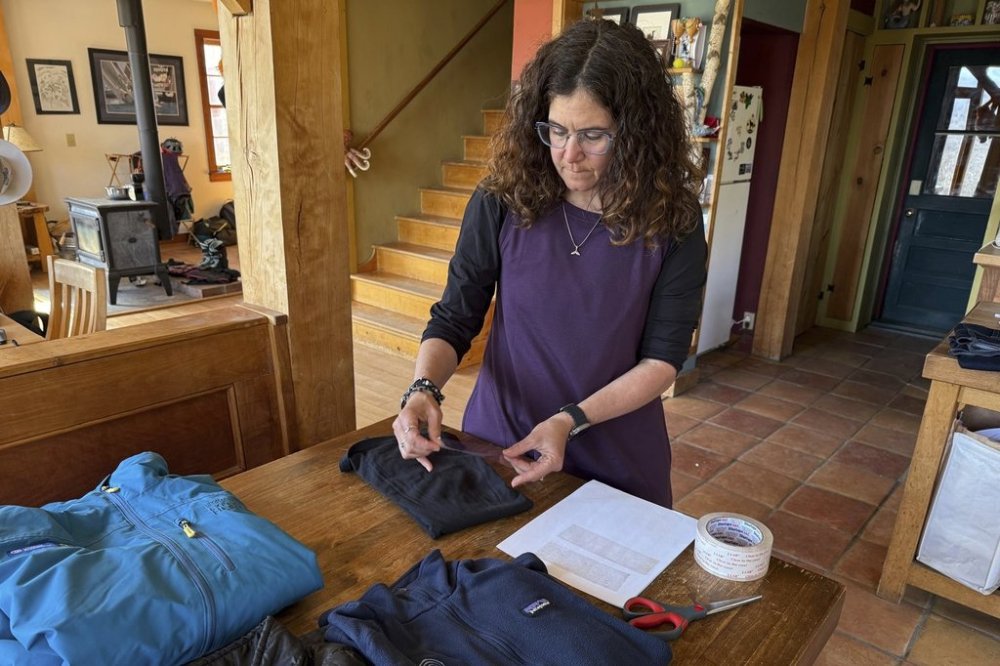
Which clothes shed the most? To find out, press a strip of clear packing tape to a garment, then stick it to white paper to check for fibers, Miller said. Garments that are loosely knit or woven tend to shed more, such as fleece.
Miller said people don’t need to rush to throw out clothing that’s more likely to shed. She owns fleece jackets herself. Instead, she suggested such clothing can be worn indoors only or outside with a layer on top, and it’s worth thinking twice about acquiring more garments like that.
“I try not to guilt or panic people because a lot of this information is very new,” Miller said. “And so we might as well just say, ‘OK, I got it. How can I be strategic about what I’ve got?’”
A push to require filters
Filters can be added to washers to capture microfibers. Samsung Electronics collaborated with Patagonia and the global conservation organization Ocean Wise to launch one in 2023. It’s now sold in more than 20 countries for front-load washers. Bosch recently launched a microfiber filter in Europe for washers.
France was first to adopt a law to mandate that new washing machines sold in the country have a microfiber filter, though implementation has been delayed.
In the U.S., efforts to mandate filters in states have failed. California Gov. Gavin Newsom vetoed a bill in 2023, saying he was concerned about the cost to consumers and he wants to incentivize, not mandate, technologies to remove microfibers in wastewater. In Oregon, state Sen. Deb Patterson proposed a bill this year requiring microfiber filters on new washers sold in that state after she came across the technology in Canada. Patterson said the bill doesn’t have enough support yet but she’ll keep trying.
The Association of Home Appliance Manufacturers opposes the proposals, saying it’s concerned about consumer costs and filter effectiveness.
Changing textiles
Some big brands are testing their fabrics to help researchers understand fiber fragmentation, including Adidas, Nike, Patagonia and Under Armour.
They’re among more than 90 brands, retailers and manufacturers to partner with The Microfibre Consortium in the United Kingdom, founded in 2018 to do research and offer solutions to transform textile production — including reducing fiber breakup.
Nearly 1,500 fabrics have been tested. None are the same, making it a tough problem to solve, consortium CEO Kelly Sheridan said.
Patagonia has been a leader in trying to stop the spread of synthetic fiber waste into air and water, saying it’s up to garment brands to prevent it at the source since cleaning up microplastics in the environment is not yet possible.
It paid for its own research starting a decade ago on the implication of its clothes. The company worked with suppliers to choose fabrics and dyes and to finish their clothing in ways that reduce shedding. They collaborated on new filtration technologies for washers, textile mills and municipal systems.

One of their best-known styles is something called the “better sweater” that shifts from virgin polyester to recycled polyester to cut shedding by about 40%, said Matt Dwyer, vice president of global product footprint. And at textile mills, there’s a prewash at the factory that can capture that first big shed, he added.
Dwyer is optimistic about progress.
“There’s a whole lot of smart people, not just understanding the problem and the scope of the problem, but also looking for solutions all the way through the manufacturing cycle and use phase,” he said. “Compared to 10 years ago, it’s a whole new world.”
___
The Associated Press’ climate and environmental coverage receives financial support from multiple private foundations. AP is solely responsible for all content. Find AP’s standards for working with philanthropies, a list of supporters and funded coverage areas at AP.org.