The US hasn’t seen a human bird flu case in 3 months. Experts are wondering why
Advertisement
Read this article for free:
or
Already have an account? Log in here »
To continue reading, please subscribe:

Digital Subscription
One year of digital access for only $205*
- Enjoy unlimited reading on winnipegfreepress.com
- Read the E-Edition, our digital replica newspaper
- Access News Break, our award-winning app
- Play interactive puzzles
*First annual payment billed as $205.00 + GST for one year. This annual subscription will automatically renew at $233.00 + GST every 52 weeks (10% off the regular annual price of $259.35). Offer available to new and qualified returning subscribers only. Cancel any time.
To continue reading, please subscribe:
Add Free Press access to your Brandon Sun subscription for only an additional
$1 for the first 4 weeks*
- Enjoy unlimited reading on winnipegfreepress.com
- Read the E-Edition, our digital replica newspaper
- Access News Break, our award-winning app
- Play interactive puzzles
*Your next Brandon Sun subscription payment will increase by $1.00 and you will be charged $17.95 plus GST for four weeks. After four weeks, your payment will increase to $24.95 plus GST every four weeks.
Read unlimited articles for free today:
or
Already have an account? Log in here »
Hey there, time traveller!
This article was published 19/05/2025 (486 days ago), so information in it may no longer be current.
Health officials are making a renewed call for vigilance against bird flu, but some experts are puzzling over why reports of new human cases have stopped.
Has the search for cases been weakened by government cuts? Are immigrant farm workers, who have accounted for many of the U.S. cases, more afraid to come forward for testing amid the Trump administration’s deportation push? Is it just a natural ebb in infections?
“We just don’t know why there haven’t been cases,” said Jennifer Nuzzo, director of the Pandemic Center at Brown University. “I think we should assume there are infections that are occurring in farmworkers that just aren’t being detected.”
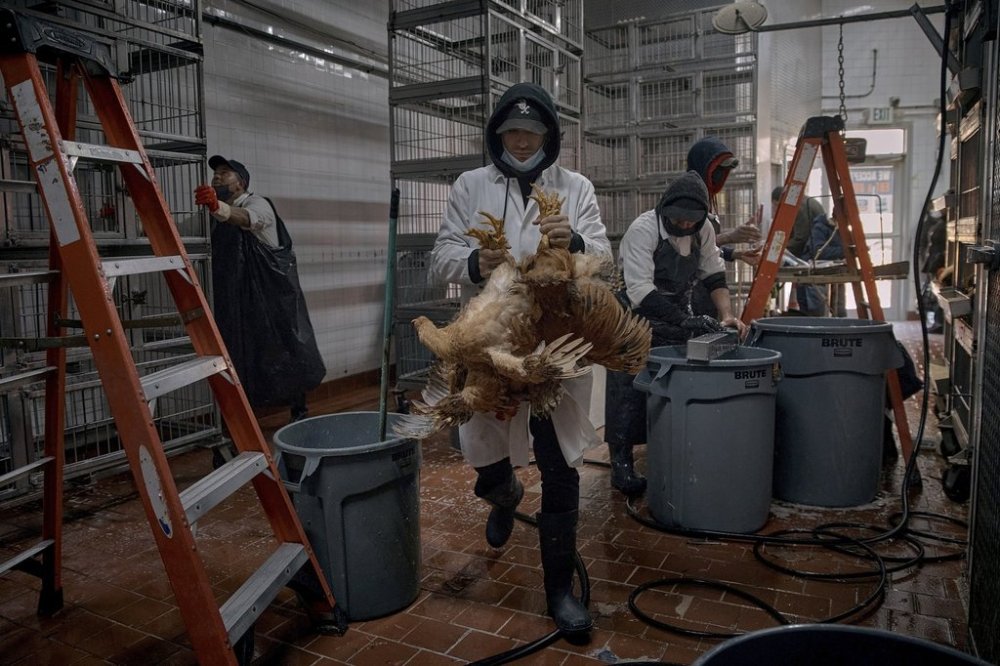
The H5N1 bird flu has been spreading widely among wild birds, poultry and other animals around the world for several years, and starting early last year became a problem in people and cows in the U.S.
In the last 14 months, infections have been reported in 70 people in the U.S. — most of them workers on dairy and poultry farms. One person died, but most of the infected people had mild illnesses.
The most recent infections confirmed by the Centers for Disease Control and Prevention were in early February in Nevada, Ohio and Wyoming.
California had been a hotspot, with three-quarters of the nation’s infections in dairy cattle. But testing and cases among people have fallen off. At least 50 people were tested each month in late 2024, but just three people were tested in March, one in April and none in May so far, state records show. Overall, the state has confirmed H5N1 infections in 38 people, none after Jan. 14.
The possible natural reason bird flu cases are down
During a call with U.S. doctors this month, one CDC official noted that there is a seasonality to bird flu: Cases peak in the fall and early winter, possibly due to the migration patterns of wild birds that are primary spreaders of the virus.
That could mean the U.S. is experiencing a natural — maybe temporary — decline in cases.
It’s unlikely that a severe human infection, requiring hospitalization, would go unnoticed, said Michael Osterholm, a University of Minnesota expert on infectious diseases.
What’s more, a patchwork system that monitors viruses in sewage and wastewater has suggested limited activity recently.
New infections are still being detected in birds and cattle, but not as frequently as several months ago.
“Given the fact that the number of animal detections has fallen according to USDA data, it’s not surprising that human cases have declined as well,” the CDC said in a statement.
Are government cuts affecting bird flu monitoring?
Dr. Gregory Gray said he wasn’t concerned about the CDC not identifying new cases in months.
“I don’t think that anybody’s hiding anything,” said Gray, an infectious disease speicialist at the University of Texas Medical Branch in Galveston.
But Osterholm and some other experts think it’s likely that at least some milder infections are going undetected. And they worry that the effort to find them has been eroding.
Resignations at the U.S. Department of Agriculture and the Food and Drug Administration’s Center for Veterinary Medicine could slow the government’s bird flu monitoring, said Keith Poulsen, director of the Wisconsin Veterinary Diagnostic Laboratory.
Three of 14 experts accepted deferred resignation offers at the National Animal Health Laboratory Network, which responds to disease outbreaks with crucial diagnostic information, he said. They are among more than 15,000 USDA staff to accept the offers, an agency spokesperson said.
And dozens of staff were fired at the FDA’s Veterinary Laboratory Investigation and Response Network, which investigates animal diseases caused by problems including contaminated pet food. Cats in several states have been sickened and died after eating raw pet food found to contain poultry infected with H5N1.
Angela Rasmussen, a virologist at the University of Saskatchewan in Canada, said “targeted surveillance has really dropped off precipitously since Trump took office.”
She wonders if immigrant farmworkers are too scared to come forward.
“I can’t argue with anyone who would be risking getting shipped to a Salvadoran gulag for reporting an exposure or seeking testing,” she said.
CDC says the risk to the general public remains low
The CDC characterizes the risk to the general public as low, although it is higher for people who work with cattle and poultry or who are in contact with wild birds.
Earlier this month, an agency assessment said there is a “moderate risk” that currently circulating strains of bird flu could cause a future pandemic, but the CDC stressed that other emerging forms of bird flu has been similarly labeled in the past.
Still, research is continuing.
Texas A&M University scientists have collected blood samples from dairy workers in multiple states to test for signs of past H5N1 exposure, said David Douphrate, a workplace health and safety expert leading the project. The yearlong study is funded by a nearly $4 million grant from the CDC and is expected to conclude in July.
Douphrate said he leveraged two decades of relationships with dairy producers and workers to gain access to the farms.
“We have had very good participation,” Douphrate said. “They have been very willing.”
Similar surveillance is “urgently needed” among domestic cats, said Kristen Coleman, a researcher at the University of Maryland at College Park who studies emerging animal diseases. She recently released a paper reviewing bird flu in infections in cats between 2004 and 2024.
Barn cats that died after drinking raw milk were one of the first signs that dairy cows were becoming infected with bird flu in 2024. Since then, the Agriculture Department has confirmed more than 120 domestic cats infected with the virus across the U.S.

Infections have mostly been found in cats that died. Less is known about milder infections, whether cats can recover from bird flu — or whether the virus can spill over into people.
Coleman has been collecting blood samples from cats across the U.S. to see if they have evidence of previous exposure to the virus. But the process is slow and research funding is uncertain.
“It’s easy to downplay something because that’s usually what humans do,” she said. “But what we really need to be doing is ramping up.”
___
The Associated Press Health and Science Department receives support from the Howard Hughes Medical Institute’s Science and Educational Media Group and the Robert Wood Johnson Foundation. The AP is solely responsible for all content.