Grow au naturel
Tips for creating a naturalistic perennial garden

Advertisement
Read this article for free:
or
Already have an account? Log in here »
To continue reading, please subscribe:

Digital Subscription
One year of digital access for only $205*
- Enjoy unlimited reading on winnipegfreepress.com
- Read the E-Edition, our digital replica newspaper
- Access News Break, our award-winning app
- Play interactive puzzles
*First annual payment billed as $205.00 + GST for one year. This annual subscription will automatically renew at $233.00 + GST every 52 weeks (10% off the regular annual price of $259.35). Offer available to new and qualified returning subscribers only. Cancel any time.
To continue reading, please subscribe:
Add Free Press access to your Brandon Sun subscription for only an additional
$1 for the first 4 weeks*
- Enjoy unlimited reading on winnipegfreepress.com
- Read the E-Edition, our digital replica newspaper
- Access News Break, our award-winning app
- Play interactive puzzles
*Your next Brandon Sun subscription payment will increase by $1.00 and you will be charged $17.95 plus GST for four weeks. After four weeks, your payment will increase to $24.95 plus GST every four weeks.
Read unlimited articles for free today:
or
Already have an account? Log in here »
Hey there, time traveller!
This article was published 31/05/2025 (503 days ago), so information in it may no longer be current.
Naturalistic gardening is a style that can be more beautiful than a traditional garden, says Nik Friesen-Hughes, a landscape designer and owner of Dogwood Landscape Design Build.
“It checks a lot of the boxes. It can be less maintenance in the long run, it can be healthier ecologically, and it can save on your water bill,” he says.
Naturalistic design is generally defined as a plant-driven approach to landscape design inspired by wild plant communities, he explains.

“It seeks to loosely imitate the patterns and dynamics found in natural ecosystems and looks at plant communities and their interactions. Plants are selected for resilience, overall structure and shape, as well as interest throughout all the seasons.”
A key component of a naturalistic style is that even the smallest residential garden can provide a lot of ecological value. Native plants are a great way of supporting local ecology, but it’s not essential to include only native plants in your design, says Friesen-Hughes. In addition, he says, while the naturalistic style often uses a wide variety of plant species, designs do not have to become chaotic or messy or unreadable.
“Having a diversity of plant forms and textures can create a feeling of naturalness, but the most important thing is to find balance and have a succession of blooms and resources for pollinators at different times of the year,” says Friesen-Hughes.
There are ways that you can have a naturalistic garden space that achieves many of your goals, and design and layout are key, says Friesen-Hughes.
Piet Oudolf, the famed Dutch landscape designer, uses the example of a fruitcake, says Friesen-Hughes, and classifies a naturalistic planting into three types: the matrix, primary plants and scatter plants.
“The matrix is the groundcover layer, and its main function is to provide cover for the soil and a soft visual backdrop for other plants,” says Friesen-Hughes. “You want plants that provide soft colours, shapes and textures that are good at staying tidy and holding space. This is going to make up the majority of your planting. Grasses are a great choice.”
Some of Friesen-Hughes’ favourite grasses with soft textures include Little Bluestem (Schizachyrium scoparium), a striking ornamental grass with blue-green foliage, Prairie Dropseed (Sporobolus heterolepis), a short, clump-forming grass with narrow, arching leaves, Blue Oat Grass (Helictotrichon sepervirens), which has steely blue foliage, and Karl Foerster Feather Reed Grass (Calamagrostis acutiflora), which has showy, wheat- coloured plumes in the fall.
“Next, you want to think about the primary plants, and these are plants that have coarser texture and strong structure,” says Friesen-Hughes.
Nik Friesen-Hughes photo
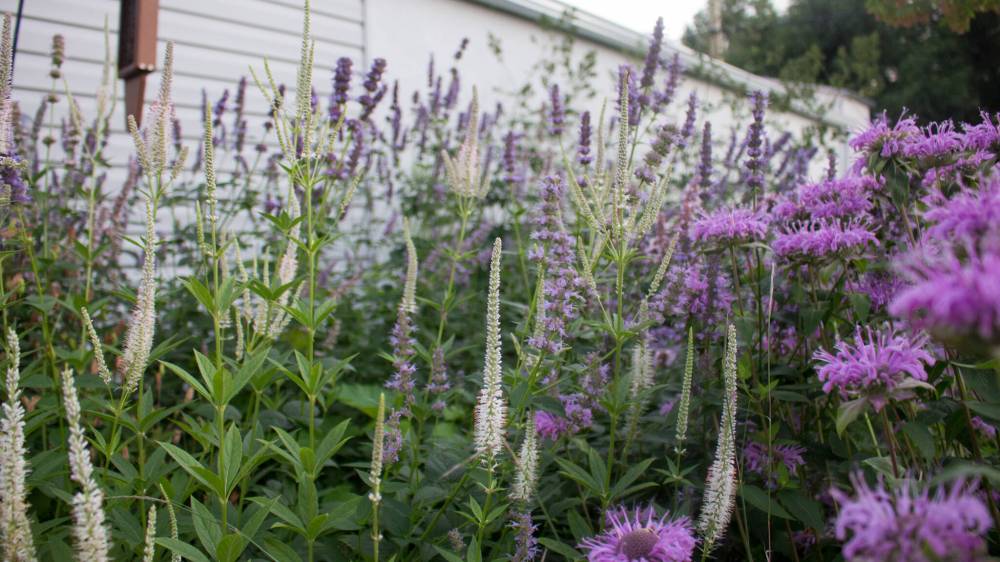
This naturalistic design shows a variety of texture, forms and structure. Plants include Culver’s Root in the foreground, Wild Bergamot on the right and Giant Hyssop in the background.
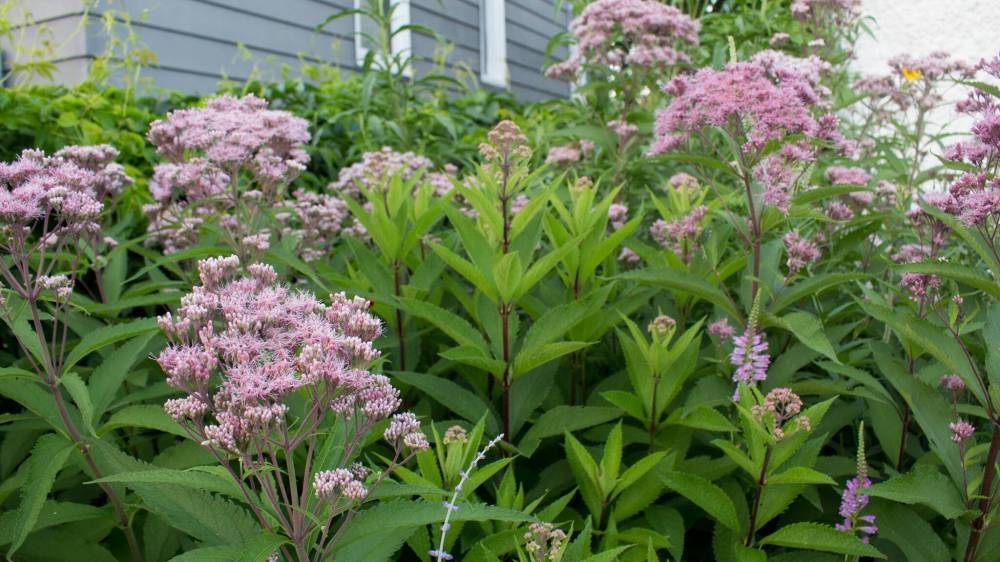
Examples include Wild Bergamot (Monarda fistulosa), Giant Hyssop (Agastache foeniculum) and Joe Pye (Eupatorium maculatum).
“Joe Pye has large, coarse leaves arranged in a whorled pattern along the stem. This plant provides significant structure throughout the warm season as well as in the winter.”
Culver’s Root (Veronicastrum virginicum) is a striking example of a perennial which provides year-round structure in the garden with its unique candelabra-like flower spires.
Scatter plants are like the sprinkles on the cake, he says. “These are the plants that might rise up here and there for a little pop of colour, like a swamp milkweed or perhaps Verbena bonariensis.”
With a more traditional planting, there are easy to read patterns or hard lines (straight lines and angles), says Friesen-Hughes, but with a naturalistic planting there are no specific rules in terms of how you arrange your plants.
“You can have loose patterns and forms, which I think is beautiful. Small planting groups can exist within your matrix layer to give a sense of definition and clarity and create a bigger visual impact.”
For example, Purple Coneflower Magnus (Echinacea purpurea) and Meadow Blazing Star (Liatris ligulistylis) are two very versatile native plants, says Friesen-Hughes.
“I would put them in a group, say, seven or 11 of each, but it would be a loose drift so they wouldn’t be right next to each other. If you were looking at it from above, they would be planted about 30 cm or so apart. I would repeat them very closely in a small area with grasses in between to create a wave of Blazing Star and a wave of Echinacea coming up through the grasses. It would be like putting a brushstroke on your painting.”
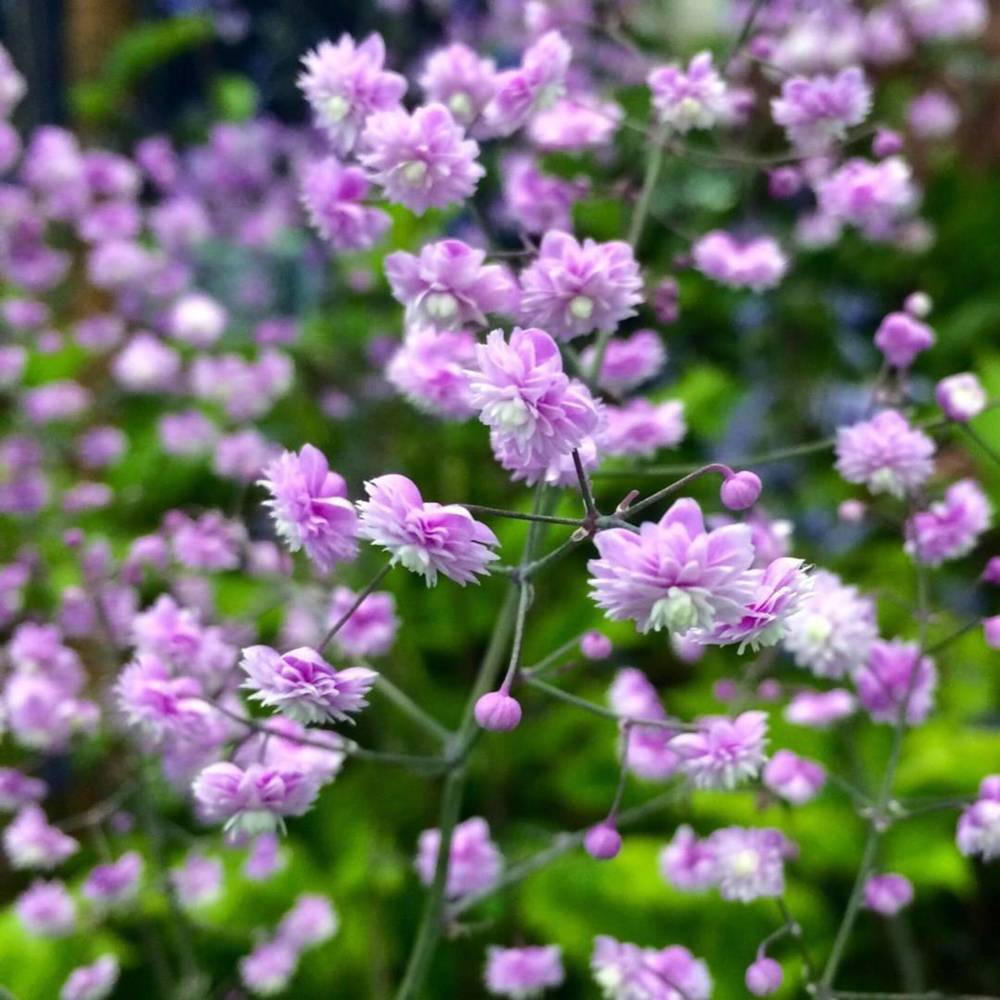
Little Bluestem and Magnus coneflower would also work well together in a loose drift, he says. One species of plant can also be planted in a group. Great examples include turtlehead (Chelone), tall meadow rue (Thalictrum dasycarpum), or yarrow (Achillea millefolium).
“I love the meadow rue cultivar — Hewitt’s Double — that grows in the outdoor gardens at The Leaf,” says Friesen-Hughes.
“The native variety of yarrow is great for planting in groups but it’s a little short-lived. My favourite is a cultivar called Achillea Terracotta which has shades of yellow, orange and terracotta. It’s reliable and versatile.”
Whatever species you choose to plant in a group, says Friesen-Hughes, think of it as being integrated within the other layers in the garden.
The British designer Gertrude Jekyll popularized the idea of planting in drifts.
“I think this is really key,” says Friesen-Hughes. “You’re not creating a square or a circle again and again, but rather longer, thinner, winding, looser shapes. When you have these more organic winding forms, they create a variety of angles for different groups to be viewed in different ways instead of just seeing them from one angle. It makes a planting more dynamic, but it also creates interest and opportunities for plants to interact with other plants along the edges. The looser shapes allow for more interesting plant interactions and combinations to occur.”
He says that another bonus of utilizing loose drifts throughout a naturalistic planting is that you don’t have to worry from year to year if one plant dies.
“Overall, the patterns are kind of intact. Rigid straight lines and angles often require more maintenance.”
When thinking about patterns in a naturalistic design, repetition and rhythm — repeating plants or groups at different distances in different shapes — can create a visual connection throughout your planting and give it a sense of cohesion, says Friesen-Hughes.
“If you have a few Prairie Dropseed grasses in one area and a few in another, repeating that grouping two or three times in a small space can help ground that planting.”
A beautiful example of repetition and arrangement can be seen at the Wellington Prairie Garden located along Wellington Crescent in Sir John Franklin Park near the footbridge. Friesen-Hughes collaborated with the Winnipeg Wildflower Project to design the garden, which provides a habitat node for urban pollinators. In one area, there are repeating groups of Stiff Goldenrod (Solidago rigida), Giant Hyssop, Wild Bergamot, Prairie Sage and False Sunflower.
“In time, the grass matrix of Sheep Fescue (Festuca ovina) and Little Bluestem will fill in between the other plant species.”
Species of goldenrod, aster and sedum are hugely beneficial for pollinators, says Friesen-Hughes.

“They provide late season interest in the garden and there are many different pollinators that will seek them out for pollen.”
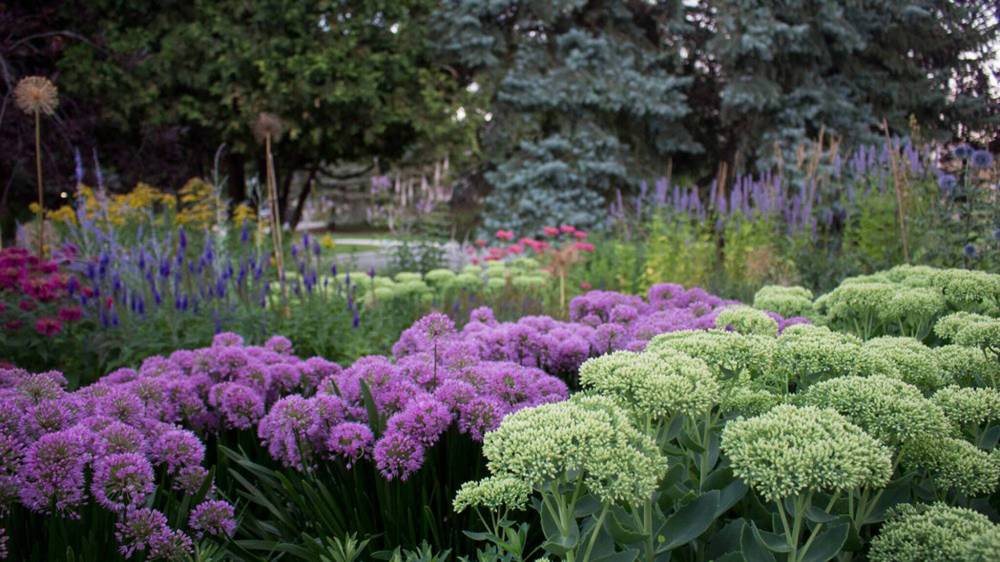
The healthiest landscape ecologically, says Friesen-Hughes, is a landscape that embraces change.
“It’s also the most beautiful and sustainable.”
colleenizacharias@gmail.com
For advice, ideas and tips to keep your outdoor and indoor plants growing, sign up to have Winnipeg Gardener, a free monthly newsletter I write for the Free Press. You can read the latest edition and sign up to receive the newsletter at https://www.winnipegfreepress.com/newsletter/winnipeg-gardener
Colleen Zacharias
Gardening columnist
Colleen Zacharias writes about many aspects of gardening including trends, plant recommendations, and how-to information that is uniquely relevant to Prairie gardeners. She has written a column for the Free Press since 2010 and pens the monthly newsletter Winnipeg Gardener. Read more about Colleen.
Every piece of reporting Colleen produces is reviewed by an editing team before it is posted online or published in print — part of the Free Press‘s tradition, since 1872, of producing reliable independent journalism. Read more about Free Press’s history and mandate, and learn how our newsroom operates.
Our newsroom depends on a growing audience of readers to power our journalism. If you are not a paid reader, please consider becoming a subscriber.
Our newsroom depends on its audience of readers to power our journalism. Thank you for your support.
Colleen Zacharias
Gardening columnist
Colleen Zacharias writes about many aspects of gardening including trends, plant recommendations, and how-to information that is uniquely relevant to Prairie gardeners. She has written a column for the Free Press since 2010 and pens the monthly newsletter Winnipeg Gardener. Read more about Colleen.
Every piece of reporting Colleen produces is reviewed by an editing team before it is posted online or published in print — part of the Free Press‘s tradition, since 1872, of producing reliable independent journalism. Read more about Free Press’s history and mandate, and learn how our newsroom operates.
Our newsroom depends on a growing audience of readers to power our journalism. If you are not a paid reader, please consider becoming a subscriber.
Our newsroom depends on its audience of readers to power our journalism. Thank you for your support.
Advertisement Advertise With Us
Advertisement Advertise With Us
History
Updated on Monday, June 2, 2025 12:10 PM CDT: Corrects photo cutline