

Sunrise at Stonehenge draws druids, pagans and revelers to celebrate the summer solstice
Advertisement
Read this article for free:
or
Already have an account? Log in here »
To continue reading, please subscribe:
Monthly Digital Subscription
$0 for the first 4 weeks*
- Enjoy unlimited reading on winnipegfreepress.com
- Read the E-Edition, our digital replica newspaper
- Access News Break, our award-winning app
- Play interactive puzzles
*No charge for 4 weeks then price increases to the regular rate of $19.95 plus GST every four weeks. Offer available to new and qualified returning subscribers only. Cancel any time.
Monthly Digital Subscription
$4.99/week*
- Enjoy unlimited reading on winnipegfreepress.com
- Read the E-Edition, our digital replica newspaper
- Access News Break, our award-winning app
- Play interactive puzzles
*Billed as $19.95 plus GST every four weeks. Cancel any time.
To continue reading, please subscribe:
Add Free Press access to your Brandon Sun subscription for only an additional
$1 for the first 4 weeks*
*Your next subscription payment will increase by $1.00 and you will be charged $16.99 plus GST for four weeks. After four weeks, your payment will increase to $23.99 plus GST every four weeks.
Read unlimited articles for free today:
or
Already have an account? Log in here »
Hey there, time traveller!
This article was published 21/06/2025 (199 days ago), so information in it may no longer be current.
LONDON (AP) — As the sun rose Saturday on the longest day of the year in the Northern Hemisphere, a crowd erupted in cheers at Stonehenge where the ancient monument in southern England has clocked the summer solstice over thousands of years.
The orange ball crested the northeast horizon behind the Heel Stone, the entrance to the stone circle, and shone its beam of light into the center of one of the world’s most famous prehistoric monuments. The solstice is one of the few occasions each year when visitors are allowed to walk among the stones, which are otherwise fenced off.
The crowd gathered before dawn at the World Heritage Site to mark the start of summer in the Northern Hemisphere, beating the heat during the U.K.’s first amber heat-health alert issued since September 2023. Temperatures later topped 33 degrees Celsius (91.4 degrees Fahrenheit) in Surrey, 80 miles (128 kilometers) east of Stonehenge, the hottest temperature recorded in the U.K. so far this year.
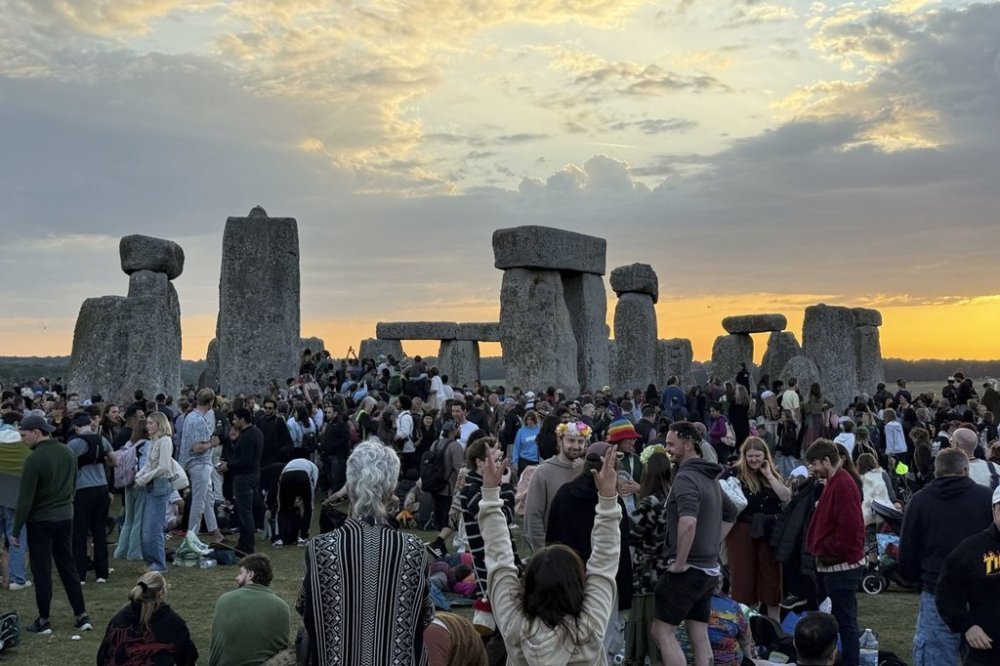
About 25,000 sun devotees and other revelers, including druids, pagans, hippies, locals and tourists, showed up, according to English Heritage which operates the site. More than 400,000 others around the world watched a livestream.
“This morning was a joyous and peaceful occasion with the most beautiful sunrise,” said Richard Dewdney, head of operations at Stonehenge. “It is fantastic to see Stonehenge continuing to enchant and connect people.”
Stonehenge was built in stages 5,000 years ago on the flat lands of Salisbury Plain approximately 75 miles (120 kilometers) southwest of London. The unique stone circle was erected in the late Neolithic period about 2,500 B.C.
Some of the so-called bluestones are known to have come from the Preseli Hills in southwest Wales, nearly 150 miles (240 kilometers) away, and the altar stone was recently discovered to have come from northern Scotland, some 460 miles (740 kilometers) away.

The site’s meaning has been vigorously debated. Theories range from it being a coronation place for Danish kings, a druid temple, a cult center for healing, or an astronomical computer for predicting eclipses and solar events.
The most generally accepted interpretation is that it was a temple aligned with movements of the sun — lining up perfectly with the summer and winter solstices.