New report suggests opening churches to the masses as attendance dwindles
Advertisement
Read this article for free:
or
Already have an account? Log in here »
To continue reading, please subscribe:

Digital Subscription
One year of digital access for only $205*
- Enjoy unlimited reading on winnipegfreepress.com
- Read the E-Edition, our digital replica newspaper
- Access News Break, our award-winning app
- Play interactive puzzles
*First annual payment billed as $205.00 + GST for one year. This annual subscription will automatically renew at $233.00 + GST every 52 weeks (10% off the regular annual price of $259.35). Offer available to new and qualified returning subscribers only. Cancel any time.
To continue reading, please subscribe:
Add Free Press access to your Brandon Sun subscription for only an additional
$1 for the first 4 weeks*
- Enjoy unlimited reading on winnipegfreepress.com
- Read the E-Edition, our digital replica newspaper
- Access News Break, our award-winning app
- Play interactive puzzles
*Your next Brandon Sun subscription payment will increase by $1.00 and you will be charged $17.95 plus GST for four weeks. After four weeks, your payment will increase to $24.95 plus GST every four weeks.
Read unlimited articles for free today:
or
Already have an account? Log in here »
Hey there, time traveller!
This article was published 22/06/2025 (480 days ago), so information in it may no longer be current.
When Rev. Kevin George first arrived at St. Paul’s Cathedral, congregants accused him of coming to rip out the pews.
“I was like, ‘OK, everybody take a breath. I don’t have my chainsaw with me,'” he said Friday, a day after welcoming the public into the newly renovated building in downtown London, Ont.
It’s been 18 months since he started working at the church, and the pews are indeed gone.
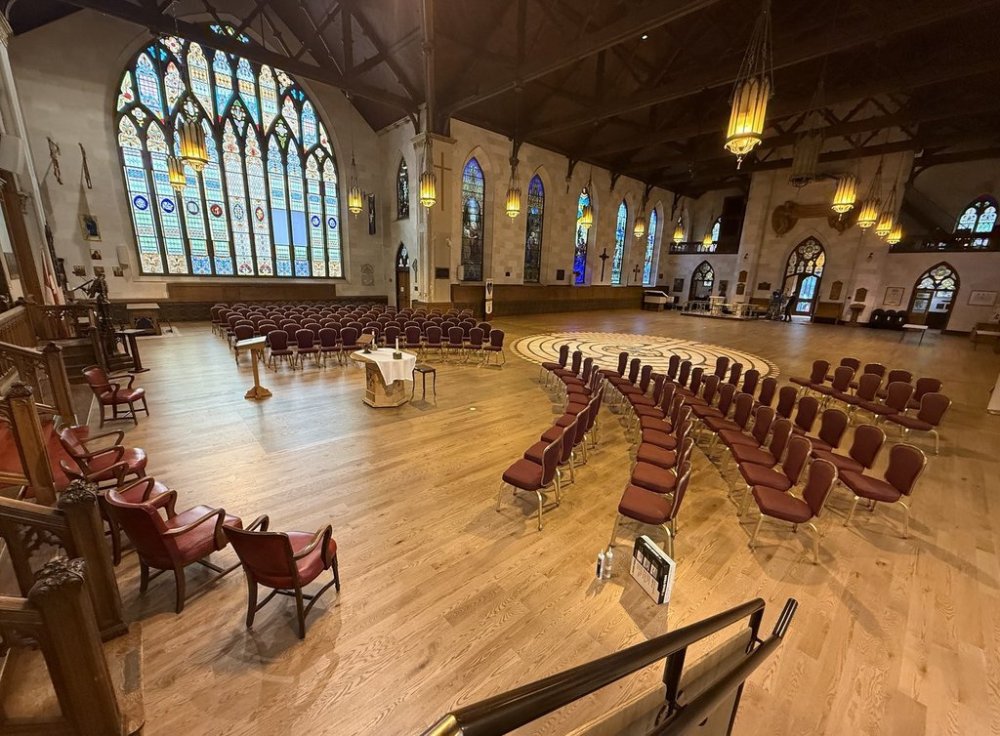
After much prayer and consideration, the change came with the blessing of the congregation.
George is leading the adaptive redevelopment of St. Paul’s in an effort to keep the Anglican church building alive in a model not unlike the one endorsed by a new report from the Canadian Urban Institute.
It argues churches must change their approach to managing their buildings because declining attendance is putting their longevity at risk. The institute fears the loss of physical buildings could spell the end for the churches’ civic function.
The non-profit’s report says that in addition to their spiritual role, church buildings have long been places where people go for social services, from food pantries to foot clinics and charity bingo to child care.
It was that same argument that got members of St. Paul’s onside, George said.
They asked themselves, “What are we doing with the space and what does that space do for us to allow us to be the church that we need to be today, tomorrow and for generations to come?” George recalled.
“And when we did that work, the barriers began to fall.”
Without the pews, which seated 700, the space can be used in any manner of ways — as a concert venue, a conference hall, and, of course, a space for worship.
The renovations, which also included making the space wheelchair accessible and installing much-needed air conditioning, have cost $1.9 million.
The congregation and Anglican Diocese of Huron have together raised $1.1 million, and they’re now looking to external sources to cover the balance. They’re hoping some funds could come from the City of London, which has endorsed the space as a new creative hub.
The church will also expand its civic role, George said.
“When I moved downtown in January of 2024, one of the overwhelming narratives about St. Paul’s was, ‘I can never get in there. The doors are locked,'” he said. “Well, that’s changed dramatically and will continue to change because our attitude now is ‘doors open.'”
If churches don’t adapt, CUI President Mary Rowe said, they face two major threats: development and decay.
“As urban environments intensify…those kinds of civic spaces that provide this kind of opportunity for informal, casual social interaction, they get encroached upon because the market pressure is such that that building starts to become more desirable for high-end housing,” Rowe said.
“And in small communities where there may not be the same kind of pressure for real estate development, there’s no money or resources to shore up the civic functions of these places.”
The report contends church spaces, which for decades have benefited from tax exemptions, have a duty to continue offering civic services. But a 2019 study by the National Trust for Canada predicted that one-third of Canada’s 27,000 faith buildings, most of which are Christian, would likely close permanently in the next 10 years.
“What we need are new models that get new resources into these places so that you can actually evolve in a way that serves the community around it,” Rowe said.
The report attempts to “unravel the Gordian knot” of how at-risk, faith-built assets like churches should be managed going forward.
That’s a question Rev. Graham Singh has spent more than a decade working to answer.
He’s the senior pastor at St. Jax Church in Montreal and CEO of the charity Releven, which works to preserve and repurpose underused churches.
St. Jax, formerly called St. James the Apostle Anglican Church, is a sort of prototype for the Releven model.
The grand cathedral on Rue Sainte-Catherine ceased operations in 2015. It was in disrepair and maintenance was extremely expensive because of its heritage designation. It reopened the following year under the new name.
“A challenge is the building itself,” Singh said. “Raising money to repair the roof, which is this heritage-listed slate roof that has to be repaired with like-for-like materials. And then the same thing with the masonry, which is a very expensive 150-year-old stone construction.”
But now, the building is home to four separate congregations and a non-religious non-profit, which will soon handle management of the building. Secular tenants of St. Jax include organizations that work in refugee resettlement, food security and youth employment.
Meanwhile, the City of Montreal is in the final stages of a process to acquire the green space outside St. Jax with the goal of turning it into a park.
Singh also knows about the complexity of working with the municipal government.
In order to make all the changes to how the St. Jax building operates, his organization had to prove they had the historic right to change the site’s purpose and use.
That heritage impact assessment has become part of the Ville-Marie Pilot Project, which opens the door for other churches in the city to share their space with non-religious groups, he said.
“The city has indeed been updating their zoning and urban planning framework to allow more of that to be happening in other locations in the future,” Singh said.
Through Releven, he’s taking that experience and helping other churches leverage it.
The CUI report found one of the barriers for churches looking to change their business model is a lack of knowledge on the part of local leadership.
“There’s very few examples of a congregation or a diocese or an owner of a faith building that have been able to do it by themselves because of the complexity of these buildings and the regulatory environment,” said Jennifer Barrett, managing director of programs, planning and policy at CUI.
Some churches have partnered with real estate developers.
Among them is All Saints’ Anglican Church in Winnipeg, whose lands are now home to West Broadway Commons, a 110-unit housing project. Fifty-six of those units are affordable.
But in many cases, Barrett said, churches are resistant to that sort of change and fearful of giving up control.

“It is challenging for faith communities to let go of their buildings,” she said.
George said that was true for the congregation at St. Paul’s. Ultimately, they decided that they should retain ownership of the property.
“We would have become sort of a tenant in our own space, and the Diocesan structure of the Anglican Church doesn’t work well for that,” George said.
“We’re working on what we believe will be a public-private partnership to administer this going forward because we know we’re going to get very busy. I mean, we’ve only just moved in yesterday, and we’re already receiving calls. There’s a demand here for a space like this.”
This report by The Canadian Press was first published June 22, 2025.
The Free Press acknowledges the financial support it receives from members of the city’s faith community, which makes our coverage of religion possible.