In temples and churches, sensory rooms remove barriers for neurodivergent worshipers
Advertisement
Read this article for free:
or
Already have an account? Log in here »
To continue reading, please subscribe:

Digital Subscription
One year of digital access for only $205*
- Enjoy unlimited reading on winnipegfreepress.com
- Read the E-Edition, our digital replica newspaper
- Access News Break, our award-winning app
- Play interactive puzzles
*First annual payment billed as $205.00 + GST for one year. This annual subscription will automatically renew at $233.00 + GST every 52 weeks (10% off the regular annual price of $259.35). Offer available to new and qualified returning subscribers only. Cancel any time.
To continue reading, please subscribe:
Add Free Press access to your Brandon Sun subscription for only an additional
$1 for the first 4 weeks*
- Enjoy unlimited reading on winnipegfreepress.com
- Read the E-Edition, our digital replica newspaper
- Access News Break, our award-winning app
- Play interactive puzzles
*Your next Brandon Sun subscription payment will increase by $1.00 and you will be charged $17.95 plus GST for four weeks. After four weeks, your payment will increase to $24.95 plus GST every four weeks.
Read unlimited articles for free today:
or
Already have an account? Log in here »
Hey there, time traveller!
This article was published 22/07/2025 (438 days ago), so information in it may no longer be current.
MAPLEWOOD, N.J. (RNS) — From organ blasts and incense to forced hugs and hand shakes, for folks who struggle to process sensory input, houses of worship can quickly feel anything but holy.
That was the case for Lark Losardo’s son Percy, who in 2017 began attending Catholic Mass with his family at age 7. Percy, who is autistic, was often overwhelmed by the Brooklyn church’s open space, noise and crowds. At first, when he needed to move around or stim (engage in repetitive actions to self-regulate), he’d leave the service with a parent. Eventually, in part because of the barriers to attending as a family, they stopped coming altogether.
Then, in 2020, the Losardos moved to Maplewood, New Jersey. After watching online services at a nearby Catholic parish called St. Joseph’s during the pandemic, Lark Losardo learned in 2024 that the parish was opening a sensory room equipped with regulation tools, including a weighted blanket, touch pillow, ear defenders and sound machine. Thanks to that room, today Percy is back in the pews, using the room to regroup whenever needed.
“It speaks volumes,” Lark Losardo told Religion News Service. “Not everyone needs this space, but just having it there sends a very clear message.”
___
This content is written and produced by Religion News Service and distributed by The Associated Press. RNS and AP partner on some religion news content. RNS is solely responsible for this story.
___
Across the U.S., families like Percy’s who once thought worship was off-limits are returning to faith communities thanks to a small but growing number of sensory rooms in religious settings. Located in underutilized classrooms, storage spaces and former nurseries, these rooms vary in size and appearance, but are all designed to offer a calm, predictable environment that can help with nervous system regulation. Disability advocates say the rooms signal that a community prioritizes the needs of neurodivergent and disabled members.
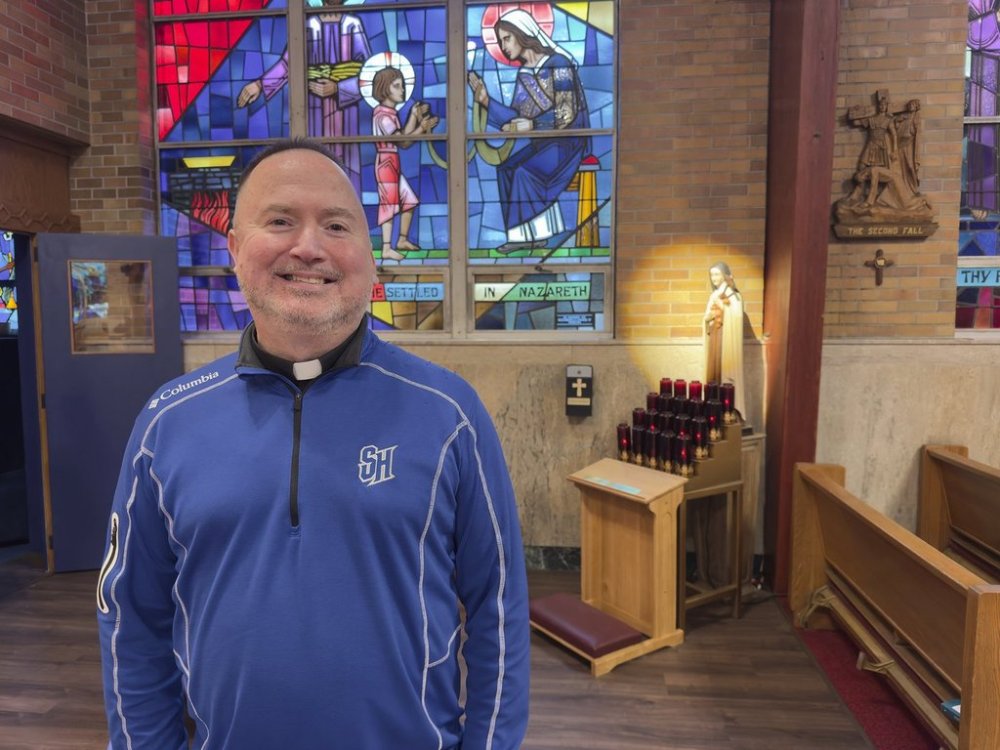
At St. Joseph’s, the Rev. Jim Worth said the new sensory room, which opened in December, isa natural extension of the parish’s faith values. To him, the room is evidence that inclusion — a principle Worth linked to Catholic social teaching — isn’t just given lip service.
“When you put intentionality behind something, it makes a world of difference,” said Worth.
On a 60-degree day in late March, the church, located on a quiet residential street, had a front stoop featuring three signs: one quoting Martin Luther King Jr., another quoting Pope Francis, and a third welcoming anyone in the community to visit the Still Waters Sensory Room.
Named after the biblical Psalm 23 passage — “he leads me beside still waters” — the sensory room was converted from an unused confessional. It was designed by Together We Bloom, a Maplewood-based nonprofit that helps make events and spaces more accessible. The room’s dark indigo walls match the comfortable chair glider and beanbag, each contributing to the soothing atmosphere. The total cost of the room was under $2,000 and was largely paid for by church funds, plus some donations.
“This sensory room has really changed everything for us,” said Pavitra Makam, a St. Joseph’s parishioner and mother of two neurodivergent kids. “Being able to worship together has been the biggest thing for our family.”
Jay Perkins, who has been in the sensory room business since 2009, said it’s often parents in need of a safe, supportive space for their kids who are spearheading the movement to build sensory rooms. When his daughter began exhibiting signs of aggression at age 4, places like libraries (too quiet), playgrounds (too loud) and trampoline parks (too crowded) were inaccessible. That applied to his Episcopal church, too.
“There are so few places where special-needs kids with sensory integration disorders can enjoy it,” said Perkins.
The lack of accessible spaces for his family inspired Perkins to begin building the kinds of rooms his daughter would thrive in. In 2018 he officially launched his company, The Sensory Room, which builds high-end, durable sensory rooms from start to finish and trains people on how to use them.
“It’s catching on,” said Perkins, whose company built roughly a dozen rooms in 2022 and 80 in 2023. Though The Sensory Room specializes in schools, Perkin’s company has also built rooms for a Broadway theater and an airport, and three in evangelical churches. Most of his custom rooms, he told RNS, start in the $20,000 range.
One of those projects was the $35,000 transformation of a storage room into a state-of-the-art sensory room at Encounter Church, an evangelical congregation about 30 minutes from Dallas. Completed in February 2024, the renovation included interactive tactile and texture panels, bubble tubes, mirrors, new carpet, paint and electrical work, and an LED-star ceiling complete with a digital shooting star. According to the Rev. Chris Binion, who co-founded the church with his wife, Tracy, the decision to create the room was prompted by the Holy Spirit.
“I was in a season of prayer and fasting, and I felt like the Lord asked me how to take care of his ‘littles,’” Binion told RNS. He felt God was urging him to support kids with “diverse needs,”including autism. “We decided through the direction of the Holy Spirit to say yes, and move forward in this kingdom assignment.”
It’s not just churches that are revamping spaces to focus on sensory integration. Temple Emanu-El, a Reform synagogue in Atlanta, has adapted two of its rooms to help folks process sensory input. A former cry room just off the main sanctuary was altered to become the Shalom Sanctuary, a small space with a large window facing the main worship space equipped with fidget toys, beanbags and headphones.
The synagogue also received a $10,000 grant from the Jewish Federation of Greater Atlanta to improve the accessibility of a classroom. That renovation is almost complete, and the room, which features a wall of sensory engagement toys, flexible furniture and alternative seating (think large rubber balls), will be especially helpful for children who need sensory breaks during religious classes or events such as the annual Purim carnival, according to Rabbi Rachael Klein Miller, associate rabbi at the synagogue.
“Something important in Judaism is the idea that we are all created ‘b’tzelem Elohim,’ in the image of God,” said Klein Miller. “And much of that is connected to the golden rule of treating people the way we want to be treated and finding space for everybody in the community.”
According to Rebecca Barlow, a regional disability specialist in The Church of Jesus Christ of Latter-day Saints, adding a sensory room to a house of worship doesn’t automatically make it accessible to those with sensory needs. “It’s just one piece of a bigger machine that you’re trying to build,” said Barlow, disability specialist for the Desert Ridge Stake in Mesa, Arizona.
The first step to building that machine, Barlow said, is asking disabled individuals and their families what it would take to make church feasible for them. When she first became a disability specialist roughly five years ago, feedback was invaluable. “The biggest thing was listening. The parents of these children know what they need,” said Barlow, who is the parent of a child with autism.
Based on the families’ input, she created a sensory room in her meeting house with new donated items. Knowing it would be used by kids who could become aggressive, she removed hard chairs and chalkboard lips that could pose safety risks. She also filled the room with the usual sensory items, added light-blocking curtains and included a night-light that projected a calming light pattern.
Still, it took more than that to get families back in the door.
“We, as parents of disabled children, often can become jaded, and we lack trust that our children are going to be cared for in a manner appropriate to how special they are,” said Barlow.
To build trust with families, church leaders invited some members of the ward to serve as one-on-one aides for each child with a disability. The aides were trained in the homes of their assigned families and eventually accompanied the kids in the sensory room during church meetings. Barlow also introduced the kids to the sensory room ahead of time via pictures and tours, and ward members, too, received basic training on understanding disabilities and how to use the sensory room.
In the few years since that sensory room opened, the model has gained traction. Barlow says the seven wards in her stake now each have their own disability specialists and sensory rooms, and she routinely takes calls from LDS church members across the country and the globe seeking to set up sensory rooms of their own.
“It feels like we’re seeing a cultural shift toward understanding and accepting and integrating people with disabilities,” said Barlow. “If we want to follow Christ, if we want to emulate him, if we want to be his disciples … they need to be foremost in our mind.”
The Free Press acknowledges the financial support it receives from members of the city’s faith community, which makes our coverage of religion possible.