
McGill University team develops AI that can detect infection before symptoms appear

Advertisement

Advertise with us

MONTRÉAL - Researchers at McGill University say they developed an artificial intelligence platform that can predict when someone is about to come down with a respiratory tract infection before they start to feel sick.

Read this article for free:


or

Already have an account? Log in here »

To continue reading, please subscribe:

Subscribe and receive a limited-edition Free Press branded hat or tote.

Digital Subscription

One year of digital access for only $205*

  • Enjoy unlimited reading on winnipegfreepress.com
  • Read the E-Edition, our digital replica newspaper
  • Access News Break, our award-winning app
  • Play interactive puzzles

*First annual payment billed as $205.00 + GST for one year. This annual subscription will automatically renew at $233.00 + GST every 52 weeks (10% off the regular annual price of $259.35). Offer available to new and qualified returning subscribers only. Cancel any time.

To continue reading, please subscribe:

Add Free Press access to your Brandon Sun subscription for only an additional

$1 for the first 4 weeks*

  • Enjoy unlimited reading on winnipegfreepress.com
  • Read the E-Edition, our digital replica newspaper
  • Access News Break, our award-winning app
  • Play interactive puzzles
Start now

*Your next Brandon Sun subscription payment will increase by $1.00 and you will be charged $17.95 plus GST for four weeks. After four weeks, your payment will increase to $24.95 plus GST every four weeks.

Hey there, time traveller!
This article was published 30/07/2025 (409 days ago), so information in it may no longer be current.

MONTRÉAL – Researchers at McGill University say they developed an artificial intelligence platform that can predict when someone is about to come down with a respiratory tract infection before they start to feel sick.

In what researchers are calling a “world first,” the study involved participants who wore a ring, a watch and a T-shirt, all of which were equipped with censors that recorded their biometric data. By analyzing the data, researchers were able to accurately predict acute systemic inflammation — an early sign of a respiratory infection such as COVID-19.

Published in The Lancet Digital Health, the study says the AI platform can one day help doctors address health problems much earlier than they normally would, particularly in patients who are fragile and for whom a new infection could have serious consequences. It could also potentially reduce costs for the health-care system by preventing complications and hospitalizations.
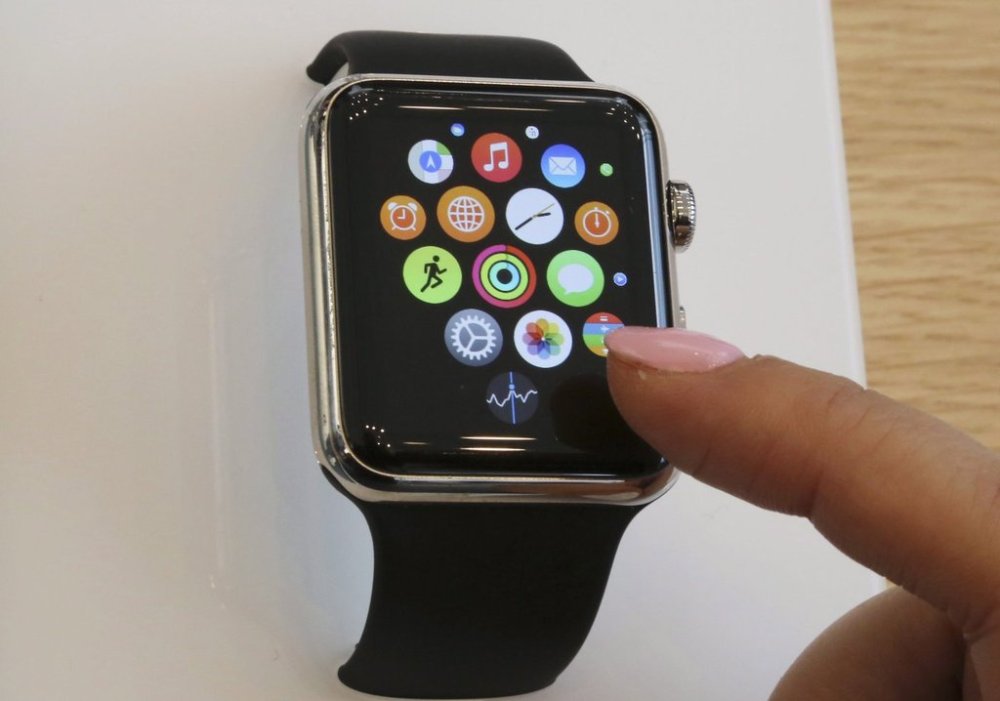
Participants wore a smart ring, a smart watch, and a smart T-shirt that monitored multiple physiological parameters and activities. In the photo, an Apple Watch in 2015 in Tokyo. (AP Photo/Koji Sasahara, File)

“We were very interested to see if physiological data measured using wearable sensors … could be used to train an artificial intelligence system capable of detecting an infection or disease resulting from inflammation,” explained the study’s lead author, Prof. Dennis Jensen of McGill University’s department of kinesiology and physical education.

“We wondered if we could detect early changes in physiology and, from there, predict that someone is about to get sick.”

Jense says the AI model his team created is the first in the world to use physiological measures — including heart rate, heart rate variability, body temperature, respiratory rate, blood pressure — rather than symptoms, to detect a problem.

Acute systemic inflammation is a natural defence mechanism of the body that usually resolves on its own, but it can cause serious health problems, especially in populations with pre-existing conditions.

“The whole idea is kind of like an iceberg,” Jensen said. “Kind of when the ice cracks the surface, that’s like when you’re symptomatic, and then it’s too late to really do much to treat it.”

During the study, McGill researchers administered a weakened flu vaccine to 55 healthy adults to simulate infection in their bodies. The subjects were monitored seven days before inoculation and five days after.

Participants wore a smart ring, smart watch, and a smart T-shirt simultaneously throughout the study. As well, researchers collected biomarkers of systemic inflammation using blood samples, PCR tests to detect the presence of respiratory pathogens, and a mobile app to collect symptoms reported by participants.

In total, more than two billion data points were collected to train machine learning algorithms. Ten different AI models were developed, but the researchers chose the model that used the least amount of data for the remainder of the project. The chosen model correctly detected nearly 90 per cent of actual positive cases and was deemed more practical for daily monitoring.

On their own, Jensen said, none of the data collected from the ring, watch, or T-shirt alone is sensitive enough to detect how the body is responding.

“An increase in heart rate alone may only correspond to two beats per minute, which is not really clinically relevant,” he explained. “The decrease in heart rate variability can be very modest. The increase in temperature can be very modest. So the idea was that by looking at … several different measurements, we would be able to identify subtle changes in physiology.”

The algorithms also successfully detected systemic inflammation in four participants infected with COVID-19 during the study. In each case, the algorithms flagged the immune response up to 72 hours before symptoms appeared or infection was confirmed by PCR testing.

Ultimately, the researchers hope to develop a system that will inform patients of possible inflammation so they can contact their health-care provider. “In medicine, we say that you have to give the right treatment to the right person at the right time,” Jensen said.

By expanding the therapeutic window in which doctors can intervene, he added, they could save lives and achieve significant savings by avoiding hospitalizations and enabling home management of chronic conditions or even aging.

“In a way, we hope to revolutionize personalized medicine.”

This report by The Canadian Press was first published July 30, 2025.

Report Error Submit a Tip

More Stories

Goodness alive, well in N.L.-set musical

Jen Zoratti 4 minute read Preview

Goodness alive, well in N.L.-set musical

Jen Zoratti 4 minute read 2:01 AM CDT

I first saw Come From Away — the true-story musical about the incredible efforts of the residents of Gander, N.L. on Sept. 11, 2001, who welcomed nearly 7,000 travellers diverted to their remote town after the attacks on the World Trade Center and the Pentagon — in 2022, when Broadway Across Canada brought it to the Centennial Concert Hall.

I went in cold, but with blunted expectations; it seemed, on premise alone, like it could tilt too far into shmaltzy sentimentality, that it would be too earnest in its goodness.

So, when I wept until my face was as wet and salty as though it had been slapped by the waves of the North Atlantic, I was pleasantly surprised. I loved it. It’s emotional, yes. It’s sentimental, yes. But you can’t help but feel both buoyed — and, dare I say, patriotic — by the end of it.

Written by Canadians Irene Sankoff and David Hein, Come From Away seemed an unlikely hit when it opened on Broadway in 2017. But there was, by then, an appetite for it.

Read
2:01 AM CDT

Chrétien says Canada bows to no one in fiery address at 9/11 commemoration

Sarah Smellie, The Canadian Press 6 minute read Preview

Chrétien says Canada bows to no one in fiery address at 9/11 commemoration

Sarah Smellie, The Canadian Press 6 minute read Updated: Yesterday at 8:15 PM CDT

GANDER - Former prime minister Jean Chrétien drew a standing ovation inside a Gander, N.L., hockey arena on Friday as he delivered a pointed message to American leaders during a ceremony marking the 9/11 terrorist attacks in the United States, 25 years ago.

The 92-year-old warned Americans never to mistake Canadian generosity for weakness, nor its kindness for softness.

U.S. Ambassador Pete Hoekstra looked on as Chrétien insisted his pointed words were a sign of friendship. Friends tell each other the truth, he said.

“We embraced our friends and we helped them in their moment of need, but we bow to no one,” Chretien said, as the crowd erupted again.

Read
Updated: Yesterday at 8:15 PM CDT

Nifty neighbours also jonesing for geniality

Maureen Scurfield 4 minute read 2:01 AM CDT

DEAR MISS LONELYHEARTS: Recently, a new couple with no children moved onto our cul de sac, and everybody is taking notice! This attractive pair with no kids both drive amazing cars, work from home and leave their garage doors up a lot. Everybody on the street walks by to sneak a peek into the big garage at just about any time of day.

Lately, the man’s been out on his front lawn in a muscle shirt in the late afternoon, planting shrubs and putting up stylish fall-themed ornaments. At night they often leave the living-room curtains open. That makes for convenient viewing for curious neighbours like us!

A few days ago, my wife invited the new couple over for a barbecue and swim in our pool. They are really nice people, but mentioned that other people nearby have been pretty stand-offish. They wonder why. Should I tell them it’s probably just jealousy over their beautiful vehicles and enviable lifestyle, or should I just shut up?

—Wanting to Help, Sage Creek

City rapped for taking five days to remove animal carcass

Morgan Modjeski 2 minute read Thursday, Sep. 10, 2026

A Winnipeg resident said she’s upset it took the city five days to retrieve a dead fawn from her yard after she reported it to 311.

Amy Gelhorn said she and her family noticed the animal carcass in her garden on Saturday. She called 311 and was told it would be picked up after the long weekend.

“It was removed this afternoon,” the north River Heights resident said Thursday. “So it took six days to remove it and we had to basically phone every day.”

She said neighbours on both sides of her house told her they saw the animal acting strangely on Friday and reported their concerns to 311. It’s believed the animal died overnight. As the days dragged on, the body continued to rot.

Canadians loving Carney’s decision to stand tall against floundering U.S. bully

Tom Brodbeck 5 minute read Preview

Canadians loving Carney’s decision to stand tall against floundering U.S. bully

Tom Brodbeck 5 minute read Yesterday at 12:11 PM CDT

It’s hard to imagine a more dramatic political contrast than the one unfolding on opposite sides of the Canada-U.S. border.

Mark Carney is fighting a trade war with Donald Trump, taking the occasional verbal punch from the American president and imposing retaliatory tariffs on U.S. products.

And the prime minister is being rewarded for it politically.

Trump, meanwhile, is fighting pretty much everyone he can find — including some of America’s closest allies — and his own voters are increasingly giving him the political equivalent of a raised middle finger. That’s quite a tale of two leaders.

Read
Yesterday at 12:11 PM CDT

Is Trump about to poke Quebec’s political beehive?

Peter McKenna 5 minute read Preview

Is Trump about to poke Quebec’s political beehive?

Peter McKenna 5 minute read 2:00 AM CDT

When was the last time that a U.S. president seriously stirred the hornet’s nest of Quebec politics?

My best recollection is former U.S. president Bill Clinton. During the 1994 Quebec referendum campaign, Clinton made clear that the U.S. wholly endorsed a united and strong federal Canada — as opposed to a dismembered one. He went on to add that an independent Quebec would have no guarantee of joining the North American Free Trade Agreement as a full-fledged member.

Today, we see U.S. President Donald Trump inserting himself — unwittingly or wittingly — into the electoral and sovereignty politics of Quebec. It’s pretty clear that the resurgent Coalition Avenir Québec government is trying to make the Oct. 5 provincial election about anything other than its own governmental record and more about Trump’s economic coercion against Canada. Of course, the Parti Québécois, the odds-on-favourite, wants to make the electoral contest a referendum on the CAQ and its party leader, Christine Fréchette.

But what if Trump really wanted to make his presence felt in Quebec’s political life? How much influence could he have on shaping political outcomes in Quebec? How much of an “X factor” could he be?

Read
2:00 AM CDT