How to protect yourself from the bad air caused by wildfires

Advertisement

Advertise with us

When wildfires burn, the smoke can travel long distances and degrade air quality far away, which presents risks for those breathing it.

Read this article for free:


or

Already have an account? Log in here »

To continue reading, please subscribe:

Subscribe and receive a limited-edition Free Press branded hat or tote.

Digital Subscription

One year of digital access for only $205*

  • Enjoy unlimited reading on winnipegfreepress.com
  • Read the E-Edition, our digital replica newspaper
  • Access News Break, our award-winning app
  • Play interactive puzzles

*First annual payment billed as $205.00 + GST for one year. This annual subscription will automatically renew at $233.00 + GST every 52 weeks (10% off the regular annual price of $259.35). Offer available to new and qualified returning subscribers only. Cancel any time.

To continue reading, please subscribe:

Add Free Press access to your Brandon Sun subscription for only an additional

$1 for the first 4 weeks*

  • Enjoy unlimited reading on winnipegfreepress.com
  • Read the E-Edition, our digital replica newspaper
  • Access News Break, our award-winning app
  • Play interactive puzzles
Start now

*Your next Brandon Sun subscription payment will increase by $1.00 and you will be charged $17.95 plus GST for four weeks. After four weeks, your payment will increase to $24.95 plus GST every four weeks.

Hey there, time traveller!
This article was published 02/08/2025 (404 days ago), so information in it may no longer be current.

When wildfires burn, the smoke can travel long distances and degrade air quality far away, which presents risks for those breathing it.

Fires burning in one state can make air worse several states away, and wildfires in Canada can send smoke into U.S. cities.

Here’s what to know about taking precautions against poor air quality due to wildfires.
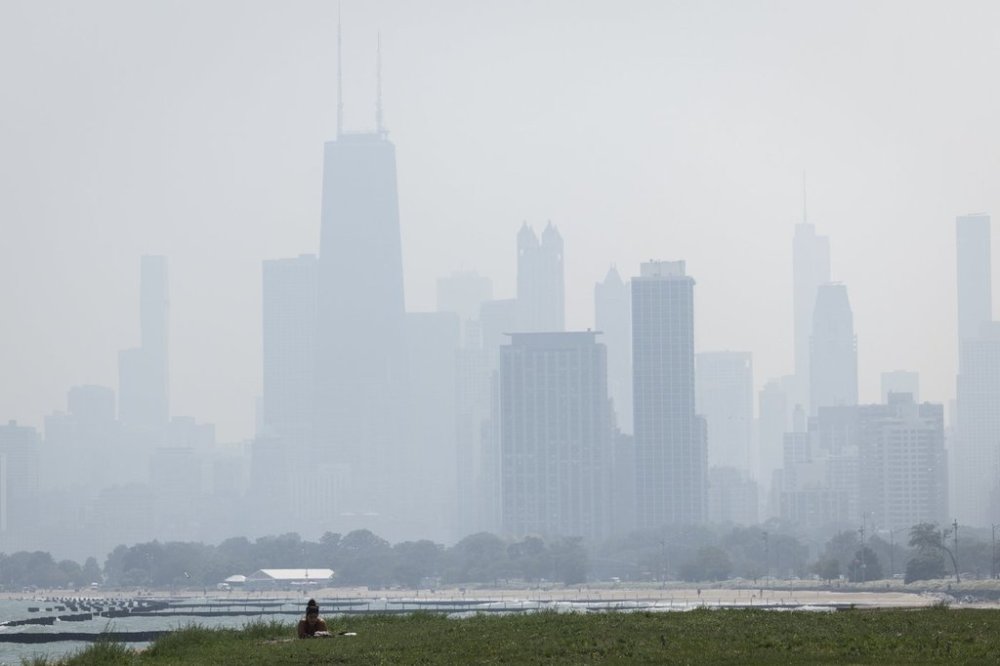
People sun tan in grass off the Lakefront Trail on the North Side as a haze of Canadian wildfire smoke blankets the Chicago area and creates poor air quality, Thursday, July 31, 2025. (Ashlee Rezin/Chicago Sun-Times via AP)

What counts as bad air?

The EPA’s Air Quality Index converts all pollutant levels into a single number. The lower the number, the better.

Anything below 50 is classified as “healthy.” Fifty to 100 is “moderate” while 100-150 is unhealthy for “sensitive groups,” and anything above 150 is bad for everyone.

Sensitive groups include people with asthma, lung disease or chronic obstructive pulmonary disease, said Dr. Sanjay Sethi, chief of the division of pulmonary, critical care and sleep medicine at the University of Buffalo’s medical school.

“If you have heart or lung problems, then you’ve got to be definitely more careful,” Sethi said. “I would either avoid going outside or wear an N95 (mask) or at least a dust mask.”

Is my air unhealthy?

Sometimes the air is bad enough to see or smell the smoke. Even if you don’t see the pollution, it can be unhealthy to breathe.

The EPA maintains a website with up-to-date, regional air quality information. PurpleAir, a company that sells air quality sensors and publishes real-time air quality data, has a citizen scientist, air quality monitoring network with a more granular map of street-by-street air quality readings.

The best way to get indoor air quality readings is to buy a monitor, said Joseph Allen, director of Harvard University’s Healthy Buildings Program.

“You can find these low-cost, indoor air quality monitors just about everywhere online now. They don’t cost all that much anymore,” he said.

What if I have to go outside?

For most people, going outside for just a short time won’t have a negative long-term impact, said Sethi.

Wearing an N95 mask, which became common during the coronavirus pandemic, will help filter out the pollution.

“N95 is going to get rid of 90-95% of the particles,” said Jennifer Stowell, a research scientist at Boston University’s Center for Climate and Health. “If you have access to a mask that has a respirator-type attachment to it, then that’s the very best.”

If you must be outside and you experience symptoms, experts say you should head indoors or somewhere else with better air quality. Even if you are healthy, it’s good to take precautions.

“If you start wheezing, which is like this whistling sound of the chest, or if you’re feeling short of breath, that’s definitely more concerning,” Sethi said.

How do I make my air cleaner?

Close the windows and turn on the air conditioner, if you have one, setting it to circulate the indoor air. Use blankets to cover cracks that allow outside air into your home, such as under doors.

Finally, swapping the air conditioner’s filter for a MERV 13 filter can help, though you should make sure it’s installed correctly.

“If you happen to have access to an air purifier, even if it’s just a room air purifier, try to keep it running and in the room that you’re doing most of your activities in,” said Stowell.

___

The Associated Press’ climate and environmental coverage receives financial support from multiple private foundations. AP is solely responsible for all content. Find AP’s standards for working with philanthropies, a list of supporters and funded coverage areas at AP.org.

Report Error Submit a Tip

More Stories

The plane truth about a dangerous president

Editorial 4 minute read Preview

The plane truth about a dangerous president

Editorial 4 minute read 2:01 AM CDT

U.S. President Donald Trump has crossed firmly into cutting-off-your-nose-to-spite-your-face territory.

Read
2:01 AM CDT

Ottawa to spend $5M on HIV self-testing kits

Scott Billeck 5 minute read Preview

Ottawa to spend $5M on HIV self-testing kits

Scott Billeck 5 minute read 4:21 PM CDT

Manitoba, which has the country’s highest HIV rate, will receive a significant share of $5 million in federal funding for HIV testing and supports.

The province declared a public health emergency over rising HIV rates in May. Manitoba’s HIV rate is more than three times the national average. In 2024, the province had 19.5 cases per 100,000 people, compared with 5.5 nationally.

Dr. Joss Reimer, Canada’s chief public health officer, said Thursday at the Manitoba Harm Reduction Network in Winnipeg, said one in 10 Canadians who have HIV do not know their status.

“Knowing one’s HIV status enables access to prevention options, or for those who test positive, early treatment to improve outcomes and prevent transmission,” Reimer said.

Read
4:21 PM CDT

‘We feel lucky — and a bit traumatized’: Tornado confirmed in River Heights Sunday

Malak Abas 5 minute read Preview

‘We feel lucky — and a bit traumatized’: Tornado confirmed in River Heights Sunday

Malak Abas 5 minute read Updated: 4:30 PM CDT

Tanner Lemieux wasn’t surprised to learn the violent winds that tore through River Heights and reached their peak near his home Sunday night have been classified as a tornado.

While driving back to his Lindsay Street home from a shopping trip with his wife Sunday, it became clear they were not in the middle of an ordinary thunderstorm when rain and wind started coming from every direction and hit every side of their truck.

The forceful wind made it impossible for him to open his door after they had parked. He climbed through the window, over the top of his vehicle, and the couple struggled to fight the whipping winds to make it into the house.

“As we were running in, the wind started pulling me backwards out of the door,” he told the Free Press while cleaning debris from his yard Thursday.

Read
Updated: 4:30 PM CDT

U of M students call for ban on far-right group

Maggie Macintosh 4 minute read Preview

U of M students call for ban on far-right group

Maggie Macintosh 4 minute read 6:00 AM CDT

Some University of Manitoba students are calling on their school to ban a far-right group from campus after posters promoting mass deportations were found during the summer break.

More than 50 people rallied on Wednesday, the first day of classes, to make known their concerns about a group called the Dominion Society of Canada.

The protest was organized after a supporter of the self-described nationalist group posted a video over the Labour Day weekend that shows him putting up flyers in Fort Garry.

“Canada is a really beautiful country and I have been welcomed here by a lot of beautiful people and it’s been amazing, but when I see harmful rhetoric online and now, on campus, it gives me a lot of anxiety,” said Ela Ancheta, an arts major at U of M.

Read
6:00 AM CDT

Labour board ruling halts Dynacare strike

Carol Sanders and Erik Pindera 6 minute read Preview

Labour board ruling halts Dynacare strike

Carol Sanders and Erik Pindera 6 minute read Tuesday, Sep. 8, 2026

The Manitoba Labour Board has cut short a strike by 350 lab workers employed by Dynacare who administer blood and urine tests for patients in Winnipeg, Brandon and surrounding communities.

The board ruled late Tuesday afternoon that the workers, who hit the picket line at 6 a.m., must return to work Wednesday.

Jason Linklater, president of their union, the Manitoba Association of Health Care Professionals, slammed the board’s decision.

“The Manitoba Labour Board is doing exactly what the government asked them to do: they are taking away our members’ right to fight for fairness,” he said in a statement.

Read
Tuesday, Sep. 8, 2026

Councillors say Main Street Project scuttles other agency’s efforts to house homeless

Scott Billeck 5 minute read Preview

Councillors say Main Street Project scuttles other agency’s efforts to house homeless

Scott Billeck 5 minute read Tuesday, Sep. 8, 2026

A Winnipeg outreach agency that’s been largely shut out of government funding says it has found housing for more people in the last five months than Manitoba’s homeless strategy that began last year.

Read
Tuesday, Sep. 8, 2026