Harvard scientists say research could be set back years after funding freeze
Advertisement
Read this article for free:
or
Already have an account? Log in here »
To continue reading, please subscribe:

Digital Subscription
One year of digital access for only $205*
- Enjoy unlimited reading on winnipegfreepress.com
- Read the E-Edition, our digital replica newspaper
- Access News Break, our award-winning app
- Play interactive puzzles
*First annual payment billed as $205.00 + GST for one year. This annual subscription will automatically renew at $233.00 + GST every 52 weeks (10% off the regular annual price of $259.35). Offer available to new and qualified returning subscribers only. Cancel any time.
To continue reading, please subscribe:
Add Free Press access to your Brandon Sun subscription for only an additional
$1 for the first 4 weeks*
- Enjoy unlimited reading on winnipegfreepress.com
- Read the E-Edition, our digital replica newspaper
- Access News Break, our award-winning app
- Play interactive puzzles
*Your next Brandon Sun subscription payment will increase by $1.00 and you will be charged $17.95 plus GST for four weeks. After four weeks, your payment will increase to $24.95 plus GST every four weeks.
Read unlimited articles for free today:
or
Already have an account? Log in here »
Hey there, time traveller!
This article was published 06/08/2025 (416 days ago), so information in it may no longer be current.
CAMBRIDGE, Mass. (AP) — Harvard University professor Alberto Ascherio’s research is literally frozen.
Collected from millions of U.S. soldiers over two decades using millions of dollars from taxpayers, the epidemiology and nutrition scientist has blood samples stored in liquid nitrogen freezers within the university’s T.H. Chan School of Public Health.
The samples are key to his award-winning research, which seeks a cure to multiple sclerosis and other neurodegenerative diseases. But for months, Ascherio has been unable to work with the samples because he lost $7 million in federal research funding, a casualty of Harvard’s fight with the Trump administration.
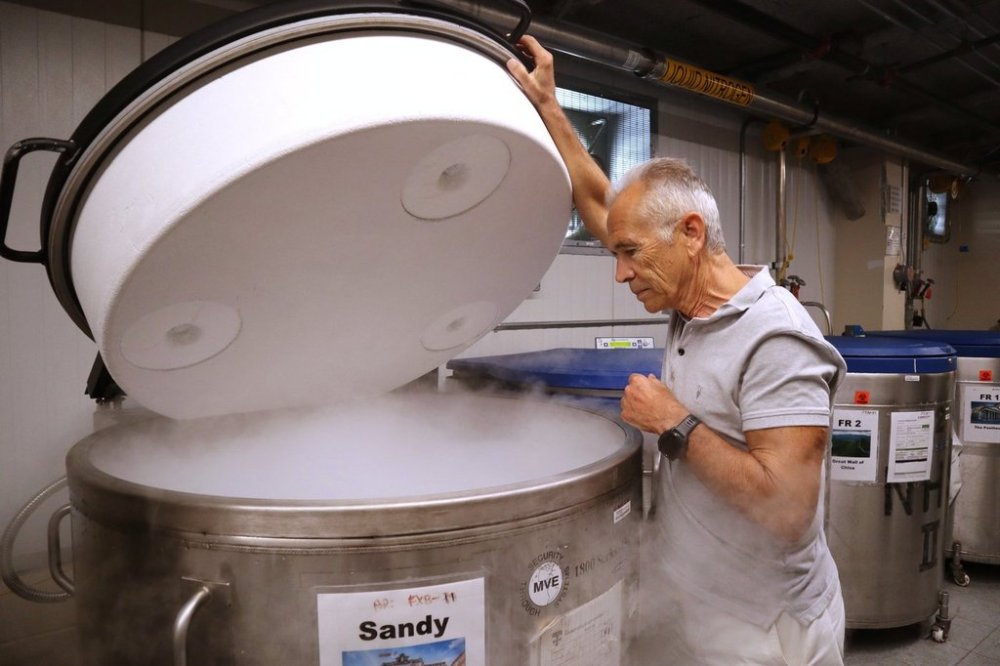
“It’s like we have been creating a state-of-the-art telescope to explore the universe, and now we don’t have money to launch it,” said Ascherio. “We built everything and now we are ready to use it to make a new discovery that could impact millions of people in the world and then, ‘Poof. You’re being cut off.’”
Researchers laid off and science shelved
The loss of an estimated $2.6 billion in federal funding at Harvard has meant that some of the world’s most prominent researchers are laying off young researchers. They are shelving years or even decades of research, into everything from opioid addiction to cancer.
And despite Harvard’s lawsuits against the administration, and settlement talks between the warring parties, researchers are confronting the fact that some of their work may never resume.
The funding cuts are part of a monthslong battle that the Trump administration has waged against some the country’s top universities including Columbia, Brown and Northwestern. The administration has taken a particularly aggressive stance against Harvard, freezing funding after the country’s oldest university rejected a series of government demands issued by a federal antisemitism task force.
The government had demanded sweeping changes at Harvard related to campus protests, academics and admissions — meant to address government accusations that the university had become a hotbed of liberalism and tolerated anti-Jewish harassment.
Research jeopardized, even if court case prevails
Harvard responded by filing a federal lawsuit, accusing the Trump administration of waging a retaliation campaign against the university. In the lawsuit, it laid out reforms it had taken to address antisemitism but also vowed not to “surrender its independence or relinquish its constitutional rights.”
“Make no mistake: Harvard rejects antisemitism and discrimination in all of its forms and is actively making structural reforms to eradicate antisemitism on campus,” the university said in its legal complaint. “But rather than engage with Harvard regarding those ongoing efforts, the Government announced a sweeping freeze of funding for medical, scientific, technological, and other research that has nothing at all to do with antisemitism.”
The Trump administration denies the cuts were made in retaliation, saying the grants were under review even before the demands were sent in April. It argues the government has wide discretion to cancel federal contracts for policy reasons.
The funding cuts have left Harvard’s research community in a state of shock, feeling as if they are being unfairly targeted in a fight has nothing to do with them. Some have been forced to shutter labs or scramble to find nongovernment funding to replace lost money.
In May, Harvard announced that it would put up at least $250 million of its own money to continue research efforts, but university President Alan Garber warned of “difficult decisions and sacrifices” ahead.
Ascherio said the university was able to pull together funding to pay his researchers’ salaries until next June. But he’s still been left without resources needed to fund critical research tasks, like lab work. Even a year’s delay can put his research back five years, he said.
Knowledge lost in funding freeze
“It’s really devastating,” agreed Rita Hamad, the director of the Social Policies for Health Equity Research Center at Harvard, who had three multiyear grants totaling $10 million canceled by the Trump administration. The grants funded research into the impact of school segregation on heart health, how pandemic-era policies in over 250 counties affected mental health, and the role of neighborhood factors in dementia.
At the School of Public Health, where Hamad is based, 190 grants have been terminated, affecting roughly 130 scientists.
“Just thinking about all the knowledge that’s not going to be gained or that is going to be actively lost,” Hamad said. She expects significant layoffs on her team if the funding freeze continues for a few more months. “It’s all just a mixture of frustration and anger and sadness all the time, every day.”
John Quackenbush, a professor of computational biology and bioinformatics at the School of Public Health, has spent the past few months enduring cuts on multiple fronts.
In April, a multimillion dollar grant was not renewed, jeopardizing a study into the role sex plays in disease. In May, he lost about $1.2 million in federal funding for in the coming year due to the Harvard freeze. Four departmental grants worth $24 million that funded training of doctoral students also were canceled as part of the fight with the Trump administration, Quackenbush said.
“I’m in a position where I have to really think about, ‘Can I revive this research?’” he said. “Can I restart these programs even if Harvard and the Trump administration reached some kind of settlement? If they do reach a settlement, how quickly can the funding be turned back on? Can it be turned back on?”
The researchers all agreed that the funding cuts have little or nothing to do with the university’s fight against antisemitism. Some, however, argue changes at Harvard were long overdue and pressure from the Trump administration was necessary.
Bertha Madras, a Harvard psychobiologist who lost funding to create a free, parent-focused training to prevent teen opioid overdose and drug use, said she’s happy to see the culling of what she called “politically motivated social science studies.”
White House pressure a good thing?
Madras said pressure from the White House has catalyzed much-needed reform at the university, where several programs of study have “really gone off the wall in terms of being shaped by orthodoxy that is not representative of the country as a whole.”
But Madras, who served on the President’s Commission on Opioids during Trump’s first term, said holding scientists’ research funding hostage as a bargaining chip doesn’t make sense.
“I don’t know if reform would have happened without the president of the United States pointing the bony finger at Harvard,” she said. “But sacrificing science is problematic, and it’s very worrisome because it is one of the major pillars of strength of the country.”
Quackenbush and other Harvard researchers argue the cuts are part of a larger attack on science by the Trump administration that puts the country’s reputation as the global research leader at risk. Support for students and post-doctoral fellows has been slashed, visas for foreign scholars threatened, and new guidelines and funding cuts at the NIH will make it much more difficult to get federal funding in the future, they said. It also will be difficult to replace federal funding with money from the private sector.
“We’re all sort of moving toward this future in which this 80-year partnership between the government and the universities is going to be jeopardized,” Quackenbush said. “We’re going to face real challenges in continuing to lead the world in scientific excellence.”