Mothers in Gaza stretch meager ingredients where they can, but say hunger persists
Advertisement
Read this article for free:
or
Already have an account? Log in here »
To continue reading, please subscribe:

Digital Subscription
One year of digital access for only $205*
- Enjoy unlimited reading on winnipegfreepress.com
- Read the E-Edition, our digital replica newspaper
- Access News Break, our award-winning app
- Play interactive puzzles
*First annual payment billed as $205.00 + GST for one year. This annual subscription will automatically renew at $233.00 + GST every 52 weeks (10% off the regular annual price of $259.35). Offer available to new and qualified returning subscribers only. Cancel any time.
To continue reading, please subscribe:
Add Free Press access to your Brandon Sun subscription for only an additional
$1 for the first 4 weeks*
- Enjoy unlimited reading on winnipegfreepress.com
- Read the E-Edition, our digital replica newspaper
- Access News Break, our award-winning app
- Play interactive puzzles
*Your next Brandon Sun subscription payment will increase by $1.00 and you will be charged $17.95 plus GST for four weeks. After four weeks, your payment will increase to $24.95 plus GST every four weeks.
Read unlimited articles for free today:
or
Already have an account? Log in here »
Hey there, time traveller!
This article was published 07/08/2025 (425 days ago), so information in it may no longer be current.
DEIR AL-BALAH, Gaza Strip (AP) — A single bowl of eggplant stewed in watery tomato juice must sustain Sally Muzhed’s family of six for the day. She calls it moussaka, but it’s a pale echo of the fragrant, layered meat-and-vegetable dish that once filled Gaza’s kitchens with its aroma.
The war has severed families from the means to farm or fish, and the little food that enters the besieged strip is often looted, hoarded and resold at exorbitant prices. So mothers like Muzhed have been forced into constant improvisation, reimagining Palestinian staples with the meager ingredients they can grab off trucks, from airdropped parcels or purchase at the market.
Israel implemented a total blockade on trucks entering the Gaza Strip in early March and began allowing aid back in May, although humanitarian organizations say the amount remains far from adequate.
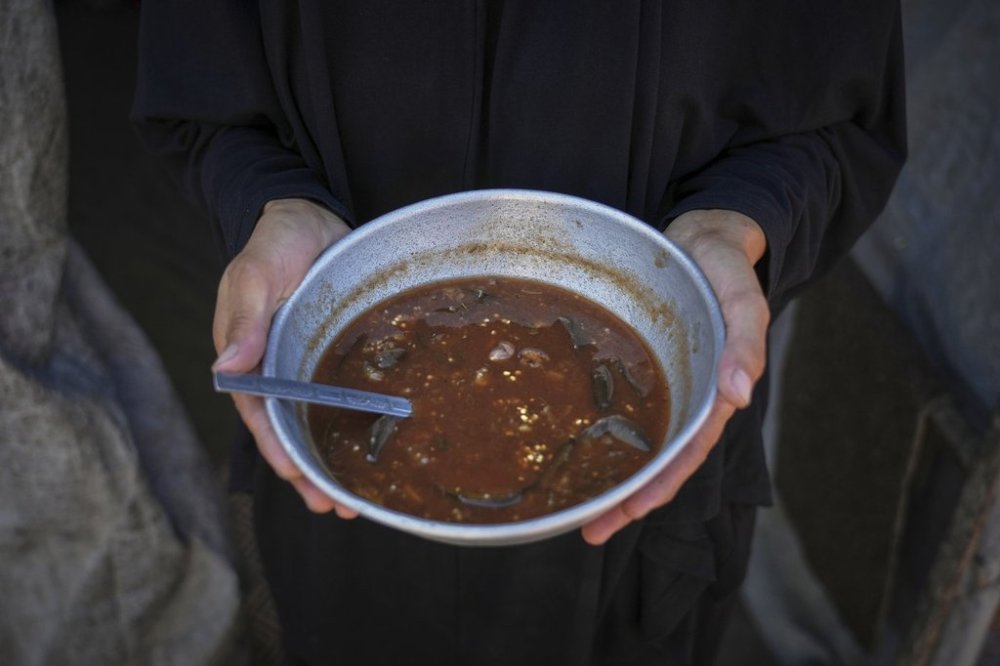
Some cooks have gotten inventive, but most say they’re just desperate to break the dull repetition of the same few ingredients, if they can get them at all. Some families say they survive on stale, brittle pita, cans of beans eaten cold for lack of cooking gas, or whatever they can get on the days that they arrive early enough that meals remain available at charity kitchens.
“The children remain hungry. Tomorrow we won’t have any food to eat,” Muzhed said from the tent where her family has been displaced in central Gaza’s Deir al-Balah.
Once, her bowl would barely have fed one child. Now she ladles it out in spoonfuls, trying to stretch it. Her son asks why he can’t have more.
The Muzhed family’s struggle is being repeated across Gaza as the territory plunges deeper into what international experts have called “the worst-case scenario of famine.”
On some days, mothers like Amani al-Nabahin manage to get mujaddara from charity kitchens. The dish, once flavored with caramelized onions and spices, is now stripped to its bare essentials of rice and lentils.
“Nearly nine out of ten households resorted to extremely severe coping mechanisms to feed themselves, such as taking significant safety risks to obtain food, and scavenging from the garbage,” the Integrated Food Security Phase Classification said on July 29.
Gas for cooking is scarce, vegetables are costly and meat has all but vanished from the markets.
Families in Gaza once dipped pieces of bread into dukkah, a condiment made of ground wheat and spices. But today, 78-year-old Alia Hanani is rationing bread by the bite, served once a day at noon, allowing each person to dip it in a wartime dukkah made of flour, lentils and bulgur.
“There’s no dinner or breakfast,” the mother of eight said.
Some people don’t even have enough to improvise. All Rehab al-Kharoubi has for her and her seven children is a bowl of raw white beans.
“I had to beg for it,” she said.
For some, it’s even less. Kifah Qadih, displaced from Khuza’a east of Khan Younis, couldn’t get any food — the bowl in front of her has remained empty all day.
“Today there is no food. There is nothing.”
Advertisement Advertise With Us
Advertisement Advertise With Us
The Free Press acknowledges the financial support it receives from members of the city’s faith community, which makes our coverage of religion possible.