AI helps Ont. researcher discover breakthrough antibiotic treatment for bowel disease
Advertisement
Read this article for free:
or
Already have an account? Log in here »
To continue reading, please subscribe:

Digital Subscription
One year of digital access for only $205*
- Enjoy unlimited reading on winnipegfreepress.com
- Read the E-Edition, our digital replica newspaper
- Access News Break, our award-winning app
- Play interactive puzzles
*First annual payment billed as $205.00 + GST for one year. This annual subscription will automatically renew at $233.00 + GST every 52 weeks (10% off the regular annual price of $259.35). Offer available to new and qualified returning subscribers only. Cancel any time.
To continue reading, please subscribe:
Add Free Press access to your Brandon Sun subscription for only an additional
$1 for the first 4 weeks*
- Enjoy unlimited reading on winnipegfreepress.com
- Read the E-Edition, our digital replica newspaper
- Access News Break, our award-winning app
- Play interactive puzzles
*Your next Brandon Sun subscription payment will increase by $1.00 and you will be charged $17.95 plus GST for four weeks. After four weeks, your payment will increase to $24.95 plus GST every four weeks.
Read unlimited articles for free today:
or
Already have an account? Log in here »
Hey there, time traveller!
This article was published 05/10/2025 (368 days ago), so information in it may no longer be current.
HAMILTON – Jon Stokes’s research lab has discovered what could be a breakthrough treatment for Crohn’s and inflammatory bowel disease in about 100 seconds.
Rather, his AI sequencing tool discovered it in 100 seconds. Then, as Stokes said, his team spent about six months testing the results to confirm they were true.
Still that’s six months of testing, rather than years. And only $60,000, rather than millions.
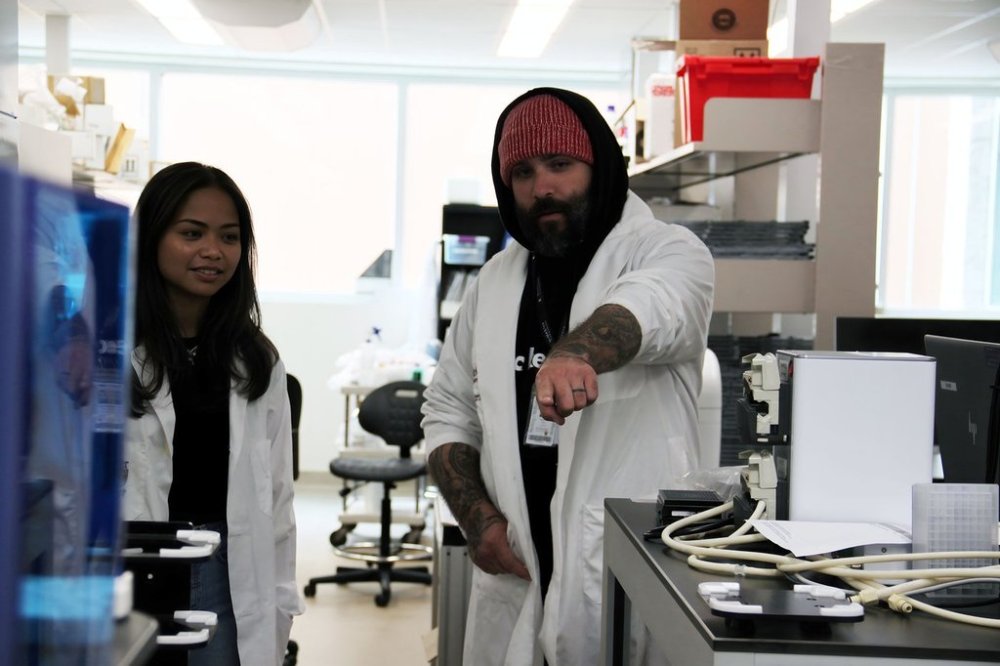
As far as new drug discoveries go, Stokes said this use case of AI could be a game changer for Canadian patients.
ANTIBIOTIC ISSUES
The problem with traditional antibiotics, said Stokes, is that many of them are designed to be broad spectrum – meaning they destroy good bacteria along with bad when aiming to clear up infection. This can be especially bad news for people with Crohn’s or bowel disease. Antibiotics can destroy healthy gut bacteria needed to stave of further infections.
What Stokes needed was to find a narrow-spectrum antibiotic.
The result was enterololin, a drug that is the first of its kind, designed to only target harmful bacteria, including E. Coli.
This is where Stokes’s lab, and their partners at the Massachusetts Institute of Technology, used AI in two distinct ways.
First, they used AI to determine which chemical structures are likely to be antibacterial. Then, they used AI to predict how those structures would actually work when targeting a cell, or what’s called the ‘mechanism of action.’
“E.Coli has roughly 4,000 genes. Out of those, probably about 300 are what we call essential,” Stokes said. “The number of things my molecule could be doing once it gets inside of a cell is mind boggling…that’s what takes years and millions of dollars.”
Stokes said the AI modelling acted like a GPS, telling the researchers which combinations of structures were most likely to produce good results.
“We weren’t flying blind anymore,” Stokes said.
AI LIMITATIONS
For the most part, AI use cases like this are a positive step forward, said Wyatt Tessari L’Allié, founder of AI Governance and Safety Canada.
The key is that AI is not at a stage where it can make these sorts of predictions without human verification.
“(AI) can do a decent first draft, or something that looks reasonable, but you still very much need the human to be thinking through exactly, why am I using the AI tool? And what kind of answers should I be getting?” said Tessari L’Allié. “(AI) looks like it’s smart. And it’s easy to think that it is smart all the time, and it’s often not.”
Stokes said the AI model in his lab spit out its predictions in less than two minutes. They then spent six months verifying them, which Tessari L’Allié said is exactly what’s needed when it comes to AI-assisted research.
The federal government has looked at AI regulation with the AI and Data Regulation Act, or Bill C-27, but the bill ultimately failed when Parliament was prorogued earlier this year. Tessari L’Allié and the team at AIGS submitted recommendations for the bill. He said part of the challenge of legislating AI is that it’s a moving target.
“Regulation is going to take multiple months, or years. So you have to ask where is AI going to be two, three, five years from now?”
AN OPTION FOR PATIENTS
Canada has one of the highest rates of inflammatory bowel disease globally, with one study out of the University of Calgary suggesting that patient numbers across the country could rise sharply over the next two decades.
Currently, a new patient is diagnosed every 48 minutes in Canada, according to Crohn’s and Colitis Canada. That’s just over 320,000 patients now, but estimated to rise to 470,000 patients in the next decade.
There is no cure for Crohn’s and associated bowel diseases. Common symptoms include pain, fatigue, persistent diarrhea and unexplained weight loss.
Stokes said he hopes his research and methods could help patients manage diseases better. More importantly, he said he hopes that AI can speed up this kind of medical research.
“AI is a set of tools to help us, as domain experts, make better experimental decisions at each key point along the development of a drug,” Stokes said. “They’re guiding us better, helping us make more informed decisions that are likely to result in a success.”
This report by The Canadian Press was first published Oct. 5, 2025.