Snug as a bug
How to best insulate and protect your precious plants during winter

Advertisement
Read this article for free:
or
Already have an account? Log in here »
To continue reading, please subscribe:

Digital Subscription
One year of digital access for only $205*
- Enjoy unlimited reading on winnipegfreepress.com
- Read the E-Edition, our digital replica newspaper
- Access News Break, our award-winning app
- Play interactive puzzles
*First annual payment billed as $205.00 + GST for one year. This annual subscription will automatically renew at $233.00 + GST every 52 weeks (10% off the regular annual price of $259.35). Offer available to new and qualified returning subscribers only. Cancel any time.
To continue reading, please subscribe:
Add Free Press access to your Brandon Sun subscription for only an additional
$1 for the first 4 weeks*
- Enjoy unlimited reading on winnipegfreepress.com
- Read the E-Edition, our digital replica newspaper
- Access News Break, our award-winning app
- Play interactive puzzles
*Your next Brandon Sun subscription payment will increase by $1.00 and you will be charged $17.95 plus GST for four weeks. After four weeks, your payment will increase to $24.95 plus GST every four weeks.
Read unlimited articles for free today:
or
Already have an account? Log in here »
Hey there, time traveller!
This article was published 25/10/2025 (291 days ago), so information in it may no longer be current.
One of the first rules for ensuring winter survival of plants, especially newly planted trees and perennials, is to water them deeply so they are well-hydrated prior to the first hard frost.
Recent rains have taken care of that task (and then some) for many gardeners in Winnipeg and surrounding areas.
The big question now is, what will winter bring? The 2026 edition of The Old Farmer’s Almanac predicts this winter will be warmer than normal across the southern Prairies with above-normal precipitation and below-normal snowfall.

Myra Froc photo
Gene Froc in his peony garden in the Qu’Appelle Valley. Tender plants will be covered with an insulated construction tarp for the winter.
Winter, though, can be harsh, regardless of predictions for mild temperatures. The impact of even brief but bitterly cold spells combined with frequent freeze-thaw cycles so characteristic of our Zone 3B climate, can wreak havoc on the root systems of plants, especially if there is below-average snow cover.
A deep, fluffy snow cover provides significant insulation for the root systems of garden plants. Without deep snow cover, plants that are borderline hardy — Zone 4 plants, for example — may not survive the winter.
What’s a cold-climate gardener to do? Fortunately, there are several solutions. Let’s start with the easiest one of all — leaves.
In my garden where I enjoy pushing zones (experimenting with growing plants that are not typically hardy), a thick layer of shredded leaves helps to protect plant roots from freezing temperatures and frost heave. I apply at least a five-centimetre layer of shredded leaves around the base of hardy perennials that are spending their first winter in the garden. A deeper protective layer of mulch (15 cm) is recommended for overwintering Zone 4A perennials. An added benefit of an insulating layer of leaves mixed with bits of grass is that it will feed your soil as it decomposes.
Another method is to cover tender perennials such as hybrid tea roses with a 25-cm layer of straw mulch.
Bernie Nikolai, an enterprising gardener who does a lot of experimenting with tender plants in his Edmonton backyard, employs several different methods. He overwinters potted figs in his attached garage, which is unheated. Typically, the temperature in an attached, unheated garage during winter does not get colder than -10 C.
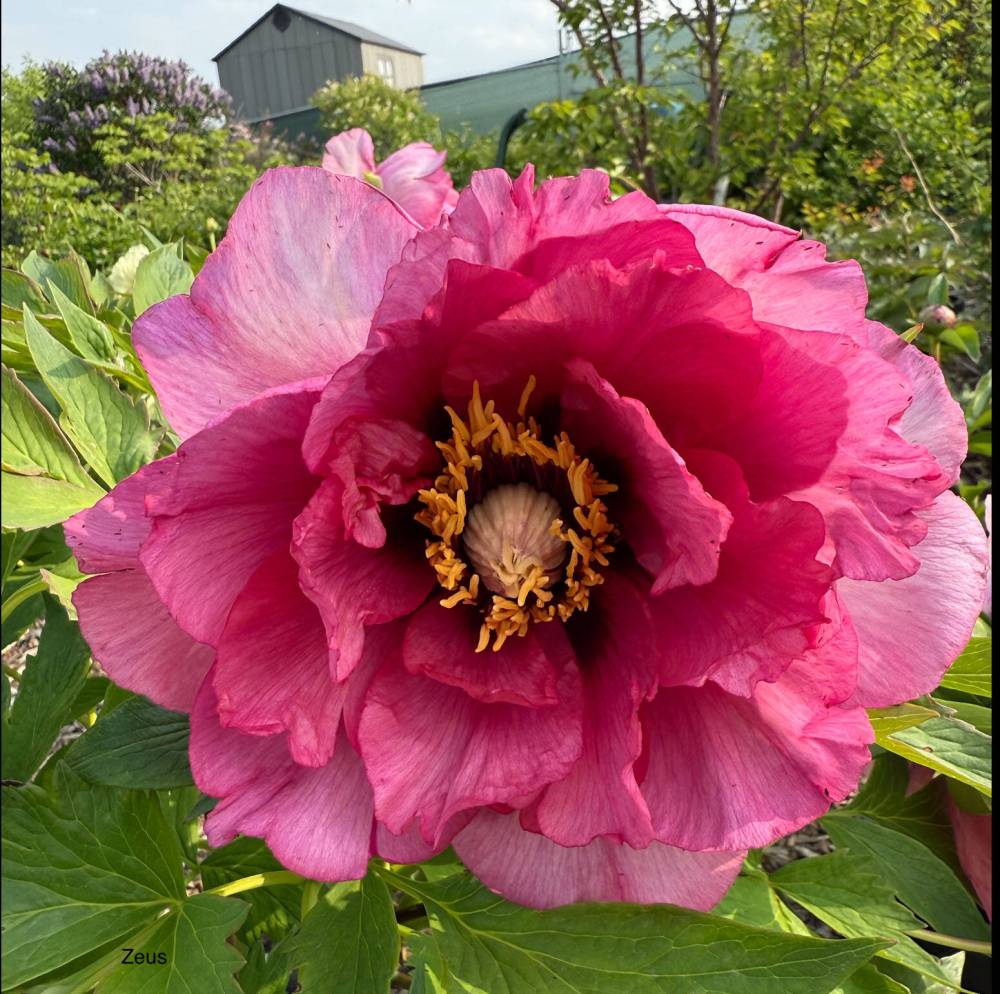
Myra Froc photo
This lovely Lutea hybrid woody peony is a tender plant in need of winter protection.
When potted plants are overwintered in a garage, it’s important to not place them directly on a cement floor. Keep them on a shelf or table or on a piece of plywood.
Nikolai has also overwintered fig trees outdoors. He starts by digging a small trench along the south side of his house next to the foundation. He places the plant into an unsealed plastic bag and tilts the plant into the shallow trench (about 30-cm deep) and then covers it with about 10-30 cm of soil. Next, he places three or four bags of leaves on top which he covers with snow once it arrives.
Another method for overwintering a tender plant is to enclose it with a wire cage which is then filled to the top with shredded leaves, ensuring complete coverage of the plant. The best material for the enclosure is hardware cloth fencing. It is essential to secure the hardware cloth fencing firmly into the ground with wooden stakes on the inside of the cage. I’ve had good success overwintering tender plants such as Ruby Slippers Oakleaf Hydrangea (Zone 4B) with this method.
But Myra and Gene Froc take a different approach altogether for overwintering their vast number of tender plants. They live in the Qu’Appelle Valley (Zone 3A) north of Regina where they grow tender roses and specialty peonies such as Suffruticosa and Lutea hybrid woody (tree) peonies — 210 in all — along with several hundred herbaceous peonies including Itoh peonies. Overall, they grow more than 700 peonies.
The Frocs cut their herbaceous peonies to the ground in autumn. Most are hardy enough to withstand the winter without added protection. “Gardeners will find that Itoh peonies are a little more tender than most herbaceous types,” says Myra Froc, former president of the Prairie Peony Society. “Some might need protection the first few years.” Mostly the Frocs are concerned with protecting their collection of woody peonies which are typically classified as Zone 4 or higher. Their area is classified as Zone 3A.

Myra Froc photo
Step 1: place a pail or barrel over the plants. Step 2: cover the garden with an insulated tarp, securing it with bricks.
“Due to potential freeze-thaw cycles during a forecasted warmer winter, we are covering everything with tarps,” says Myra. Here’s how they protect their specialty peonies. (This simple method will also work for overwintering many types of tender plants.)
Step 1 is to remove the leaves from the woody peonies. Plastic barrels that have been sawed in half are placed over the large, older peonies. Smaller, younger peonies are covered with a five-gallon pail.
“We then cover the whole garden area with oversized insulated construction tarps which are held down with tent pegs, stones or bricks,” says Myra. The purpose of the pail is to prevent branch breakage from the weight of the tarp and snow cover. “The pails have very little insulation value, but they do protect against wind damage and desiccation.” Old styrofoam coolers can also be used, says Myra.
“The insulated tarp must be a large one because of the law of thermodynamics which says ground heat is better conserved over a large area. And don’t cut them up to make smaller ones because you lose insulating value.” The Frocs remove the tarps in spring once all danger of frost has passed.
“We have lost zero woody (tree) peonies since we started using this method 17 years ago,” says Myra.

Bernie Nikolai photo
To overwinter a tender plant, place it in an unsealed plastic bag in a shallow trench and cover with bags of leaves.
Gene Froc is a geotechnical engineer and former vice-president of the Prairie Peony Society. He has collected data over the years using temperature sensors to compare the effectiveness of overwintering plants under leaves, bare tarps and snow-covered tarps.
“It may be surprising that extreme freeze-thaw cycles are more damaging to tender plants than the coldest temperatures,” says Gene. It’s his experience that using insulated boxes is less efficient than going with insulated construction tarps.

“The engineering principle (thermodynamics) behind using an insulated tarp system is to treat the underlying soil as a heat sink,” says Gene. “If you cover it with an insulated tarp, the warmer temperatures of the soil help keep the air trapped underneath the tarp warmer than the air outside the tarp.
“The insulation does not necessarily prevent the trapped air from freezing — it just keeps it much warmer. So, while the soil underneath the insulated tarp will still freeze when outside temperatures get very cold, its temperature is always warmer than the air outside the tarp. The same thermodynamic principle is used for modern-day heat pump systems.”
The width and thickness of the tarp is significant. “The temperature difference between the outside air and the air under the tarps is directly proportional to the insulation thickness and size of the area covered,” says Gene. “It is quite amazing that an insulated tarp thickness of only one-quarter inch (6.35 millimetres) spread over an area of 12-by-24 feet (3.7-by-7.3 metres) has major positive effects.”

Colleen Zacharias / Free Press
This Zone 4B Oakleaf Hydrangea has a ring of hardware cloth fencing, and is filled with leaves for winter protection.
Where can you find insulated construction tarps? The Frocs buy theirs at Princess Auto where they just happen to be on sale until Nov. 2. See you there!
colleenizacharias@gmail.com
Colleen Zacharias
Gardening columnist
Colleen Zacharias writes about many aspects of gardening including trends, plant recommendations, and how-to information that is uniquely relevant to Prairie gardeners. She has written a column for the Free Press since 2010 and pens the monthly newsletter Winnipeg Gardener. Read more about Colleen.
Every piece of reporting Colleen produces is reviewed by an editing team before it is posted online or published in print — part of the Free Press‘s tradition, since 1872, of producing reliable independent journalism. Read more about Free Press’s history and mandate, and learn how our newsroom operates.
Our newsroom depends on a growing audience of readers to power our journalism. If you are not a paid reader, please consider becoming a subscriber.
Our newsroom depends on its audience of readers to power our journalism. Thank you for your support.
Colleen Zacharias
Gardening columnist
Colleen Zacharias writes about many aspects of gardening including trends, plant recommendations, and how-to information that is uniquely relevant to Prairie gardeners. She has written a column for the Free Press since 2010 and pens the monthly newsletter Winnipeg Gardener. Read more about Colleen.
Every piece of reporting Colleen produces is reviewed by an editing team before it is posted online or published in print — part of the Free Press‘s tradition, since 1872, of producing reliable independent journalism. Read more about Free Press’s history and mandate, and learn how our newsroom operates.
Our newsroom depends on a growing audience of readers to power our journalism. If you are not a paid reader, please consider becoming a subscriber.
Our newsroom depends on its audience of readers to power our journalism. Thank you for your support.
Advertisement Advertise With Us
Advertisement Advertise With Us