Doing these fall garden chores will make your spring easier

Advertisement

Advertise with us

We tend to think that fall is when the garden winds down, and spring is when the work begins. But there are several chores that, if completed now, will make your spring job much easier.

Read this article for free:


or

Already have an account? Log in here »

To continue reading, please subscribe:

Subscribe and receive a limited-edition Free Press branded hat or tote.

Digital Subscription

One year of digital access for only $205*

  • Enjoy unlimited reading on winnipegfreepress.com
  • Read the E-Edition, our digital replica newspaper
  • Access News Break, our award-winning app
  • Play interactive puzzles

*First annual payment billed as $205.00 + GST for one year. This annual subscription will automatically renew at $233.00 + GST every 52 weeks (10% off the regular annual price of $259.35). Offer available to new and qualified returning subscribers only. Cancel any time.

To continue reading, please subscribe:

Add Free Press access to your Brandon Sun subscription for only an additional

$1 for the first 4 weeks*

  • Enjoy unlimited reading on winnipegfreepress.com
  • Read the E-Edition, our digital replica newspaper
  • Access News Break, our award-winning app
  • Play interactive puzzles
Start now

*Your next Brandon Sun subscription payment will increase by $1.00 and you will be charged $17.95 plus GST for four weeks. After four weeks, your payment will increase to $24.95 plus GST every four weeks.

Hey there, time traveller!
This article was published 18/11/2025 (288 days ago), so information in it may no longer be current.

We tend to think that fall is when the garden winds down, and spring is when the work begins. But there are several chores that, if completed now, will make your spring job much easier.

For starters, pulling up weeds by their roots in the fall will dramatically reduce their reappearance when the weather warms up again. I’m practically addicted to a long-handled tool called Grampa’s Weeder, which makes easy work of the task.

While you’re at it, thoroughly rake beds and borders where fungus, black spot or mildew diseases emerged this year. This will help prevent the pathogens from taking hold in the soil and infecting next year’s plants. Dispose of the leaves and debris in the trash.
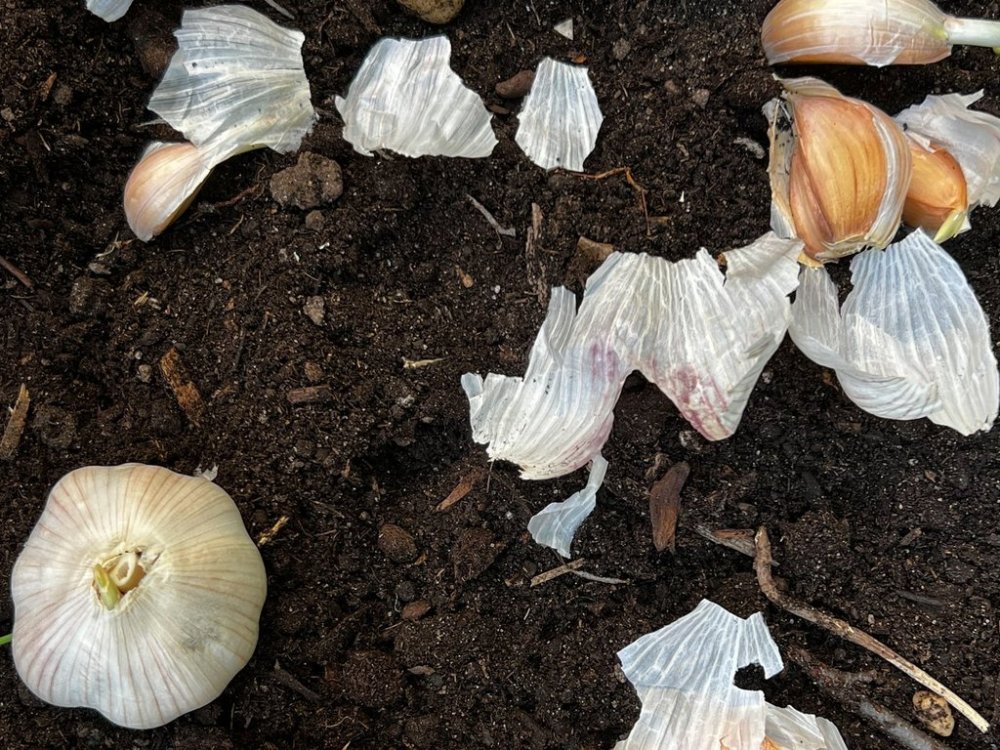
This Oct. 16, 2021, image provided by Jessica Damiano shows garlic bulbs and cloves resting on a cleared garden bed in advance of planting. (Jessica Damiano via AP)

Other disease-preventing measures include removing shriveled, “mummified” fruit from tree branches, and disinfecting tomato cages and plant stakes before storing (use a solution made of 1 part bleach and 9 parts water, or spray with a household disinfectant spray and allow to air dry.)

Clean, sharpen and oil tools now so they’ll be ready when you are. There’s little worse than heading out to plant your new seedlings only to find your spade has rusted over the winter.

Protect your trees and property

If you planted new fruit trees this year, install protective guards around them to prevent mouse and rabbit damage. I’m partial to coiled-plastic trunk wraps, but mesh, wire and higher-end metal tree surrounds are also highly effective.

For safety’s sake, examine tree branches now, and remove any that are split, dead or broken, lest they rip off during winter storms and threaten people and property.

Prepare for new beds

If you’re planning to start new beds next year, save yourself the back-breaking labor of digging up the lawn (or the money spent on renting a sod cutter) by smothering the grass over winter.

Define the future bed and cover the area with large pieces of cardboard or thick layers of newspaper, using landscape staples or rocks to hold it in place. Then, cover it with a few inches of mulch or compost.

The cardboard may be entirely decomposed by spring, but if not, just leave it in place and dig planting holes right through it.

Clear out the old beds

Clear out spent vegetable beds, then lightly turn the soil, incorporating compost, well-rotted manure and, if indicated by a low pH test result, lime. The amendments will work their way deeply into the soil by spring, enriching the root zone to give next year’s crops a natural, nutritional boost.

And for an early-spring gift to yourself, don’t forget to get flower bulbs (and garlic!) into the ground. The longer you wait, the bigger the risk of delayed blooms, but you can keep planting them as long as the soil is soft enough to dig.

___

Jessica Damiano writes weekly gardening columns for the AP and publishes the award-winning Weekly Dirt Newsletter. You can sign up here for weekly gardening tips and advice.

___

For more AP gardening stories, go to https://apnews.com/hub/gardening.

Report Error Submit a Tip

More Stories

Dangerous offender status sought for convicted killer

Erik Pindera 5 minute read Preview

Dangerous offender status sought for convicted killer

Erik Pindera 5 minute read Yesterday at 2:00 AM CDT

Crown prosecutors intend to apply to have a convicted killer, who also admitted his guilt in an assault on a stranger at The Forks and a robbery at a local beer vendor, designated as a dangerous offender.

Daniel Christopher Dumas, who is in his mid-30s, pleaded guilty to assault causing bodily harm and robbery in front of provincial court Judge Donovan Dvorak on Monday for the attacks on June 6 and 7, 2025. He will be sentenced at a later date.

Prosecutor Monique Cam said the Crown plans to apply for a dangerous offender designation for Dumas, which, if granted, could result in him being given an indefinite prison sentence.

“The Crown does intend to make an application at a future date … for a remand for assessment to have Mr. Dumas assessed by a court-ordered assessor for the purpose of pursuing a dangerous offender application,” Cam said.

Read
Yesterday at 2:00 AM CDT

Kevin Klein to run for mayor

1 minute read Updated: Yesterday at 2:18 PM CDT

A former city councillor and provincial cabinet minister says he will enter the race to become Winnipeg’s next mayor.

“I have decided, after some consideration, that I will be throwing my name into the election for mayor. I'm going to go up against Scott Gillingham and we're going to make a race of it,” said Kevin Klein, in a video posted to the Winnipeg Sun website. Klein is the president and CEO of Klein Media Group, which publishes the Winnipeg Sun.

Klein, a former Charleswood-Tuxedo-Westwood councillor and Manitoba Progressive Conservative environment minister, finished third in the 2022 mayoral race with 28,806 votes. Gillingham claimed a narrow victory with 53,663, followed by Glen Murray with 49,272.

In the video, Klein said he had decided not to enter the race weeks ago due to an unspecified health scare that required surgery. After recovering, he said he decided to run.

Provencher Park eyed for new aquatic centre

Malak Abas 4 minute read Preview

Provencher Park eyed for new aquatic centre

Malak Abas 4 minute read Updated: Yesterday at 6:49 PM CDT

Provencher Park may be the next site for a new aquatic centre.

Read
Updated: Yesterday at 6:49 PM CDT

Today’s horoscope

Georgia Nicols 4 minute read Preview

Today’s horoscope

Georgia Nicols 4 minute read 2:00 AM CDT

MOON ALERT: Caution! After 5:15 a.m. today, avoid shopping (except food and gas) and important decisions for the rest of the day. The moon is in Taurus.

ARIES (March 21-April 19)

You might have excellent ideas about your work, job and health. Quite likely, they’ll relate to your finances. You might need to know how much money you need ahead of time? Or you might check out the cost of making home improvements.

TAURUS (April 20-May 20)

Read
2:00 AM CDT

Filtering the worst of our behaviour

Gwynne Dyer 5 minute read 2:00 AM CDT

On Sunday, Aug. 30, a Falcon Heavy rocket delivered the Nancy Grace Roman space telescope onto a direct transfer trajectory to its permanent home at the Lagrange Two Point (L2), 1.5-million km from Earth. In 100 days it will reach its station, power up, and start observing the universe.

Astronomers will use it to try to understand the nature of dark matter, which makes up most of the mass in the universe (but some say may not even exist).

It is expected to find up to 100,000 new exoplanets circling other stars, and may be able to spot ones even smaller than Mars. Current methods can only see much bigger ones.

It will test a new technology called a coronagraph, which may one day be able to detect life on some of those planets by analyzing the light reflected from them. It would be nice to have a better answer to scientist Enrico Fermi’s famous question: “Where is everybody?”

Rare and tough to notice, sarcomas may lurk in the body

Jen Zoratti 12 minute read Preview

Rare and tough to notice, sarcomas may lurk in the body

Jen Zoratti 12 minute read Monday, Aug. 31, 2026

Last summer, Michelle Finley was going about a normal day.

She had just dropped her car off at a garage and was walking back to her office building downtown when, suddenly, she was stopped in her tracks by a searing cramp on the bottom of her right foot.

“It was so painful it took my breath away,” says Finley, now 52. “I stopped and held on to the side of a building for a second — like, it was bringing tears to my eyes.”

Finley thought she had a really bad case of plantar fasciitis. Nine months later she would lose her foot to sarcoma.

Read
Monday, Aug. 31, 2026