It’s not personal, AI… and that’s the problem

Advertisement
Read this article for free:
or
Already have an account? Log in here »
To continue reading, please subscribe:
Digital Subscription
One year of digital access for only $1.44 a week*
- Enjoy unlimited reading on winnipegfreepress.com
- Read the E-Edition, our digital replica newspaper
- Access News Break, our award-winning app
- Play interactive puzzles
*Billed as $5.77 plus GST every four weeks. After 52 weeks, price increases to the regular rate of $19.95 plus GST every four weeks. Offer available to new and qualified returning subscribers only. Cancel any time.
To continue reading, please subscribe:
Add Free Press access to your Brandon Sun subscription for only an additional
$1 for the first 4 weeks*
- Enjoy unlimited reading on winnipegfreepress.com
- Read the E-Edition, our digital replica newspaper
- Access News Break, our award-winning app
- Play interactive puzzles
*Your next Brandon Sun subscription payment will increase by $1.00 and you will be charged $17.95 plus GST for four weeks. After four weeks, your payment will increase to $24.95 plus GST every four weeks.
Read unlimited articles for free today:
or
Already have an account? Log in here »
Hey there, time traveller!
This article was published 13/12/2025 (317 days ago), so information in it may no longer be current.
I have a photo album on my phone called Smile File.
In it are screen shots of all kinds of correspondence from my friends and family, a hall of fame of sorts. Like the text my dad sent me after he dropped me off at the airport to see Chappell Roan in Nashville: “3 songs in H-O-T-T-O-G-O.” Or the funny messages from friends that make me feel like they really know me. Or thoughtful emails from readers letting me know my writing has affected them in some way.
Among my most prized keepers: two notes from two different dear friends, asking me if I would be Auntie Jen to their kids.
Matt Rourke / The Associated Press Files
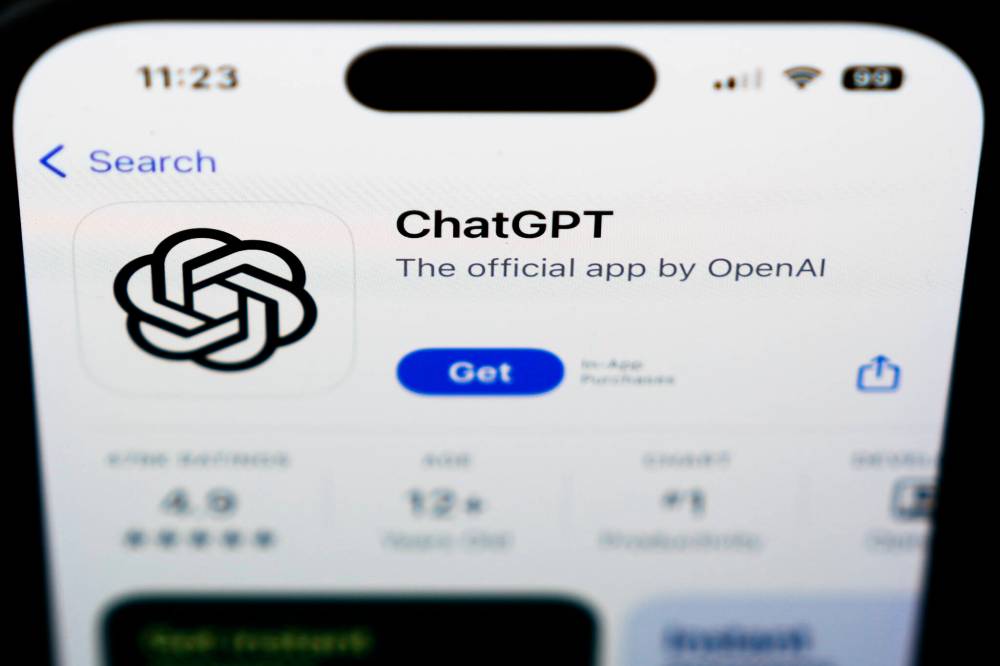
AI can do many things, but creating a heartfelt, personal message isn’t one of them.
I look at my Smile File on the days when my brain is tricking me into thinking nobody likes me or when I worry that I’ve run out of words and maybe I’m actually secretly illiterate.
So, I am not exaggerating when I tell you that it would break my heart to learn that any of these missives were actually written by ChatGPT.
People are offloading all kinds of tasks to chat bots to “save time” and “maximize productivity.” We know that people are using chatbots to write essays at university or to put together slide decks and spreadsheets at work.
But people are also using ChatGPT to compose obituaries, birthday and sympathy texts, wedding vows, speeches. You know, the kinds of personal missives that are supposed to be, well, personal. Sincere and from the heart.
I understand the impulse. Despite being a professional writer, I, too, can be at a loss for words — especially when someone I love is in pain.
It can be so hard to know what to say when everything feels wrong and inadequate. I’m sorry, I’m sorry, I’m sorry. Heart emoji, heart emoji, heart emoji.
And that’s the crux of it, isn’t it? Feeling wrong and inadequate. I wonder if we’re so hung up on saying the “right” thing, the perfect thing, that we’re becoming overly self-conscious communicators who can’t rely — or are made to feel like we can’t rely — on our own brains.
It’s also a byproduct of the modern desire to live a frictionless life. Other people’s emotions are messy and inconvenient; no one can time the death of a parent or their unexpected ER visit with your work schedule. Relationships require effort and maintenance.
Those ideas are at odds with a digital world in which ease, convenience and comfort are a few taps away.
What about greeting cards, you might ask. OK, what about greeting cards? Those still take effort, even if you didn’t write the sentiment inside. Selecting, purchasing and possibly mailing a card — which usually also has a hand-written note or, at the very least, “love” in your person’s penmanship — is an act of thought and care.
Enlisting ChatGPT to compose a “thinking of you” message might smooth out the (temporary, I will add) discomfort of not knowing what to say and potentially getting it wrong. But it will also make you sound like someone else.

Your friends want to hear from you. They want you to show up, however imperfectly. You can rely on your own brain, I promise. I’d rather get an “I’m sorry” or a “girl, that blows” or even an emoji than an uncanny-valley message spit out by a bot.
We will be poorer for it if we outsource our compassion and creativity to a machine that can only ever approximate emotions because it’s never felt any. The machine can’t speak from the heart because it doesn’t have one. ChatGPT can only make you sound more empathetic. It can’t make you be more empathetic.
It’s OK to not know what to say or how to say it. But I also think you actually do know what to say.
And if you truly don’t, find a poem. Or a song lyric. Something written by another human being who has, at the very least, felt what you’re feeling.
jen.zoratti@freepress.mb.ca
Jen Zoratti is a columnist and feature writer working in the Arts & Life department, as well as the author of the weekly newsletter NEXT. A National Newspaper Award finalist for arts and entertainment writing, Jen is a graduate of the Creative Communications program at RRC Polytech and was a music writer before joining the Free Press in 2013. Read more about Jen.
Every piece of reporting Jen produces is reviewed by an editing team before it is posted online or published in print – part of the Free Press‘s tradition, since 1872, of producing reliable independent journalism. Read more about Free Press’s history and mandate, and learn how our newsroom operates.
Our newsroom depends on a growing audience of readers to power our journalism. If you are not a paid reader, please consider becoming a subscriber.
Our newsroom depends on its audience of readers to power our journalism. Thank you for your support.
Jen Zoratti is a columnist and feature writer working in the Arts & Life department, as well as the author of the weekly newsletter NEXT. A National Newspaper Award finalist for arts and entertainment writing, Jen is a graduate of the Creative Communications program at RRC Polytech and was a music writer before joining the Free Press in 2013. Read more about Jen.
Every piece of reporting Jen produces is reviewed by an editing team before it is posted online or published in print – part of the Free Press‘s tradition, since 1872, of producing reliable independent journalism. Read more about Free Press’s history and mandate, and learn how our newsroom operates.
Our newsroom depends on a growing audience of readers to power our journalism. If you are not a paid reader, please consider becoming a subscriber.
Our newsroom depends on its audience of readers to power our journalism. Thank you for your support.
Advertisement Advertise With Us
Advertisement Advertise With Us