Food-waste program hits pay dirt in first year
Initiative diverted 345,700 kg of waste from landfills, looks to expand on success
Advertisement
Read this article for free:
or
Already have an account? Log in here »
To continue reading, please subscribe:
Digital Subscription
One year of digital access for only $1.44 a week*
- Enjoy unlimited reading on winnipegfreepress.com
- Read the E-Edition, our digital replica newspaper
- Access News Break, our award-winning app
- Play interactive puzzles
*Billed as $5.77 plus GST every four weeks. After 52 weeks, price increases to the regular rate of $19.95 plus GST every four weeks. Offer available to new and qualified returning subscribers only. Cancel any time.
To continue reading, please subscribe:
Add Free Press access to your Brandon Sun subscription for only an additional
$1 for the first 4 weeks*
- Enjoy unlimited reading on winnipegfreepress.com
- Read the E-Edition, our digital replica newspaper
- Access News Break, our award-winning app
- Play interactive puzzles
*Your next Brandon Sun subscription payment will increase by $1.00 and you will be charged $17.95 plus GST for four weeks. After four weeks, your payment will increase to $24.95 plus GST every four weeks.
Read unlimited articles for free today:
or
Already have an account? Log in here »
Hey there, time traveller!
This article was published 20/12/2025 (308 days ago), so information in it may no longer be current.
“When was the last day you threw nothing away?”
It’s a question Karrie Blackburn likes to ask people to encourage thought and awareness about how we view waste.
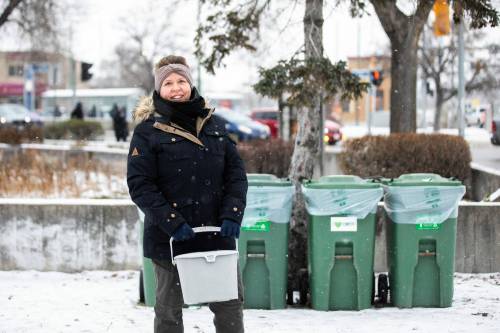
As Winnipeg celebrates one year of success with community food waste drop-off sites, Blackburn — sales and customer service lead with Compost Winnipeg — remains passionate about all things related to composting and saving landfills from more methane-producing waste.

MIKAELA MACKENZIE / FREE PRESS
Karrie Blackburn, Compost Winnipeg sales and customer service lead, says the organization is proud of the Winnipeg community for embracing the food waste drop-off program and working toward a culture of sustainability.
“We are incredibly proud of our community for embracing the food waste drop-off program,” she said. “This program diverts waste, reduces greenhouse gas emissions and fosters a culture of sustainability in our city. The results speak for themselves.”
From October 2024 to October 2025, the initiative diverted 345,700 kilograms of food waste from landfills, showcasing the commitment of Winnipeggers to sustainable practices and environmental stewardship. The Community Food Waste Drop-off Program offered by Compost Winnipeg (a program of the Green Action Centre) in partnership with the City of Winnipeg, allows residents to drop off their food waste for free at 17 designated locations throughout Winnipeg, 24 hours a day, seven days a week.
“The people who are going out of their way to participate have a vested interest in doing it properly,” said Blackburn. “People are wanting to do right by their waste. When given the opportunity, people do want to support green causes, and the bigger picture.”
Compost Winnipeg recently hosted the annual pumpkin drop with Polo Park. The event allows Winnipeggers to toss pumpkins off the CF Polo Park parkade into a compost bin below.
“We diverted 40 tons of pumpkins; last year: 19 tons,” Blackburn said about the initiative she started.
While the rotten pumpkins became compost, the good ones were donated to the Leftovers Foundation to be made into delicious dishes for distribution to under-served communities.
With continued and growing interest in waste management and composting, Blackburn reminds people that everyone can make a positive difference. With her own composting journey, she realized that quickly.
“Change needed to come from my household. What can I change that will have the greatest impact? Composting. What really changed for me is changing what I was calling waste. It was a definition change. We hear ‘it’s garbage’, but it’s a resource, so we need to look at resource management. Where am I putting my food scraps?” she continued, adding that it’s also important to get a better understanding of recycling programs.
When she committed to composting, Blackburn saw immediate and impressive results.
“My garbage became next to nothing. There was no food waste. It just doesn’t fill up. What was an especially helpful thing for me was asking, ‘what can I do differently today and again tomorrow?’ Build new habits and new behaviours that will have an impact henceforth.”
The enthusiasm that came from changes at home followed her to her work with Compost Winnipeg.
Initially there was some skepticism about the food waste program, Blackburn recalled, and concern about pests, odours and vandalism.
“Those fears are not founded in fact — feelings are not necessarily factual,” she said.
She said people are using the bins for their intended purpose, and emphasized the importance of community co-operation to the program’s goal of keeping food waste out of landfills.
She added that the success of the program will soon see more community partners and drop-off locations as it expands.
“This is what I wanted to see. Winnipeggers needed better access composting. They’re here for it.”
“We hear ‘it’s garbage’, but it’s a resource, so we need to look at resource management. Where am I putting my food scraps?”
Each site is gaining in popularity and seeing an increase in bins to accommodate the neighbourhood needs. The drop-off sites are monitored with the help of community bin caretakers and drivers who check the locations four days per week, take photos and gather data on the bins’ contents.
Blackburn encourages Winnipeggers to try it for a week, and see for themselves how much doesn’t need to be sent to the landfill.
“Have the interaction with your waste in a different way. Recognize how we talk about our waste — ‘we threw it away.’ Object permanence — just because it’s not in your presence doesn’t mean it doesn’t exist. The landfill is being filled up twice as much as necessary. A landfill is not a dump; it’s a highly engineered site,” she said, noting the importance of not discarding batteries, electronics and other items that increase toxicity levels.
Thanks to the efforts of the public, contamination levels have remained low, ensuring that the collected food waste can be efficiently processed and repurposed as compost. This achievement highlights the public’s understanding of the program and their commitment to making a difference to the environment.
As a result of the program’s success and to further encourage participation, Compost Winnipeg is working on expanding the food waste drop-off program to more neighbourhoods. In addition, some existing locations will be moved to improve access and increase convenience for residents, making it easier than ever to participate.
Accepted items for food waste drop-off include, among other things: fruit and vegetable scraps, meat, fish and bones, solid fats, dairy products, eggshells, bread, pasta, rice, grains, beans, cereal, baked goods, desserts, nuts, seeds, chips, candy, coffee grounds and filters, tea leaves and tea bags. In addition, food-soiled paper products like paper towels, napkins and paper plates, and even greasy takeout food bags and pizza boxes (cut or broken down to create more space) can be disposed of at those locations.
Items that are not accepted include: plastic bags and containers, coffee cups, glass and metal. Blackburn reminds residents that yard waste is not accepted, as it takes up a lot of space, and the focus of the program is food waste only.
The free program is designed to make it as easy as possible for residents to take part. To accommodate people’s practices, there are different ways to dispose of the waste when arriving at the sites.

Blackburn said food waste can be dropped directly in the bins. She asked that people use compostable bags, paper bags or newspaper wrapping when taking bagged compost to bins, and noted that bins are all already pre-bagged.
“Everything stays really contained. Whatever your level of comfort, we are meeting people where they are.”
Winnipeg residents can now more easily make a measurable impact on the environment with their daily choices, a vital step towards a greener world.
Visit winnipeg.ca/foodwaste.
fpcity@freepress.mb.ca
Related Articles
Backlog of 2,100 Winnipeg homes waiting for garbage, recycling cart replacements

Advertisement Advertise With Us
Advertisement Advertise With Us