The rise of deepfake cyberbullying poses a growing problem for schools

Advertisement

Advertise with us

Schools are facing a growing problem of students using artificial intelligence to transform innocent images of classmates into sexually explicit deepfakes.

Read this article for free:


or

Already have an account? Log in here »

To continue reading, please subscribe:

Subscribe and receive a limited-edition Free Press branded hat or tote.

Digital Subscription

One year of digital access for only $205*

  • Enjoy unlimited reading on winnipegfreepress.com
  • Read the E-Edition, our digital replica newspaper
  • Access News Break, our award-winning app
  • Play interactive puzzles

*First annual payment billed as $205.00 + GST for one year. This annual subscription will automatically renew at $233.00 + GST every 52 weeks (10% off the regular annual price of $259.35). Offer available to new and qualified returning subscribers only. Cancel any time.

To continue reading, please subscribe:

Add Free Press access to your Brandon Sun subscription for only an additional

$1 for the first 4 weeks*

  • Enjoy unlimited reading on winnipegfreepress.com
  • Read the E-Edition, our digital replica newspaper
  • Access News Break, our award-winning app
  • Play interactive puzzles
Start now

*Your next Brandon Sun subscription payment will increase by $1.00 and you will be charged $17.95 plus GST for four weeks. After four weeks, your payment will increase to $24.95 plus GST every four weeks.

Hey there, time traveller!
This article was published 21/12/2025 (289 days ago), so information in it may no longer be current.

Schools are facing a growing problem of students using artificial intelligence to transform innocent images of classmates into sexually explicit deepfakes.

The fallout from the spread of the manipulated photos and videos can create a nightmare for the victims.

The challenge for schools was highlighted this fall when AI-generated nude images swept through a Louisiana middle school. Two boys ultimately were charged, but not before one of the victims was expelled for starting a fight with a boy she accused of creating the images of her and her friends.
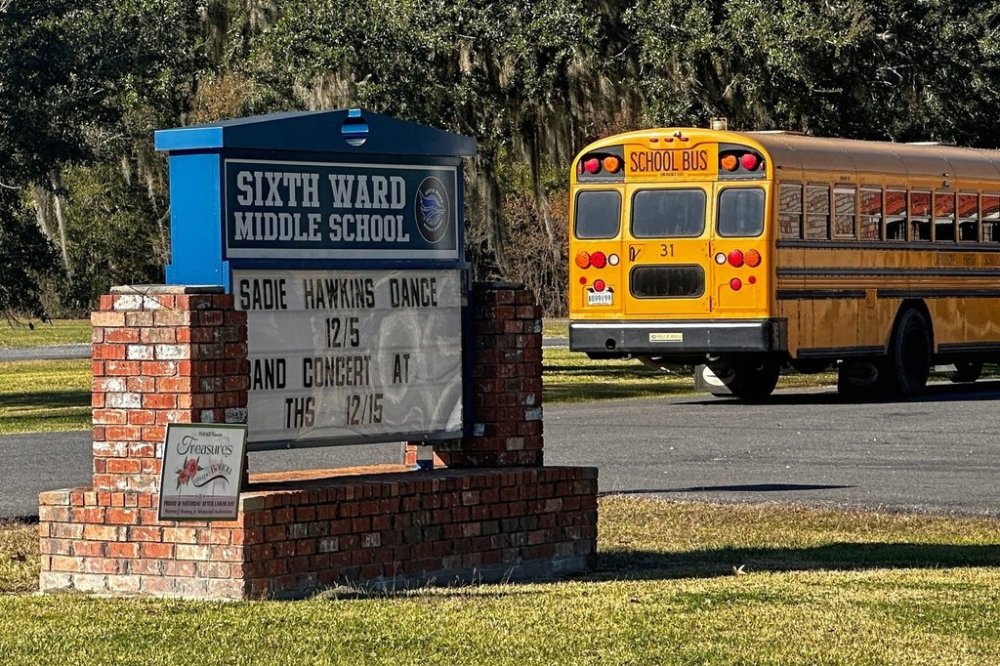
A school bus carries children at the end of a school day at Sixth Ward Middle School in Thibodaux, La., on Dec, 11, 2025. (AP Photo/Stephen Smith)

“While the ability to alter images has been available for decades, the rise of A.I. has made it easier for anyone to alter or create such images with little to no training or experience,” Lafourche Parish Sheriff Craig Webre said in a news release. “This incident highlights a serious concern that all parents should address with their children.”

Here are key takeaways from AP’s story on the rise of AI-generated nude images and how schools are responding.

More states pass laws to address deepfakes

The prosecution stemming from the Louisiana middle school deepfakes is believed to be the first under the state’s new law, said Republican state Sen. Patrick Connick, who authored the legislation.

The law is one of many across the country taking aim at deepfakes. In 2025, at least half the states enacted legislation addressing the use of generative AI to create seemingly realistic, but fabricated, images and sounds, according to the National Conference of State Legislatures. Some of the laws address simulated child sexual abuse material.

Students also have been prosecuted in Florida and Pennsylvania and expelled in places like California. One fifth grade teacher in Texas also was charged with using AI to create child pornography of his students.

Deepfakes become easier to create as technology evolves

Deepfakes started as a way to humiliate political opponents and young starlets. Until the past few years, people needed some technical skills to make them realistic, said Sergio Alexander, a research associate at Texas Christian University who has written about the issue.

“Now, you can do it on an app, you can download it on social media, and you don’t have to have any technical expertise whatsoever,” he said.

He described the scope of the problem as staggering. The National Center for Missing and Exploited Children said the number of AI-generated child sexual abuse images reported to its cyber tipline soared from 4,700 in 2023 to 440,000 in just the first six months of 2025.

Experts fear schools aren’t doing enough

Sameer Hinduja, the co-director of the Cyberbullying Research Center, recommends that schools update their policies on AI-generated deepfakes and get better at explaining them. That way, he said, “students don’t think that the staff, the educators are completely oblivious, which might make them feel like they can act with impunity.”

He said many parents assume that schools are addressing the issue when they aren’t.

“So many of them are just so unaware and so ignorant,” said Hinduja, who is also a professor in the School of Criminology and Criminal Justice at Florida Atlantic University. “We hear about the ostrich syndrome, just kind of burying their heads in the sand, hoping that this isn’t happening amongst their youth.”

Trauma from AI deepfakes can be particularly harmful

AI deepfakes are different from traditional bullying because instead of a nasty text or rumor, there is a video or image that often goes viral and then continues to resurface, creating a cycle of trauma, Alexander said.

Many victims become depressed and anxious, he said.

“They literally shut down because it makes it feel like, you know, there’s no way they can even prove that this is not real — because it does look 100% real,” he said.

Parents are encouraged to talk to students

Parents can start the conversation by casually asking their kids if they’ve seen any funny fake videos online, Alexander said.

Take a moment to laugh at some of them, like Bigfoot chasing after hikers, he said. From there, parents can ask their kids, “Have you thought about what it would be like if you were in this video, even the funny one?” And then parents can ask if a classmate has made a fake video, even an innocuous one.

“Based on the numbers, I guarantee they’ll say that they know someone,” he said.

If kids encounter things like deepfakes, they need to know they can talk to their parents without getting in trouble, said Laura Tierney, who is the founder and CEO of The Social Institute, which educates people on responsible social media use and has helped schools develop policies. She said many kids fear their parents will overreact or take their phones away.

She uses the acronym SHIELD as a roadmap for how to respond. The “S” stands for “stop” and don’t forward. “H” is for “huddle” with a trusted adult. The “I” is for “inform” any social media platforms on which the image is posted. “E” is a cue to collect “evidence,” like who is spreading the image, but not to download anything. The “L” is for “limit” social media access. The “D” is a reminder to “direct” victims to help.

“The fact that that acronym is six steps I think shows that this issue is really complicated,” she said.

___

The Associated Press’ education coverage receives financial support from multiple private foundations. AP is solely responsible for all content. Find AP’s standards for working with philanthropies, a list of supporters and funded coverage areas at AP.org.

Report Error Submit a Tip

More Stories

The rise of deepfake cyberbullying poses a growing problem for schools

Heather Hollingsworth, The Associated Press 5 minute read Preview

The rise of deepfake cyberbullying poses a growing problem for schools

Heather Hollingsworth, The Associated Press 5 minute read Sunday, Dec. 21, 2025

Schools are facing a growing problem of students using artificial intelligence to transform innocent images of classmates into sexually explicit deepfakes.

The fallout from the spread of the manipulated photos and videos can create a nightmare for the victims.

The challenge for schools was highlighted this fall when AI-generated nude images swept through a Louisiana middle school. Two boys ultimately were charged, but not before one of the victims was expelled for starting a fight with a boy she accused of creating the images of her and her friends.

“While the ability to alter images has been available for decades, the rise of A.I. has made it easier for anyone to alter or create such images with little to no training or experience,” Lafourche Parish Sheriff Craig Webre said in a news release. “This incident highlights a serious concern that all parents should address with their children.”

Read
Sunday, Dec. 21, 2025

Telekinetic teen hits small screen

Denise Duguay 4 minute read Preview

Telekinetic teen hits small screen

Denise Duguay 4 minute read 2:00 AM CDT

At desperate times like these, it’s good to be reminded that one person can make a difference. A telekinetic high schooler, grieving lover, ambitious law firm, frantic father and spiritual climber offer a variety of inspiring lessons in this new offering of TV recommendations.

Carrie (series premières Wednesday, Oct. 7 on Prime Video)Famously over-the-top filmmaker Brian De Palma (Phantom of the Paradise, Dressed to Kill, Scarface) directed the 1976 Carrie into its status as one of the scariest films of the time and beyond. It became better known than the debut horror novel by Stephen King from which it was adapted. It even trumped the three adaptations that followed. This new TV series looks ready to challenge that supremacy. Taking the title role made famous by Sissy Spacek, Manitoba actress Summer H. Howell (see Randall King’s interview at wfp.to/carrie) plays a homeschooler thrilled to finally be allowed to attend public high school. But when the mean girls begin circling and blood manifests in scary new ways, the new girl’s telekinetic potential blossoms in spectacular fashion. Also of horrific note as Halloween approaches: Below (Netflix miniseries premièring Thursday) stars Josh Hartnett as a fisherman trying to protect his family and town from a mysterious sea creature; Eternally Yours (sitcom premièring Thursday, Oct. 8, on CBS/Global) is a new vampire comedy; and Crystal Lake (thriller series premières Oct. 15 on Crave) stars Linda Cardellini (DTF St. Louis) as Pam Voorhees, single mom of a tormented kid named Jason, in this Friday the 13th origin story. Boo!


Small Prophets (series Canadian première Wednesday, Oct. 7, on Apple TV)Canadian fans of British TV have been champing at the bit for this quirky series since its acclaimed U.K. première in February. It’s a shaggy, quietly hilarious character study in the vein of Detectorists (2014-22, AcornTV), both of which were created by Mackenzie Crook (Pirates of the Caribbean), who also starred in Detectorists and plays a supporting role in Small Prophets. When the new story opens, Michael Sleep (Detectorists’ Pearce Quigley) is living a life of quiet desperation, visiting his father (Sir Michael Palin) and pining for the return of his disappeared beloved, Clea. Until, that is, Dad shares a loony alchemical recipe that sparks hope in Michael that he might be able to summon spirits to then summon Clea to … the garden shed? Not as creepy as it sounds? A tale of hope, frustratingly indirect action, meddlesome and ineffectual neighbours and, of course, true, true love.

Read
2:00 AM CDT

Pimp sentenced to 11 years in prison

Erik Pindera 5 minute read Preview

Pimp sentenced to 11 years in prison

Erik Pindera 5 minute read 2:00 AM CDT

A man who picked up a vulnerable 17-year-old child-welfare ward on the streets of Winnipeg and coerced her into providing sexual services for several months has been sent to prison for more than a decade.

After a trial, Hassan Kargbo, who’s in his early 30s, was found guilty of sexual exploitation, making child sexual abuse and exploitation material, receiving a material benefit from sexual services provided by a person under 18, procuring a person under 18 and advertising sexual services.

Provincial court Judge Julie Frederickson sentenced him to 11 years behind bars late last month.

“Mr. Kargbo picked up a young Indigenous girl walking over the Osborne Street bridge and quickly got her involved in drug use and escorting,” Frederickson said in a written decision.

Read
2:00 AM CDT

A Selkirk woman was sentenced to two-and-a-half years in prison last week for nearly $500,000 in tax fraud, the Canada Revenue Agency says

Michele Gabrielle pleaded guilty to one count of fraud over $5,000 in provincial court in Selkirk on Friday, the CRA says.

The tax agency had uncovered a scheme in which Gabrielle fraudulently claimed Manitoba tax credits from 2016 and 2019. She also filed and amended returns for two family members and a romantic partner, using their names to commit further fraud.

She made false claims in 22 of her own returns and 33 returns file or amended on behalf of others, the CRA says.

Puzzles Palace

1 minute read Monday, Jul. 27, 2026

To solve our puzzles, please subscribe with this special offer: |

Former host/VJ Rick Campanelli revisits his gambling addiction in new memoir

Jen Zoratti 7 minute read Preview

Former host/VJ Rick Campanelli revisits his gambling addiction in new memoir

Jen Zoratti 7 minute read Yesterday at 6:00 AM CDT

To many Canadians, veteran media personality Rick Campanelli is better known as Rick the Temp, the energetic, baby-faced intern-turned-VJ on MuchMusic in the 1990s and early 2000s.

But behind that winning smile was a much darker reality.

In his new memoir, Tempted: My Story, released last month via HarperCollins Canada and co-written with John Meyer, Campanelli, 56, opens up for the first time about his struggles with a serious — and secret — gambling addiction, which reached its nadir in 2008 when the then-host of Entertainment Tonight Canada was detained by U.S. Homeland Security for unpaid casino debts on a flight back from Las Vegas.

The Free Press caught up with Campanelli in advance of his Winnipeg launch Monday evening at McNally Robinson Grant Park. This interview has been lightly edited for length and clarity.

Read
Yesterday at 6:00 AM CDT