Knock, knock, who’s there? B.C. biologists identify unique sounds of 8 fish species

Advertisement

Advertise with us

There are grunts and growls, knocks and croaks — but the wild sounds detected by a team of British Columbia researchers don't belong to any of the province's famous forest creatures.

Read this article for free:


or

Already have an account? Log in here »

To continue reading, please subscribe:

Subscribe and receive a limited-edition Free Press branded hat or tote.

Digital Subscription

One year of digital access for only $205*

  • Enjoy unlimited reading on winnipegfreepress.com
  • Read the E-Edition, our digital replica newspaper
  • Access News Break, our award-winning app
  • Play interactive puzzles

*First annual payment billed as $205.00 + GST for one year. This annual subscription will automatically renew at $233.00 + GST every 52 weeks (10% off the regular annual price of $259.35). Offer available to new and qualified returning subscribers only. Cancel any time.

To continue reading, please subscribe:

Add Free Press access to your Brandon Sun subscription for only an additional

$1 for the first 4 weeks*

  • Enjoy unlimited reading on winnipegfreepress.com
  • Read the E-Edition, our digital replica newspaper
  • Access News Break, our award-winning app
  • Play interactive puzzles
Start now

*Your next Brandon Sun subscription payment will increase by $1.00 and you will be charged $17.95 plus GST for four weeks. After four weeks, your payment will increase to $24.95 plus GST every four weeks.

Hey there, time traveller!
This article was published 09/01/2026 (267 days ago), so information in it may no longer be current.

There are grunts and growls, knocks and croaks — but the wild sounds detected by a team of British Columbia researchers don’t belong to any of the province’s famous forest creatures.

The noises are made by fish off coastal B.C., and the biologists say they have identified the unique sounds made by eight different species.

The University of Victoria researchers used an underwater microphone to eavesdrop on rockfish and other species near the community of Bamfield in Barkley Sound, on the southwest coast of Vancouver Island.
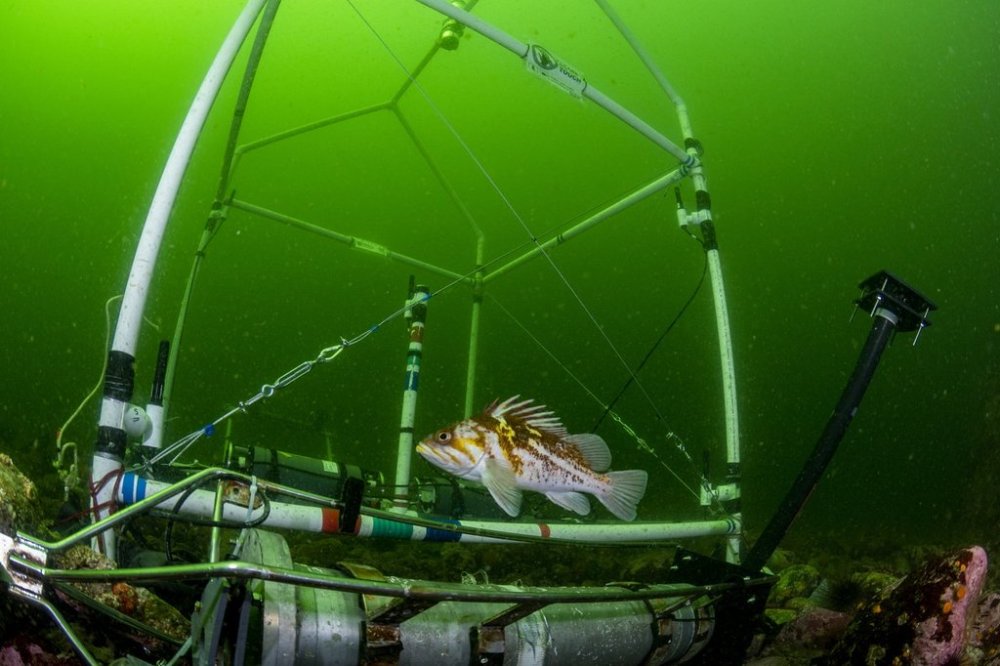
A copper rockfish swims near an underwater microphone device in this undated handout photo. THE CANADIAN PRESS/Handout, Shane Gross (Mandatory Credit)

They developed a machine learning model that examined the unique characteristics of the fish noises, and were able to differentiate those made by separate species — including those that are closely related — with high accuracy. 

“This research project was really exciting,” said Darienne Lancaster, the University of Victoria PhD candidate who led the project. “Some of (the fish) have never been recorded as making these sounds before.” 

The research was published last month in the Journal of Fish Biology.

They identified sounds for black, quillback, copper, canary and vermillion rockfish, as well as ling cod, kelp greenling and pile perch that commonly occupy B.C.’s rocky reefs. 

Researchers listened to the knocking and grunting noises the fish made to see if they could pinpoint them to the exact species. 

Some species’ grunts sounded more like croaks or growls, and identifying sound characteristics like length and frequency helped separate the noises made by different fish. 

Lancaster said identifying the unique sounds made by the fish could help scientists understand more about their behaviour. 

The team recorded video of the fish, and when paired with the audio recordings they saw a connection between the sounds the fish made and their actions that followed. 

For example, some fish, like the copper rockfish, made knocking sounds while they chased prey along the ocean floor, but sounded different when it was them being hunted. 

“We learned that both copper and quillback rockfish make a lot more grunting type sounds when they’re running away from predators,” Lancaster said. 

She said that while her research project identified sounds for eight species, there are dozens more that could be identified off B.C.’s coast, including 41 species of rockfish. 

Lancaster said if researchers can tell which fish species are in an area based on the noises they make, it could help conservation and fisheries monitoring efforts in the province, by identifying the presence of certain fish without having to catch them.

“We can just go out, have a fish sound detector, and know that there’s, say, eight different species in that particular location. And that’s really important because then we can start to make conservation objectives like marine protected areas for those very vulnerable fish species,” she said. 

Her team wants to create a “fish sound detector” to tell which fish are in a certain area based on acoustic data, which could help track changes in fish populations, she said. 

They also plan to research in different regions of B.C. to see if fish have a different “accent” or “dialect” depending on their location. 

“I think this project is really important for people in B.C. and just (fish) management in general along the B.C. coast,” Lancaster said. “If we can go out and put a simple microphone down in the water and know what species are living there, it’s a really great non-invasive way to start to count these fish.”

This report by The Canadian Press was first published Jan. 9, 2025. 

Report Error Submit a Tip

More Stories

Mayoral candidate Vogiatzakis criticized for living outside Winnipeg

Malak Abas 4 minute read Preview

Mayoral candidate Vogiatzakis criticized for living outside Winnipeg

Malak Abas 4 minute read Updated: Yesterday at 6:03 PM CDT

A mayoral hopeful took heat from other candidates Friday for living outside Winnipeg while running in the civic election.

Mike Vogiatzakis’s primary residence is in the Rural Municipality of St. Andrews, about 25 kilometres north of Winnipeg — a community with its own mayor and councillors.

But the funeral director said he owns a home in Winnipeg where he divides his time, and he would move to the city full-time if elected mayor.

“It doesn’t matter where a person lives. Why are we dividing St. Andrews and Manitoba and Winnipeg? I’ve met the criteria to run for mayor,” Vogiatzakis said Friday morning.

Read
Updated: Yesterday at 6:03 PM CDT

A spiritual vision will help anchor a health civic outlook

John Longhurst 5 minute read 2:01 AM CDT

We have an election coming up. With that in mind, the Free Press asked some of their columnists to write about the challenges ahead and how the city can become better.

For Tom Brodbeck, the main challenge is finances — and how candidates will pay for their many promises for fixing roads, improving public safety and making transit better.

Rebecca Chambers said that the concerns of inner-city residents need to be taken seriously by those who aspire to work at city hall.

Niigaan Sinclair said the most pressing issue in Winnipeg isn’t construction projects, light-rail transit, public safety, taxes or social services. For him, it’s the city’s relationship with Indigenous people.

What’s luck got to do with it?

Tim Kist 5 minute read 2:01 AM CDT

We all seek certainty in our daily lives. We expect if we make a decision, the outcome will be just as we planned: a direct correlation between the decision and result.

You, as a business leader, seek the same certainty from the decisions you make. And sometimes, the result is what was expected. Sometimes, it isn’t.

The big question is: why is it so difficult to achieve the business results you expect when you carefully craft your plans and seemingly make good decisions?

The truth is we cannot predict the future. This means we almost never know precisely how customers will respond to a sales quote, what competitors are planning, and a myriad of other external variables at play.

Jets bench boss Arniel talks rebuilding from last season’s struggles

Mike McIntyre and Ken Wiebe 12 minute read Preview

Jets bench boss Arniel talks rebuilding from last season’s struggles

Mike McIntyre and Ken Wiebe 12 minute read Thursday, Oct. 1, 2026

Scott Arniel has a lot on his plate these days.

But the head coach of the Winnipeg Jets took some time Thursday to sit down with Free Press hockey writers Mike McIntyre and Ken Wiebe to discuss a number of topics on the eve of a new hockey season. This interview has been condensed and edited for clarity.

Wiebe: What was the evaluation of last season like? What did you personally do in an attempt to improve after going from first-overall to 26th-overall?

I just went back and looked at things and made sure my communication was where it needed to be with my players. Was my communication where it needed to be with my boss, with my general manager (Kevin Cheveldayoff)? How our coaching staff worked. How we handled highs and lows. Things I felt I could have done better.

Read
Thursday, Oct. 1, 2026

Brandonmeat packer thriving on its own

Abiola Odutola 3 minute read Preview

Brandonmeat packer thriving on its own

Abiola Odutola 3 minute read 2:01 AM CDT

BRANDON — Canada Packers has strengthened its business and laid the foundation for future growth during its first year as an independent company, its president says.

The Brandon-based pork producer, separated from Maple Leaf Foods in October 2025, established its own leadership, strategy, systems, culture and identity while continuing operations across its hog production farms and regional hog barns in southern and eastern Manitoba.

The company’s first year was focused on building a successful standalone business while continuing to serve customers, communities and shareholders, president Dennis Organ said.

“Market conditions over the past year have been more challenging than we anticipated when we became a separate entity,” he said in an email. “Despite that, we continued to execute against our priorities, including increasing processing volumes, maintaining disciplined operations and strengthening the business.”

Read
2:01 AM CDT

Letters, Oct. 3

7 minute read 2:01 AM CDT

A morning in the life …

My very first lesson does not start when I walk into that lecture hall, oh no — it starts long before. It begins when I walk to my car, check the estimated arrival time to the University of Manitoba and hope that Winnipeg traffic agrees with it.

A drive that appears completely manageable changes almost immediately when I’m greeted by a tsunami of orange pylons and a line of cars that appears to go on forever. Traffic moves by the inch, lanes magically disappear and the detour I took yesterday now has a detour of its own. These factors make me do a calculation that I have become all too familiar with. How late can I arrive and still find parking, run to my class across campus and get to class with enough time left to make it worth it?

I have grown used to people saying, “Why not just leave earlier?” I do. But when I’m already leaving for my 8:30 a.m. class at 7 a.m., there’s only so much I can do. This drive that some would think is relaxing is one that feels like an assignment that I didn’t know I had to complete and is due at 8:30 a.m.