

A sea turtle with 3 flippers swims free after Florida rehab, now followed by satellite
Advertisement
Read this article for free:
or
Already have an account? Log in here »
To continue reading, please subscribe:
Monthly Digital Subscription
$1 per week for 24 weeks*
- Enjoy unlimited reading on winnipegfreepress.com
- Read the E-Edition, our digital replica newspaper
- Access News Break, our award-winning app
- Play interactive puzzles
*Billed as $4.00 plus GST every four weeks. After 24 weeks, price increases to the regular rate of $19.95 plus GST every four weeks. Offer available to new and qualified returning subscribers only. Cancel any time.
Monthly Digital Subscription
$4.99/week*
- Enjoy unlimited reading on winnipegfreepress.com
- Read the E-Edition, our digital replica newspaper
- Access News Break, our award-winning app
- Play interactive puzzles
*Billed as $19.95 plus GST every four weeks. Cancel any time.
To continue reading, please subscribe:
Add Free Press access to your Brandon Sun subscription for only an additional
$1 for the first 4 weeks*
*Your next subscription payment will increase by $1.00 and you will be charged $16.99 plus GST for four weeks. After four weeks, your payment will increase to $23.99 plus GST every four weeks.
Read unlimited articles for free today:
or
Already have an account? Log in here »
JUNO BEACH, Fla. (AP) — Cheers rose from a bundled-up crowd as a loggerhead sea turtle that survived a likely shark attack trundled back into the ocean after months of rehabilitation in Florida, carrying a satellite tracker to see how she fares with only three flippers.
The air on the beach was chilly, with temperatures in the 40s Fahrenheit (roughly 4 to 9 degrees Celsius ). But the Atlantic Ocean has hovered around a comfortable 77 F (25 C), said Heather Barron, chief science officer and a veterinarian at the Loggerhead Marinelife Center in Juno Beach.
To acclimate the turtle for reentry, the facility kept her tank’s water temperature at around 80 F (27 C), Barron said. Beachgoers snapped photos as the turtle crawled down the sand, the satellite tracker’s long antenna waving in the air, before she disappeared into the waves.
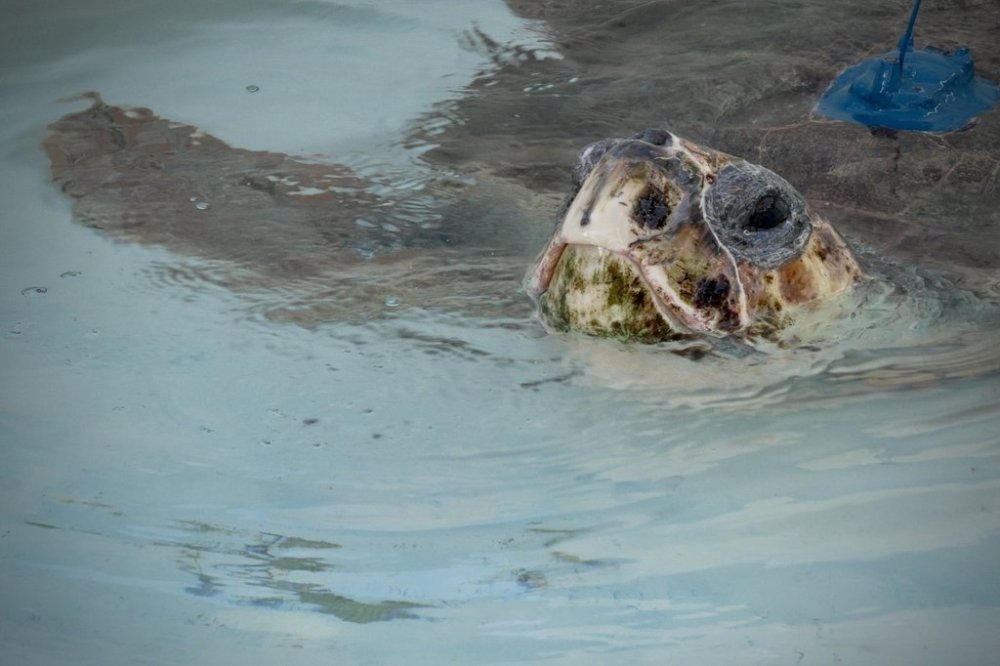
The turtle was named Pyari, a Hindi term of endearment meaning “lovely” or “beloved.” She arrived at the center in November from the nearby Inwater Research Group.
Some kind of predator had tried to make a meal of her, the marine center said in a statement, leaving Pyari with extensive injuries to her neck, shell and both front flippers. That led to the amputation of most of her left forelimb.
“It’s definitely always very gratifying to see these animals go back into their ocean home,” Barron said. “And I think it’s particularly gratifying when you can track them on satellite, and see exactly where they’re going and what they’re doing.”
While those satellite tags are expensive, about $10,000 each, Barron said it’s important to gather data on these three-legged turtles because scientists know very little about how well they do after rehabilitation.
In addition to Pyari, the center is tracking two other amputees, she said. “Every little bit of information helps us to understand the behavior and the success of these animals.”
Follow the journey of Pyari and the other turtles on the center’s website.