A chatbot entirely powered by humans, not artificial intelligence? This Chilean community shows why
Advertisement
Read this article for free:
or
Already have an account? Log in here »
To continue reading, please subscribe:

Digital Subscription
One year of digital access for only $205*
- Enjoy unlimited reading on winnipegfreepress.com
- Read the E-Edition, our digital replica newspaper
- Access News Break, our award-winning app
- Play interactive puzzles
*First annual payment billed as $205.00 + GST for one year. This annual subscription will automatically renew at $233.00 + GST every 52 weeks (10% off the regular annual price of $259.35). Offer available to new and qualified returning subscribers only. Cancel any time.
To continue reading, please subscribe:
Add Free Press access to your Brandon Sun subscription for only an additional
$1 for the first 4 weeks*
- Enjoy unlimited reading on winnipegfreepress.com
- Read the E-Edition, our digital replica newspaper
- Access News Break, our award-winning app
- Play interactive puzzles
*Your next Brandon Sun subscription payment will increase by $1.00 and you will be charged $17.95 plus GST for four weeks. After four weeks, your payment will increase to $24.95 plus GST every four weeks.
Read unlimited articles for free today:
or
Already have an account? Log in here »
Hey there, time traveller!
This article was published 02/02/2026 (206 days ago), so information in it may no longer be current.
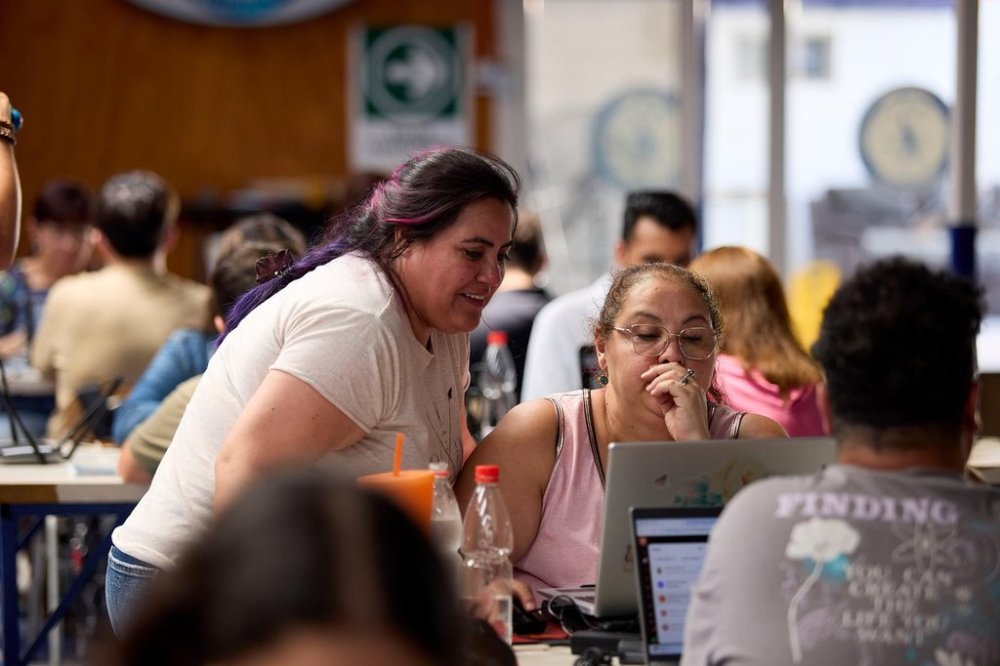
About 50 residents of a community outside Chile’s capital spent Saturday trying their best to power an entirely human-operated chatbot that could answer questions and make silly pictures on command, in a message to highlight the environmental toll of artificial intelligence data centers in the region.
Organizers say the 12-hour project fielded more than 25,000 requests from around the world.
Asking the Quili.AI website to generate an image of a “sloth playing in the snow” didn’t instantly produce an output, as ChatGPT or Google’s Gemini would. Instead, someone responded in Spanish to wait a few moments and reminded the user that a human was responding.
Then came a drawing about 10 minutes later: a penciled sketch of a cute and cartoonish sloth in a pile of snowballs, with its claws clutching one and about to throw it.
“The goal is to highlight the hidden water footprint behind AI prompting and encourage more responsible use,” said a statement from organizer Lorena Antiman of the environmental group Corporación NGEN.
The answers came from a rotating crew of volunteers working on laptops in a community center in Quilicura, a municipality at the urban edge of Santiago that has become a data center hub. Asked by an Associated Press reporter for the identity of who made the sloth drawing, the website responded that it was a local youth who’s helping with illustrations.
The website responded quickly to questions that drew on residents’ cultural knowledge, like how to make Chilean sopaipillas, a fried pastry. When they didn’t know the answer, they walked around the room to see if someone else did.
“Quili.AI isn’t about always having an instant answer. It’s about recognizing that not every question needs one,” Antiman said. “When residents don’t know something, they can say so, share perspective, or respond with curiosity rather than certainty.”

She said it’s not designed to reject the “incredibly valuable” uses of AI but to think more about the impacts of so much “casual prompting” on water-stressed places like Quilicura.
The backdrop behind the campaign is a debate, in Chile and elsewhere, about the heavy costs of AI usage. Data center computer chips running AI systems require huge amounts of electricity and some also use large volumes of water for cooling, with usage varying depending on location and type of equipment.
Cloud computing giants Amazon, Google and Microsoft are among a number of companies that have built or planned data centers in the Santiago region.
Google has argued that the Quilicura data center it switched on in 2015 is the “most energy efficient in Latin America” and has highlighted its investment in wetlands restoration and irrigation projects in the surrounding Maipo River basin. But it faced a court challenge over another project near Santiago over water usage concerns.
Chile has faced a decade of severe drought, which experts say contributed to the spread of recent deadly wildfires.
Related Articles
Anthropic, OpenAI rivalry spills into new Super Bowl ads as both fight to win over AI users
Advertisement Advertise With Us
Advertisement Advertise With Us