Doctors, health groups call for action as Canada lags on cervical cancer prevention
Advertisement
Read this article for free:
or
Already have an account? Log in here »
To continue reading, please subscribe:

Digital Subscription
One year of digital access for only $205*
- Enjoy unlimited reading on winnipegfreepress.com
- Read the E-Edition, our digital replica newspaper
- Access News Break, our award-winning app
- Play interactive puzzles
*First annual payment billed as $205.00 + GST for one year. This annual subscription will automatically renew at $233.00 + GST every 52 weeks (10% off the regular annual price of $259.35). Offer available to new and qualified returning subscribers only. Cancel any time.
To continue reading, please subscribe:
Add Free Press access to your Brandon Sun subscription for only an additional
$1 for the first 4 weeks*
- Enjoy unlimited reading on winnipegfreepress.com
- Read the E-Edition, our digital replica newspaper
- Access News Break, our award-winning app
- Play interactive puzzles
*Your next Brandon Sun subscription payment will increase by $1.00 and you will be charged $17.95 plus GST for four weeks. After four weeks, your payment will increase to $24.95 plus GST every four weeks.
Read unlimited articles for free today:
or
Already have an account? Log in here »
Hey there, time traveller!
This article was published 25/02/2026 (226 days ago), so information in it may no longer be current.
OTTAWA – Cervical cancer is both the fastest-growing type of cancer in Canada and one that is almost completely preventable — and advocates gathered in Ottawa on Wednesday to call on the federal government to step up screening, prevention and vaccination.
The Society of Gynecologic Oncology of Canada, the Women’s Health Coalition and representatives from 19 other groups held a press conference to urge lawmakers to act to reverse the worrying trend.
“We have the tools to make cervical cancer the first cancer ever eliminated in Canada. We have the medical expertise. We just need the political will,” said Dr. Shannon Salvador, president of the Society of Gynecologic Oncology of Canada, at a press conference in Ottawa on Wednesday.
Canada has set a goal of eliminating cervical cancer before 2040. Countries like Australia and Sweden are nearing that target of fewer than four cases per 100,000 population.
Canada’s rate is more than double that and rising, Salvador said in a media statement.
“We are failing our sisters and our mothers and our daughters,” said Dr. Sarah Kean, a gynecologist from Winnipeg.
More than 90 per cent of cervical cancers are caused by the human papillomavirus, or HPV, a common virus with multiple strains. It’s estimated that 75 per cent of people will have at least one HPV infection in their lifetime.
A highly effective vaccine for the virus has been widely available for years and the National Advisory Committee on Immunization recommends a single dose for school-aged children.
It’s been shown to prevent up to 90 per cent of cancers caused by the virus. Research that examined data from 2014-18 in 14 countries, including Canada, found that girls who received the vaccine saw an 83 per cent reduction in the two main cancer-causing types of HPV.
An advisory committee of federal and provincial experts on cervical cancer has released a “white paper” on the subject.
“No other single tool is as effective in preventing cancers as the HPV vaccine,” the paper’s authors said.
Canada’s cervical cancer elimination goal depends on having 90 per cent of children under 18 vaccinated by 2025. But vaccine uptake is much lower than that.
The provinces and territories have HPV vaccination programs for children between the ages of nine and 13, but research shows only about 64 per cent of eligible children get the shot, on average.
The rate varies across the country from 47 per cent in Ontario to 81 per cent in Nova Scotia, P.E.I. and Quebec.
Salvador said there has been widespread misinformation about the vaccine.
“There’s a multitude of studies around the HPV vaccination showing how incredibly safe it is,” she said.
Kean said provinces can make policy changes that would help. She said in Manitoba — which has an “opt-in” policy allowing parents to sign permission slips for their child to get the HPV vaccine in school — the vaccination rate is around 52 per cent. In Newfoundland and Labrador, where parents need to sign a form to opt out of the shot, coverage is at 76 per cent.
The report is calling for supports and advocacy to ensure all children are vaccinated through school programs, and for a catch-up program to ensure anyone under 18 can get the shot if they didn’t get it in school.
It’s also suggesting a policy of publicly funded access to the vaccine for anyone under 45.
The vaccine costs around $215 per dose and a typical course of treatment for adults requires two doses. Access to the vaccine is uneven across the country.
Quebec covers the cost of the vaccine for people between the ages of nine and 20, and it launched a temporary program in October 2024 to allow people up to age 45 to get two doses of the vaccine. That program “will soon come to an end,” says the province’s website.
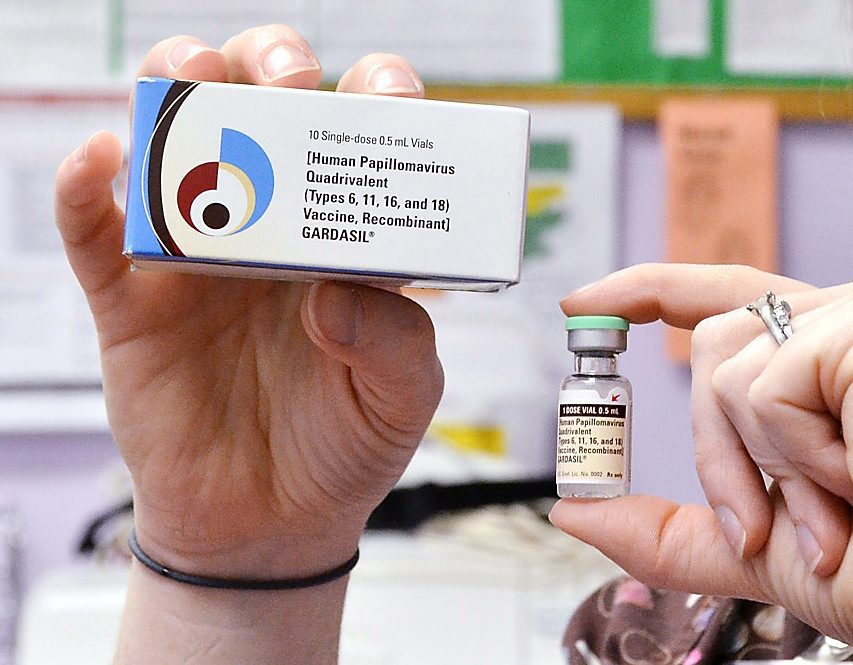
In the territories and in other provinces, including B.C., Alberta, Saskatchewan and New Brunswick, the cost of the vaccine is covered for people up to age 26.
Ontario and Manitoba cover the vaccine for school-aged children and those deemed to be in high-risk groups.
While it is most commonly associated with cervical cancer, HPV can cause cancer of the vagina and vulva.
It also causes cancers that affect men, such as penile, anal and mouth and throat cancer. The report says rates of these diseases are also rising and boys should be vaccinated as well.
The paper calls for better early detection and screening programs. Some provinces, including Quebec, Ontario, P.E.I. and B.C., are now using tests for HPV as the primary cervical cancer screening tool, instead of the less-effective Pap test. Some provinces also have implemented self-testing programs.
“We are calling for an immediate national shift to HPV DNA testing for cervical cancer screening and implementation of HPV self-collection swabs and kits,” Salvador said.
The self-collection kits allow women in rural and remote communities, people without access to family doctors, and people with a history of sexual trauma to do the test at home.
Carmen Wyton, president of the Women’s Health Coalition of Canada, is urging lawmakers in Ottawa to pass a Senate bill that would create a national framework to promote, enhance and protect women’s heath.
Passing Bill S-243 could standardize access to HPV testing and self-sampling across provinces and maintain health equity, Wyton said in a press release.
Health Minister Marjorie Michel said during an unrelated interview with CBC Radio on Wednesday morning that she was working with the Senate on the legislation.
Canada has had a national strategy on women’s health since the 1990s but “nothing has happened with it since then,” Wyton said Wednesday.
A spokesperson for Michel thanked the groups for their advocacy on Wednesday and said Canada has spent $33 million on research into cervical cancer in recent years.
“Tomorrow, Feb. 26, Minister Michel will announce an additional $4 million for two projects related to (HPV) and cervical cancer,” Guillaume Bertrand said in an email.
This report by The Canadian Press was first published Feb. 25, 2026.