Still unsure about composting? Here’s why and how to make ‘black gold’ for the garden

Advertisement

Advertise with us

I love the idea of transforming garbage into free mulch and fertilizer. Composting is a win-win: I save money and keep my eggshells, coffee grounds and weeds out of a landfill.

Read this article for free:


By clicking the button above, an account will be created and you will begin to receive some of our recommended newsletters. You may opt out of any newsletter by visiting your Email and Communication Preferences page or by clicking "unsubscribe" at the bottom of any email.

or

Already have an account? Log in here »

To continue reading, please subscribe:

Digital Subscription

One year of digital access for only $1.44 a week*

  • Enjoy unlimited reading on winnipegfreepress.com
  • Read the E-Edition, our digital replica newspaper
  • Access News Break, our award-winning app
  • Play interactive puzzles

*Billed as $5.77 plus GST every four weeks. After 52 weeks, price increases to the regular rate of $19.95 plus GST every four weeks. Offer available to new and qualified returning subscribers only. Cancel any time.

To continue reading, please subscribe:

Add Free Press access to your Brandon Sun subscription for only an additional

$1 for the first 4 weeks*

  • Enjoy unlimited reading on winnipegfreepress.com
  • Read the E-Edition, our digital replica newspaper
  • Access News Break, our award-winning app
  • Play interactive puzzles
Start now

*Your next Brandon Sun subscription payment will increase by $1.00 and you will be charged $17.95 plus GST for four weeks. After four weeks, your payment will increase to $24.95 plus GST every four weeks.

I love the idea of transforming garbage into free mulch and fertilizer. Composting is a win-win: I save money and keep my eggshells, coffee grounds and weeds out of a landfill.

Compost is the single best additive available for improving any soil type. Is your soil too sandy? Add compost. Too dense? Add compost. Lacking nutrients? Say it with me now: Add compost! That’s why we gardeners call it “black gold.”

It’s as close to a cure-all as we can get, increasing the water-holding capacity of sand and the drainage of clay, while introducing billions of beneficial organisms that will nourish your plants for a long time.
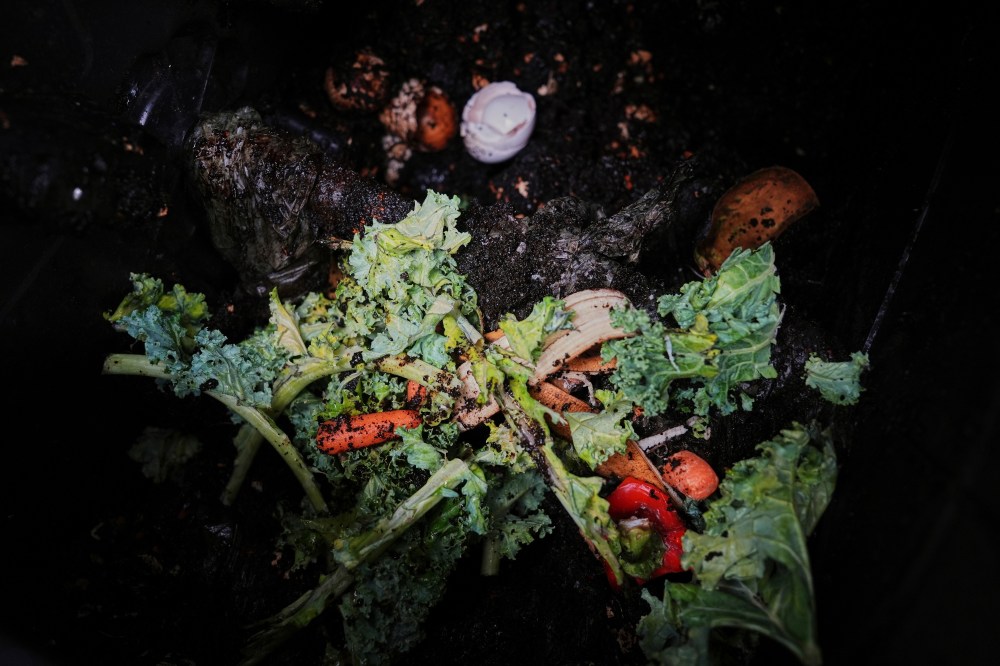
FILE - Food scraps sit inside a residential compost bin in Cincinnati on July 29, 2025. (AP Photo/Joshua A. Bickel, File)

Location, location, location

Before starting, decide whether you want an open or contained pile. From what I’ve seen, compost bins and tumblers could set you back anywhere from $50 to $300. This might be worth it to you if you’re concerned about aesthetics.

But an open pile in a back corner of the yard would work just as well. Or, you could compromise and make your own receptacle by bending a length of chicken wire into a round or oval shape, fastening its ends with strong twine or zip ties, then anchoring it into the ground with stakes.

Your pile or bin should be close enough to avoid an out-of-sight-out-of-mind situation, but maybe not right next to where you’re grilling dinner. And despite what you might think, a properly constructed pile of rotting garbage won’t create unpleasant odors.

Proportions matter

There are two ingredient categories in compost, “browns” and “greens,” and they should be added in almost equal parts.

Browns, which are usually but not always brown, include spent perennials, dry leaves, cut-up (undyed) leather, twigs, paper and straw. They should make up 50% or slightly more of your pile’s ingredients. Browns are full of carbon and will keep things from smelling badly.

Green materials are rich in nitrogen and, likewise, are mostly green, or at least fresher than browns. They include grass clippings, fruit and vegetable scraps, and freshly picked weeds that have not gone to seed. Cornstarch packing peanuts and coffee grounds also are rich in nitrogen, so even though they defy this color-coding principle, they are considered greens, which help speed the decomposition of all the ingredients in the pile. Greens should make up 50% or slightly less of your pile.

Cutting up large or coarse ingredients like banana peels will speed up their decomposition.

Never add meat, fish, dairy, fat or oils to compost. Avoid diseased plants or weeds that have gone to seed, and skip plastic, glass or anything that won’t break down. Manure from animals that don’t consume meat (rabbits, cows, horses) is fine, but do not use waste from carnivores. That means leave dog poop and kitty litter out.

Caring for your compost

Keep your pile moist but not soggy. Monitor its moisture and sprinkle a little water on it if it begins to dry out. Give it another sprinkle every time you add a new layer of materials.

As it decomposes, the bacteria in the pile will cause its center to heat up and “cook” your compost. Turn the pile with a pitchfork or spade (or spin your tumbler) about twice a week to keep the heat evenly distributed.

The process can take anywhere from a couple of months (if your pile is small and you toss and moisten it regularly) to a couple of years (for very large or neglected piles). Regardless, you will end up with a dark, crumbly, highly nutritious amendment that resembles rich soil.

If some larger pieces, like sticks, remain in your finished compost, you can sift them out with a screen. Use a 1/2-inch (1.4-centimeter) screen if you intend to use your compost in potting mix or garden beds, and 1/4-inch (0.6 centimeter) screen for seed-starting mix. Rubbing the compost against the screen with a gloved hand will help things along.

Incorporate compost into new beds before planting, mix it into containers, scatter it over the lawn or use it in place of mulch. It will provide slow-release nutrients, fortify roots, and create rich, healthy soil that will support and protect your plants over time.

___

Jessica Damiano writes regular gardening columns for The Associated Press. She publishes the award-winning Weekly Dirt Newsletter. Sign up here for weekly gardening tips and advice.

___

For more AP gardening stories, go to https://apnews.com/hub/gardening.

Report Error Submit a Tip

More Stories

Letters, Oct. 23

7 minute read 2:00 AM CDT

People over cars — always

Re: Researchers: lights at crossing ‘long overdue’ (Oct. 22)

Maggie Macintosh’s article was right on the mark. The biggest problem with pedestrian crossings is the remarkable inconsistency, but there is also the fact that drivers at every traffic light are trained to keep running through amber lights until they turn to red.

I use the pedestrian crossing at Roblin Boulevard and Hunterspoint Road and drive through it every day. Almost every day I see drivers, from a full block away, who will just keep going through the flashing ambers (at the crossing), especially if there is traffic ahead of them doing the same thing.

Chief medical officer quits, cites work environment ‘challenges’

Chris Kitching 6 minute read Preview

Chief medical officer quits, cites work environment ‘challenges’

Chris Kitching 6 minute read Yesterday at 5:47 PM CDT

Manitoba’s provincial chief medical officer is resigning from his position at Shared Health, citing the role’s demands and work environment challenges in an email viewed by the Free Press.

Dr. José François, who’s held the executive position since April 2024, sent an email to provincial medical specialty leads that said his final day will be Jan. 17, 2027, after he submitted his resignation Wednesday. Several other senior leaders have departed the provincial health authority in recent months.

“Serving in this role has been a privilege,” François, a longtime family physician from Ste. Anne, wrote in the email.

He said his “greatest pleasure” was working alongside and supporting an “exceptional group” of provincial medical specialty leads and chief medical officers.

Read
Yesterday at 5:47 PM CDT

Hydro is getting ahead of itself

Tim Sale 5 minute read 2:00 AM CDT

Manitoba Hydro is pressing ahead with its proposed $3-billion gas-turbine project in Brandon as though approval was a foregone conclusion. Six weeks of Public Utilities Board hearings exposed serious doubts about the need for three turbines, their escalating cost and whether more affordable alternatives have been adequately examined. Yet before the PUB has delivered its recommendations and the government has authorized the investment, Hydro applied for an environmental license on Oct. 8.

Starting the environmental review early may save time but proceeding before the premier and his cabinet have made a decision risks reducing regulatory scrutiny and political approval to mere formalities. Has the government already given Hydro the green light?

Few dispute that Manitoba will need more capacity as demand grows. Daymark Energy Advisors, the PUB’s independent consultant, concluded that Hydro had established a need for additional capacity by 2030. However, Daymark questioned the size of the projected shortfall, Hydro’s load forecasts and its turbine cost assumptions. Hydro itself acknowledged that its planning costs were based on 2024 information, and that surging North American demand for gas turbines has since put significant upward pressure on prices. Then there’s the impact of Trump’s trade war. These are not minor details, but updated costs have not been obtained.

The bigger problem is how Hydro has framed the alternatives. Interim CEO Hal Turner recently argued that wind and battery storage alone cannot reliably carry Manitoba through prolonged extreme cold. Fair enough. However, critics are not proposing wind and batteries alone.

Reynolds exerts ‘maximum effort’ to boost Winnipeg after quick meet with mayor

Gabrielle Piché 3 minute read Preview

Reynolds exerts ‘maximum effort’ to boost Winnipeg after quick meet with mayor

Gabrielle Piché 3 minute read Updated: Yesterday at 8:13 PM CDT

Ryan Reynolds wasn’t wearing his Deadpool suit, but that didn’t stop Mayor Scott Gillingham from wanting to talk about films with the Vancouver-born Hollywood movie star.

Reynolds, who appeared at IG Wealth Management's 100th anniversary celebration Wednesday at the RBC Convention Centre, took to social media afterward, sharing a photo of himself with Gillingham and trumpeting the province’s tax incentives.

“An incredible place to shoot,” the Instagram post read.

On Thursday, Gillingham said the actor, best known for portraying an irreverent, erratic anti-hero on the big screen, is a “really nice gentleman.”

Read
Updated: Yesterday at 8:13 PM CDT

Alberta sees its way through the fog

Editorial 4 minute read Preview

Alberta sees its way through the fog

Editorial 4 minute read 2:01 AM CDT

“The owls are not what they seem.”

It was a confusing line in a confusing television show, back when television watchers had to wait a week, or sometimes more, for a new episode of a show.

What the owls were — or weren’t — was one small element of the astounding panoply of events in Twin Peaks.

In case this is all flying right over your head, Twin Peaks was a surrealist television show, a mystery/horror/something that premiered in 1990. It had an amazing ability to leave viewers both entertained and, well, hanging.

Read
2:01 AM CDT

Winnipeg business closure scare leads Hydro to reschedule planned outage

Free Press staff 2 minute read Wednesday, Oct. 21, 2026

Manitoba Hydro has cancelled a planned River Heights neighbourhood outage after a miscommunication led to area businesses fearing unexpected closure.

Hydro had planned to shut down power along Lanark and Renfrew streets between Corydon Avenue and John Brebeuf Place on Friday.

Overhead electrical maintenance work can only be done with the power off, during the day, for safety reasons, Hydro spokesman Peter Chura said. It chose Friday from 9 a.m. to 3 p.m. because St. John Brebeuf School had an in-service day.

However, the affected area houses a strip of businesses including a Royal Bank of Canada, eateries, shops, services such as physiotherapy and a medical centre.