

The balikbayan box: The way Filipino Americans have sent love all the way back home
Advertisement
Read this article for free:
or
Already have an account? Log in here »
To continue reading, please subscribe:
Digital Subscription
One year of digital access for only $1.44 a week*
- Enjoy unlimited reading on winnipegfreepress.com
- Read the E-Edition, our digital replica newspaper
- Access News Break, our award-winning app
- Play interactive puzzles
*Billed as $5.77 plus GST every four weeks. After 52 weeks, price increases to the regular rate of $19.95 plus GST every four weeks. Offer available to new and qualified returning subscribers only. Cancel any time.
To continue reading, please subscribe:
Add Free Press access to your Brandon Sun subscription for only an additional
$1 for the first 4 weeks*
- Enjoy unlimited reading on winnipegfreepress.com
- Read the E-Edition, our digital replica newspaper
- Access News Break, our award-winning app
- Play interactive puzzles
*Your next Brandon Sun subscription payment will increase by $1.00 and you will be charged $17.95 plus GST for four weeks. After four weeks, your payment will increase to $24.95 plus GST every four weeks.
Read unlimited articles for free today:
or
Already have an account? Log in here »
PHOENIX (AP) — Beginning in the 1970s, just about every Filipino household in America was either hauling balikbayan boxes in person or mailing them to relatives back in the Philippines.
These care packages that held goodies from the U.S. were seen as an expression of support during hard economic times — as well as one of pure love.
“Balik” and “bayan,” Tagalog for “return” and “homeland,” respectively, was what President Ferdinand Marcos Sr. called the tourism initiatives he established in 1973. After declaring martial law a year earlier, he wanted to compel Filipino immigrants to come back and visit and further “legitimize his new dictatorial regime,” says Adrian De Leon, an assistant professor of history at New York University and author of “Balikbayan: A Revenant History of the Filipino Homeland.”
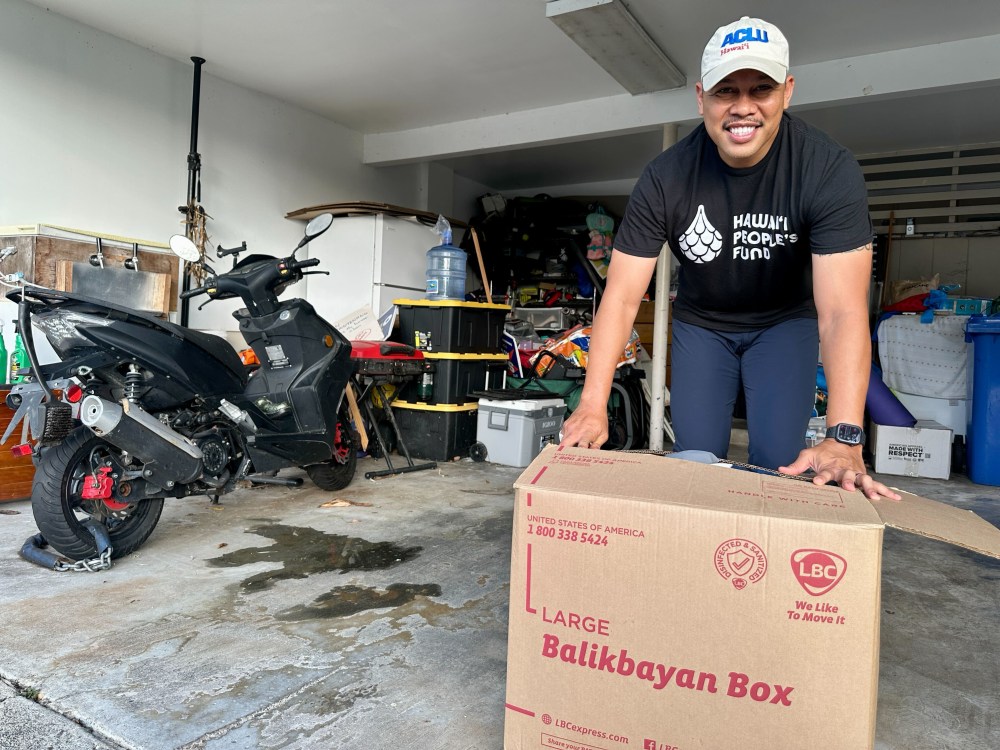
The balikbayan program proved “incredibly profitable” for the government as middle-class Filipino Americans came and spent capital.
“The dollar stretches way more,” De Leon says. “Bulk buying becomes a way through which overseas Filipinos are incentivized to maintain an economic connection to their homeland so that the government can take cuts from it and use it for like everything.”
The practice of shipping balikbayan boxes grew from there. Initially, canned meat like Spam was a staple of these boxes. Over time, small luxuries like skin-care products, clothes and candy became sought after, too. Then American entertainment like music cassettes and movies on Betamax were tossed in.

“What might have been letters being sent back home, now with the balikbayan box, you’re sending back American pop culture,” De Leon says. “Filipinos are doing the work of American soft power for Filipinos at home.”
Sending balikbayan boxes has thrived as its own industry. There are a handful of shipping companies in the U.S. that market door-to-door delivery to the Philippines. Filipino immigrants visiting the country get quicker entry at Manila’s Ninoy Aquino International Airport through a designated “balikbayan lane.”
Jamming as many gifts as possible into a balikbayan box remains culturally ingrained in the Filipino diaspora. Filipino American comedian Rex Navarrete has typically made it a stand-up bit, advising: “One thing you should never pack in a balikbayan box is air.”
___
Part of a recurring series, “American Objects,” marking the 250th anniversary of the United States. For more American objects, click here. For more stories on the anniversary, click here.