Humanoids dance and thread needles as Japanese robotics developers look to outdo Chinese

Advertisement

Advertise with us

TOKYO (AP) — Mechanical hands dexterous enough to thread a needle, childlike dancing robots and adult-sized ones to help with deliveries were on display Thursday as the Humanoids Summit Tokyo opened.

Read this article for free:


or

Already have an account? Log in here »

To continue reading, please subscribe:

Subscribe and receive a limited-edition Free Press branded hat or tote.

Digital Subscription

One year of digital access for only $205*

  • Enjoy unlimited reading on winnipegfreepress.com
  • Read the E-Edition, our digital replica newspaper
  • Access News Break, our award-winning app
  • Play interactive puzzles

*First annual payment billed as $205.00 + GST for one year. This annual subscription will automatically renew at $233.00 + GST every 52 weeks (10% off the regular annual price of $259.35). Offer available to new and qualified returning subscribers only. Cancel any time.

To continue reading, please subscribe:

Add Free Press access to your Brandon Sun subscription for only an additional

$1 for the first 4 weeks*

  • Enjoy unlimited reading on winnipegfreepress.com
  • Read the E-Edition, our digital replica newspaper
  • Access News Break, our award-winning app
  • Play interactive puzzles
Start now

*Your next Brandon Sun subscription payment will increase by $1.00 and you will be charged $17.95 plus GST for four weeks. After four weeks, your payment will increase to $24.95 plus GST every four weeks.

TOKYO (AP) — Mechanical hands dexterous enough to thread a needle, childlike dancing robots and adult-sized ones to help with deliveries were on display Thursday as the Humanoids Summit Tokyo opened.

Among the dozens of companies taking part, including well-known players like Boston Dynamics and Toyota Motor Corp., the big stars now were clearly the Chinese.

Chinese newcomers, like Booster Robotics and LimX Dynamics, took the technology initially developed in Japan and the U.S. and fine-tuned it, often for cheaper mass production. It’s a repeat of what happened in other Japanese industries, from consumer electronics to cellphones and electric vehicles. In humanoids, Japan was initially ahead but then failed to produce major commercial solutions.
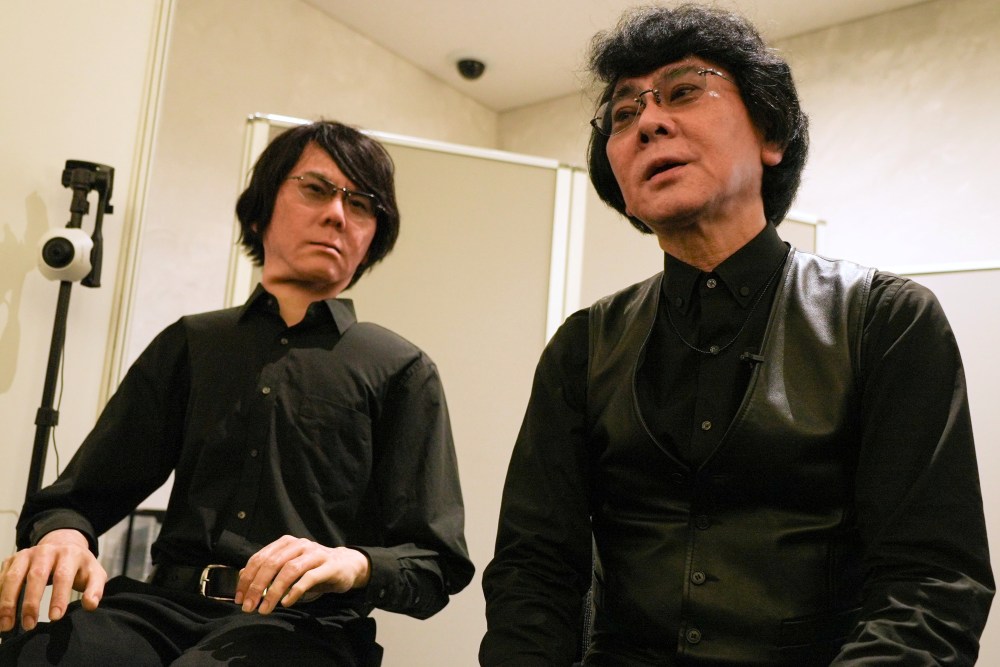
Professor Hiroshi Ishiguro, right, of Osaka University talks to android robot Geminoid at the Humanoids Summit 2026 in Tokyo, Thursday, May 28, 2026. (AP Photo/Ayaka McGill)

Tim Hornyak, author of “Loving the Machine: The Art and Science of Japanese Robots,” who was at the event, categorized it as the so-called “Galapagos syndrome,” referring to how innovative Japanese products evolve in isolation and end up not translating for the international market.

“I really hope that Japan can come up with a Ford Model T-version of humanoid roots. But I think China has already stolen their lunch. It’s a bit too little too late,” he said.

The dancing and wiggling Mini Pi Plus robot from High Torque of China, for instance, still can’t help at an auto plant or do your dishes. But it’s cute. And it doesn’t come with an eye-popping price tag, starting at $5,500.

Chinese robots are dominating

One telling example of Chinese robotics use in Japan was GMO, a Tokyo-based AI and robotics company working on a humanoid with camera eyes that will help with Japan Airlines cargo and other chores at an airport.

The key is to have the robot do the work in the same way as people so they would be interchangeable, an initiative meant to tackle the labor shortage problem that is increasingly serious in Japan.

The inner robotics workings were all courtesy of Unitree, a Chinese outfit, which is also working on a four-legged dog-like “stellar explorer.”

Experts say Japan, with its finesse in manufacturing, proved a good breeding ground for robotics development. The sociological backdrop of a public receptive to robotics also helped.

A recent Pew global survey showed that people in Japan are highly aware of AI but are less anxious about it, at about 28%, than people in the U.S. at 50%.

Japanese automaker Honda Motor Co., a leader in robotics with its walking humanoid Asimo, first shown in 2000, was demonstrating a motorized four-fingered robotic hand that could screw on and off tiny bolts, or thread a needle.

It didn’t seem to bother Keisuke Tsuta, assistant chief engineer, that similar mechanical hands were on display galore near his booth, many of them from Chinese makers.

Japanese robotics show their prowess

The technology Honda had developed is more durable and powerful than rival offerings, and the Japanese have historically shown they can excel at quality mass production, according to Tsuta.

The looming threat of a Chinese robotics domination didn’t seem to phase Osaka University Professor Hiroshi Ishiguro, who has worked on humanoids for decades, including one that’s his clone.

“What’s significant is that Japan has a culture that’s receptive to robotics. If we’re going to really start using robots in society, Japan is the ideal place,” he said, stressing that Japanese don’t discriminate against robots.

His robotic counterpart, dressed all in black like the professor, did as good a job, if not better, of answering a key existentialist question on the meaning of robots.

“I think robots will coexist with people. Robots are the mirror of human beings,” the robot replied in a slightly monotonous but human-like voice.

Earlier, the professor had answered a similar question, but a bit differently.

“No one is interested in me. All everyone cares about is my robot,” he said, sitting next to his twin-like humanoid.

“As long as people identify with what I have produced, I am a success,” he added. ___

Yuri Kageyama is on Threads: https://www.threads.com/@yurikageyama

Report Error Submit a Tip

More Stories

Donating plasma for good reasons

Bob Cox 5 minute read 2:00 AM CDT

It was the baby’s picture that got to me. Featured in an ad seeking plasma donors, I looked at the infant and the accompanying message that I could help save lives. A few days later I was at the donation centre on the University of Manitoba campus.

That was 15 years ago. Almost weekly since then, I have returned to sit for an hour or so while blood is pumped out of me, plasma is extracted, and then the blood is pumped back in.

Grifols, the Spanish company that operates the U of M clinic as well as donation centres across Canada, paused collections on Aug. 14 as it deals with questions surrounding the deaths of two people following donations at Winnipeg locations.

Health Canada said the deaths were not linked to plasma donations, but raised concerns about alarm monitoring and other procedures and issued a non-compliance order for a clinic on Taylor Avenue.

‘We got attacked’: Carney says retaliatory tariffs on U.S. to take effect next month

Catherine Morrison and David Baxter, The Canadian Press 7 minute read Preview

‘We got attacked’: Carney says retaliatory tariffs on U.S. to take effect next month

Catherine Morrison and David Baxter, The Canadian Press 7 minute read Saturday, Aug. 22, 2026

OTTAWA - Prime Minister Mark Carney says retaliatory tariffs will hit the U.S. starting next month after Canada walked away from what he called a "bad deal."

The U.S. introduced new 50 per cent tariffs on billions of dollars in Canadian exports on Saturday after trade talks failed.

"We got attacked," Carney told reporters on Parliament Hill Saturday when asked about the escalating trade war.

Carney suspended talks with the United States late Friday and summoned his negotiators back to Ottawa.

Read
Saturday, Aug. 22, 2026

‘Strong sense of unity’

By Melissa Martin 6 minute read Preview

‘Strong sense of unity’

By Melissa Martin 6 minute read Saturday, Aug. 22, 2026

Manitoba government and business leaders are rallying behind Prime Minister Mark Carney’s plan to fight back, after a sudden collapse of trade talks between the U.S. and Canada sparked a new salvo of U.S. tariffs on some Canadian goods.

On Saturday, after Carney vowed to respond with retaliatory tariffs, Manitoba premier Wab Kinew said his government stood “100 per cent” behind the prime minister’s plan to respond to what Kinew called U.S. president Donald Trump’s “unjustified and immoral” tariffs.

“History will not be kind to Donald Trump, so we should never appease him,” Kinew said. “We should fight back, which is what Canada is doing today.”

Kinew met reporters for a brief news conference at the legislature on Saturday afternoon, about an hour after finishing a call with Carney and the other premiers. There was a “really strong sense of unity” on that call, Kinew said, and emphasized that he backs the federal decision to “walk away from what would have been a bad deal.”

Read
Saturday, Aug. 22, 2026

Stick with familial roles that work for you

Maureen Scurfield 5 minute read 2:00 AM CDT

DEAR MISS LONELYHEARTS: My teenage mother abandoned me as a baby boy. She left town after dropping me off to live with my teenage father, who still lived with his parents and their large Franco-Manitoban family. I had a good life and was spoiled by him, mémère and all the other kids.

My birth mother moved in with some of her family in another province, and didn’t figure in my life at all. I never saw her or heard from her, but I wasn’t really bitter about that. She just didn’t exist for me, except for a photo or two.

My grandmother, who told me to call her Mom if I wanted, was a great mother figure to me. She and my grandfather really loved all the kids, including me — the surprise new baby.

But now my birth mother is coming back to Manitoba for a holiday and has told people in the family she wants to see me. Why now? To see how I turned out without her? My stomach churns when I think about it. I’ve had a good life and I don’t want her coming back to claim me as her son now.

Manitoba beginning to produce ‘elite-level golfers’: Kuntz

Mike McIntyre 4 minute read Preview

Manitoba beginning to produce ‘elite-level golfers’: Kuntz

Mike McIntyre 4 minute read Yesterday at 9:03 PM CDT

It may not have ended the way everyone wanted, but make no mistake: this was a banner week for local golfers.

Let’s start with Braxton Kuntz, who managed to qualify his way into the Manitoba Open and then found himself lurking near the top of the leaderboard after an opening round five-under 65. Although he didn’t finish as strong as he started — rounds of 72, 70 and then 76 followed — the 22-year-old proved he can hang with the pros on PGA Tour Americas.

“I think over the last couple of years I’ve been continually getting better and that’s been great to see,” Kuntz told the Free Press.

“I’ve been fortunate to compete against some great players and hold my own. This was another good learning experience for me, and I’m just going to take it and run with it. I’m sure I’m one of the youngest, if not the youngest, in this field, so I’ve got a long road ahead of me.”

Read
Yesterday at 9:03 PM CDT

Woman stabbed in Spence neighbourhood

1 minute read Yesterday at 4:08 PM CDT

A woman was stabbed in the Spence neighbourhood Saturday and Winnipeg police are investigating.

The stabbing happened before 4:45 p.m. Aug. 22 in the 600 block of Ellice Avenue, and a passerby called 911 when the injured victim, in her 30s, asked for help. The victim was taken to hospital in unstable condition with an upper-body wound and was later upgraded to stable.

General patrol officers canvassed the area and the Winnipeg Police Service's major crimes unit took over the investigation. Police are asking anyone with information to contact major crimes at 204-986-6219, or leave an anonymous tip at Crime Stoppers: 204-786-8477 or winnipegcrimestoppers.org.