Some anglers praise forward-facing sonar, others say high-tech fishing ruins a day at the lake

Advertisement

Advertise with us

BISMARCK, N.D. (AP) — Ah, the serenity of fishing.

Read this article for free:


or

Already have an account? Log in here »

To continue reading, please subscribe:

Subscribe and receive a limited-edition Free Press branded hat or tote.

Digital Subscription

One year of digital access for only $205*

  • Enjoy unlimited reading on winnipegfreepress.com
  • Read the E-Edition, our digital replica newspaper
  • Access News Break, our award-winning app
  • Play interactive puzzles

*First annual payment billed as $205.00 + GST for one year. This annual subscription will automatically renew at $233.00 + GST every 52 weeks (10% off the regular annual price of $259.35). Offer available to new and qualified returning subscribers only. Cancel any time.

To continue reading, please subscribe:

Add Free Press access to your Brandon Sun subscription for only an additional

$1 for the first 4 weeks*

  • Enjoy unlimited reading on winnipegfreepress.com
  • Read the E-Edition, our digital replica newspaper
  • Access News Break, our award-winning app
  • Play interactive puzzles
Start now

*Your next Brandon Sun subscription payment will increase by $1.00 and you will be charged $17.95 plus GST for four weeks. After four weeks, your payment will increase to $24.95 plus GST every four weeks.

BISMARCK, N.D. (AP) — Ah, the serenity of fishing.

Just an angler, a fishing pole and maybe thousands of dollars worth of sonar equipment offering an exact image of what that walleye or bass is doing in the watery depths below.

It’s called forward-facing sonar, and the hot-selling products are not only helping anglers increase their catch, they are raising questions about why people go fishing in the first place and whether fish populations can survive the new technology.
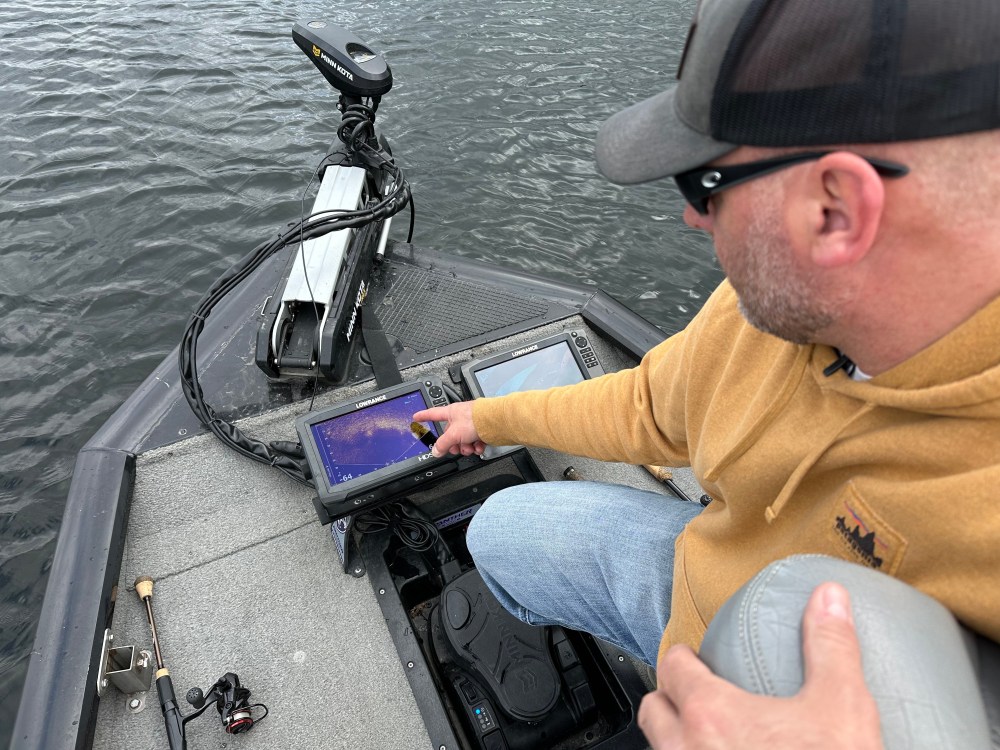
Terry Rehm points out a fish on his forward looking sonar system Saturday, May 23, 2026 in Nowthen, Minn. (AP Photo/Mark Vancleave)

“You’ve got people that are concerned about what’s going to happen to the sport of fishing,” said Gary Korsgaden, who has written about the sport for decades.

How fishing with sonar works

Fish-finding sonar is typically mounted on the bow or back of a boat, sending out sound frequencies that are converted into a picture on a screen based on the time it takes the pings to hit the bottom and return. Earlier products would show where fish were located, but advancements now enable anglers to see images of fish in real time.

“With forward-facing sonar, you can attach it to a trolling motor and you can look around the water under you and you could find exactly, pinpoint where that fish exactly is at any given time,” said Dave Dunn, a sales executive at Garmin, a company that manufactures the equipment.

Dunn notes the equipment, which costs about $2,500 for a full setup, enables anglers to even see their lures and cast directly to fish. It does have a learning curve.

For Minnesota angler Terry Rehm, the new technology is invaluable. Rehm said he doesn’t get a lot of lake time due to his work and kids’ schedules and forward-facing sonar ensures he makes good use of his time plying the waters.

“It’s just nice to be able to hone in on them a little quicker and find them quicker and catch more fish when I’m out here,” he said.

Growing use of the technology

Tens of millions of people fish recreationally each year, making it one of the nation’s top activities.

But people fish for different reasons and those who care most about the tranquility and beauty of being on a lake can find it puzzling that other anglers eagerly hunch over their screens, watching as fish swim by below.

Still, the use of the technology is growing dramatically, with surveys in Minnesota finding about 30% of anglers now use forward-facing sonar. Surveys of anglers on several Minnesota lakes found the user rate as high as 63% on one lake last fall, Walleye Alliance spokesperson Nate Blasing said.

Much of the debate around forward-facing sonar plays out on social media, but also podcasts, online fishing forums, trade shows and tournaments.

“It’s much like politics now. It tends to get personal. You can agree to disagree,” Blasing said.

Criticisms and reactions go back and forth on social media, said Korsgaden, the fishing writer. He said tournament anglers have banned him from their Facebook pages for even raising the topic.

“I think the unfortunate reality is fishing has gotten to be more about, shall we say, success or numbers or quantity, that type of thing, instead of the actual enjoyment of the engagement and making decisions on your own,” Korsgaden said.

Sonar may make little difference

Even as anglers say the equipment helps ensure they will actually catch fish, some studies indicate it hasn’t led to overfishing.

Wisconsin researchers conducted a controlled experiment last year with two teams of anglers fishing for smallmouth bass, one with forward-facing sonar, the other without. Halfway through the summer, the teams switched.

The team without the technology had higher catch rates, though the team using it caught slightly longer fish, said Greg Sass, fisheries research team leader with the Wisconsin Department of Natural Resources’ Office of Applied Science. The sonar users searched more for fish before even fishing, while the other team spent more time actively fishing.

Sass said he is reluctant to apply the study to all fish species and water bodies, but the findings “would be counterintuitive to what I’m hearing in the bait shops or from other people that are on both sides of the fence with technology,” he said. More studies are ahead, including for the muskie, a prized predator fish.

Eric Sanft, a fisheries specialist for the Minnesota Department of Natural Resources, said an analysis of lakes across the state didn’t find “negative impacts” from the use of forward-facing sonar in fishing.

Surveys by wildlife officers in Minnesota found people using forward-facing sonar ended up catching similar numbers and variety of fish as anglers who cast their lines the old-fashioned way.

“To some degree, it can get scapegoated a little bit, and people’s perceptions of what other people are doing is often different than what the reality is,” said Marc Bacigalupi, a regional fisheries supervisor for the Minnesota Department of Natural Resources.

The department has proposed reducing the daily walleye limit from six fish to four, partially because of advancements in fish-finding technology, among other factors such as a boom in ice fishing, attention on hot spots from social media and lower limits in surrounding states.

Fishing is about ‘making memories’

For Daren Schneider, a lifelong angler from Bismarck, North Dakota, forward-facing sonar has changed everything he thought he knew about fishing.

When seeking walleye, for example, he thought you needed to catch them on or near the lake bottom, but after watching on sonar, he found “they do all kinds of things that you never thought a walleye would do.”

The technology has enhanced his understanding of fish and his enjoyment of fishing, Schneider said.

“Fishing isn’t necessarily about catching fish and getting your limit or whatever,” he said. “It’s about being out there and making memories, and if it’s making memories with forward-facing sonar, why is that such a bad thing?”


Report Error Submit a Tip

More Stories

Teacher barred for ‘repeated boundary-crossing conduct’

Maggie Macintosh 3 minute read Yesterday at 11:01 PM CDT

A disciplinary panel has ordered the cancellation of a Chinese-Canadian teacher’s certificate because of her “repeated boundary-crossing with a student” during her tenure at an international school with local ties.

Janice Wen Ying Ma is permanently barred from teaching on Manitoba soil or at a Manitoba-accredited institution as of Sept. 14.

The new ruling concludes that Ma engaged in inappropriate physical interaction and “emotionally intimate online messages” with a girl who attended Clifford International School in Guangzhou, China in 2024-25.

“This conduct represents a fundamental departure from the standards expected of a teacher,” the panel, chaired by public representative Gordon Schumacher, wrote in its 22-page decision.

Bathhouse owner upset after judge grants bail to man accused in foiled bombing

Dean Pritchard and Morgan Modjeski 5 minute read Preview

Bathhouse owner upset after judge grants bail to man accused in foiled bombing

Dean Pritchard and Morgan Modjeski 5 minute read Updated: Yesterday at 5:00 PM CDT

The owner of a Notre Dame Avenue bathhouse is troubled after a man accused of planting a pipe bomb outside his club was granted bail.

Erik Lymen Olson, 59, was granted release following a contested bail hearing last Monday.

“I don’t think he should have got out with something like this — at all,” said Christopher Gregoire, owner of AQ Sauna.

Olson was arrested Sept. 12, one day after allegedly planting a pipe bomb outside the sex and lifestyle club.

Read
Updated: Yesterday at 5:00 PM CDT

Wab Kinew as ‘communicator in chief’

Paul G. Thomas 6 minute read Preview

Wab Kinew as ‘communicator in chief’

Paul G. Thomas 6 minute read Yesterday at 2:00 AM CDT

Premier Wab Kinew and his party have been riding high in the polls longer than normal for a government one year or less away from its first re-election contest. One reason is his ubiquitous, dominating communications presence as NDP leader and premier.

The argument here is that Kinew has supplemented his prerogatives as premier and party leader (such as appointing cabinet ministers and approving party nominations) with the skilful use of communications to advance his policy agenda, boost his personal popularity and maintain the competitive advantage of his party over the opposition Progressive Conservatives.

Communications has always been a significant part of politics and policy making. However, in the contemporary political and media environments, communications considerations have moved from the background to the foreground of decision-making by political parties, including when they are performing in the role of government. Campaigning and governing now overlap in what has been described as a permanent election campaign.

Political parties use communications strategies for several purposes: to establish an image of the leader which makes a positive emotional connection with voters; to promote a coherent message and to keep party members on message; and to gain favourable media coverage for its policies and other actions on almost a daily basis.

Read
Yesterday at 2:00 AM CDT

Jets defenceman spent whole summer working on getting to the next level

Ken Wiebe 8 minute read Preview

Jets defenceman spent whole summer working on getting to the next level

Ken Wiebe 8 minute read Updated: Yesterday at 1:57 PM CDT

Tyrel Bauer makes no apologies for the pugilistic piece of his path.

The Winnipeg Jets defenceman is ready to drop the gloves and throw down when the situation calls for it and he takes great pride in protecting his teammates.

It’s a big part of the reason Bauer will be among the 23 players submitted by the Jets on the opening-day roster on Monday.

“I’ve fought and clawed, both metaphorically and literally and now I just want to show that I can play as well,” Bauer said during a chat with the Free Press during training camp. “(Toughness) is always something that I have, it’s always something in my back pocket and something that I take a lot of pride in doing, for my teammates, for the city and the people who invest in this hockey club. That will never change.

Read
Updated: Yesterday at 1:57 PM CDT

Province to acquire campground near former residential school

Morgan Modjeski 3 minute read Preview

Province to acquire campground near former residential school

Morgan Modjeski 3 minute read 6:00 AM CDT

A burial site for dozens of children who died while attending the Brandon Indian Residential School will be acquired by the province, the Free Press has learned.

Premier Wab Kinew will announce the province’s plan to protect Turtle Crossing Campground at a news conference in Brandon Wednesday to mark National Day for Truth and Reconciliation. The move is in partnership with the City of Brandon.

The graves of at least 56 children are located at the campground, the Sioux Valley Dakota Nation has said, pointing to a geophysical study conducted by an archaeology firm in 2018.

There have been longstanding concerns from Indigenous leaders and community members that people were camping on the resting place of children victimized by colonialism.

Read
6:00 AM CDT

Completely separating inmates unrealistic, inquest judge says in report on three Stony Mountain slayings

Erik Pindera 5 minute read Preview

Completely separating inmates unrealistic, inquest judge says in report on three Stony Mountain slayings

Erik Pindera 5 minute read 1:43 PM CDT

Nothing short of keeping inmates separated at all times could have prevented three unrelated prisoner-on-prisoner killings several years ago in Stony Mountain Institution’s maximum-security unit, an inquest judge has found.

Provincial court Judge Lindy Choy made the finding after overseeing an inquest earlier this year into the slayings of Adrian Fillion, 42, Michael Monney, 27, and Nolan Thomas, 26, all of which occurred at the hands of fellow maximum-security inmates in the federal prison just north of Winnipeg. The killings occurred when cells were unlocked, allowing inmates to briefly move around to other areas in the cell block.

“The overall impression I was left with from the (Stony Mountain Institution) witnesses was that management of inmates in a custodial facility is a very complex undertaking. There are clearly multiple levels of oversight involved in any decisions that are made and it is all done in a very structured manner,” Choy wrote in her report on the inquest, which was made public Tuesday.

“While maintaining complete physical distance between inmates at all times would have prevented the homicides from occurring, we know that from a social and psychological perspective, this is not generally realistic nor acceptable.”

Read
1:43 PM CDT