Inside the colorful, compelling and controversial jersey designs at the World Cup

Advertisement

Advertise with us

There will be blood, sweat and tears on players’ soccer jerseys at the World Cup — and plenty of deeper cultural and historical meaning, too.

Read this article for free:


or

Already have an account? Log in here »

To continue reading, please subscribe:

Subscribe and receive a limited-edition Free Press branded hat or tote.

Digital Subscription

One year of digital access for only $205*

  • Enjoy unlimited reading on winnipegfreepress.com
  • Read the E-Edition, our digital replica newspaper
  • Access News Break, our award-winning app
  • Play interactive puzzles

*First annual payment billed as $205.00 + GST for one year. This annual subscription will automatically renew at $233.00 + GST every 52 weeks (10% off the regular annual price of $259.35). Offer available to new and qualified returning subscribers only. Cancel any time.

To continue reading, please subscribe:

Add Free Press access to your Brandon Sun subscription for only an additional

$1 for the first 4 weeks*

  • Enjoy unlimited reading on winnipegfreepress.com
  • Read the E-Edition, our digital replica newspaper
  • Access News Break, our award-winning app
  • Play interactive puzzles
Start now

*Your next Brandon Sun subscription payment will increase by $1.00 and you will be charged $17.95 plus GST for four weeks. After four weeks, your payment will increase to $24.95 plus GST every four weeks.

There will be blood, sweat and tears on players’ soccer jerseys at the World Cup — and plenty of deeper cultural and historical meaning, too.

Here, The Associated Press runs you through some of the more compelling — and controversial — backstories from the kit designs on show in soccer’s biggest event, currently taking place in the United States, Canada and Mexico.

Cape Verde’s flight paths

Cabo Verde's Telmo Arcanjo during the World Cup Group H soccer match between Spain and Cape Verde in Atlanta, Monday, June 15, 2026. (AP Photo/Stew Milne)

For its World Cup debut, the smallest nation by population at the tournament is paying homage to the roughly 525,000 inhabitants who live on 10 volcanic islands off the coast of Africa.

A geometric, triangular print across its blue (home) and white (away) jerseys represents the network of flight paths that connect the islands.

The idea is that the people of Cape Verde are united behind the players at the World Cup — and that togetherness showed as the team held firm to seal an unlikely 0-0 draw with heavily favored Spain in their first match.


Belgium’s surrealism
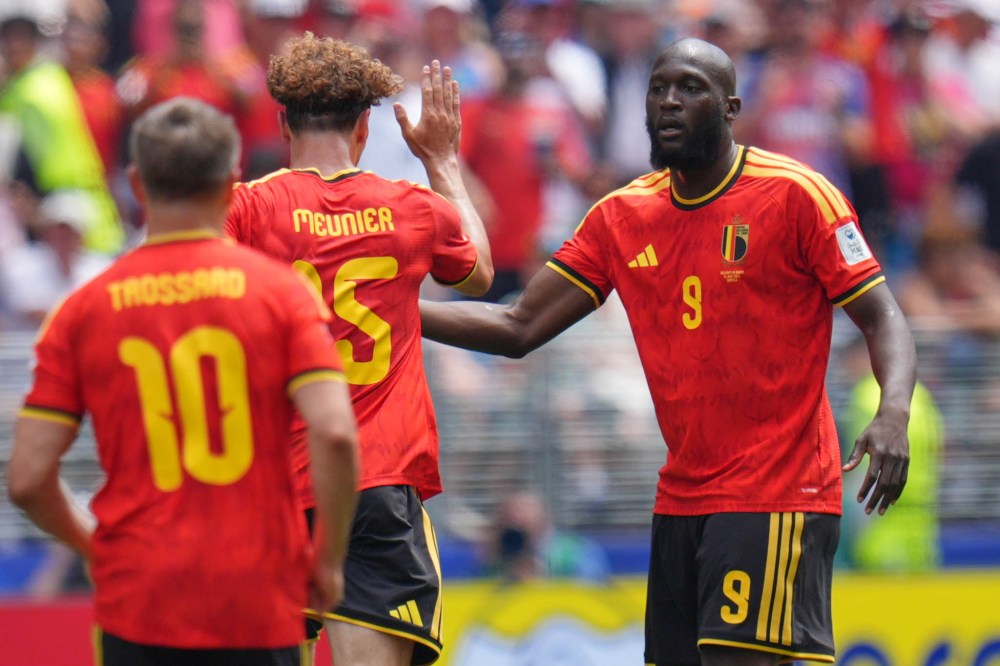
Belgium's Romelu Lukaku, celebrates with teammates after scoring his sides first goal during the World Cup Group G soccer match between Belgium and Egypt in Seattle, Monday, June 15, 2026. (AP Photo/Manu Fernandez)

“This is not a jersey,” reads a message on the collar of Belgium’s multicolor away shirt.

No, the Belgians aren’t losing their minds. It’s just a nod to the European nation’s surrealist heritage — and notably the work of its master in this artistic movement from the early 20th century. Throughout his career, Belgian artist René Magritte questioned the enigmatic relationship of mind and eye, reality and language, writing under “The Treachery of Images” — his iconic painting of a pipe — the words: “Ceci n’est pas une pipe (This is not a pipe).”

The light-blue jersey features pink patterns and black detailing, incorporating soccer-inspired motifs such as pitch lines and a ball.

“True to the surrealism theme, the kit sparks the imagination and invites conversation,” the Belgian federation says.


Haiti’s battle scene

Haiti's Ricardo Ade (4) controls the ball during the World Cup Group C soccer match between Haiti and Scotland in Foxborough, Mass., near Boston, Saturday, June 13, 2026. (AP Photo/Charlie Krupa)

The original jersey submitted by this Caribbean nation included a depiction of the final battle of the Haitian War of Independence in 1803 on its front.

In the words of Colombian sportswear manufacturer Saeta, it was a “tribute to the men and women who contribute every day to Haiti’s future.”

It didn’t go down too well with FIFA, which rejected the image during its approval process, deeming it too political.

So an updated blue soccer kit was needed, one that no longer includes the battle artwork.


Argentina’s swirling paint technique
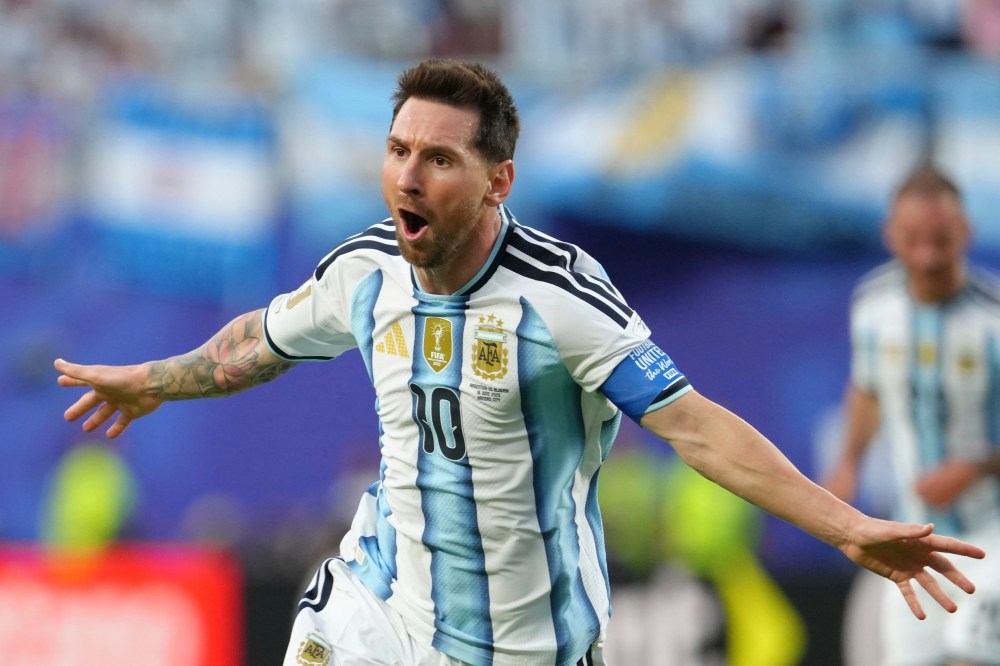
Argentina's Lionel Messi (10) celebrates after scoring the opening goal during the World Cup Group J soccer match between Argentina and Algeria in Kansas City, Mo., Tuesday, June 16, 2026. (AP Photo/Ed Zurga)

The defending World Cup champion is mixing sporting heritage with artistic expression in its jerseys.

The home kit — worn by Lionel Messi for his hat trick against Algeria on Tuesday — features three shades of blue on its stripes, an homage to the South American nation’s World Cup-winning uniforms from 1978, 1986 and 2022.

As for its dark blue away jersey, that’s inspired by a traditional painting technique from capital city Buenos Aires — filete porteño — that’s used for ornamental design, combining brilliant, swirling colors with specific lettering styles.


France’s American connection

France's Kylian Mbappe celebrates after scoring his side's third goal during the World Cup Group I soccer match between France and Senegal in East Rutherford, N.J., near New York, Tuesday, June 16, 2026. (AP Photo/Frank Franklin II)

France arrived for the World Cup with an away kit that honors a gift the nation famously gave to the United States: the Statue of Liberty.

The jersey has a green hue that resembles the oxidized color of the iconic sculpture designed by a Frenchman — Frédéric-Auguste Bartholdi — and given to the United States in 1886 as a symbol of French-American friendship.

On the jersey is a logo in copper — the original color of the statue — with the words “Nos différences nous unissent” (Our differences unite us).


Iran’s endangered Asiatic cheetah

Iran's Mohammad Mohebbi (8) celebrates after scoring his side's second goal during the World Cup Group G soccer match between Iran and New Zealand in Inglewood, Calif., near Los Angeles, Monday, June 15, 2026. (AP Photo/Mark J. Terrill)

The most striking imagery on Iran’s home (white) and away (red) kits is an Asiatic cheetah low across the front.

There also are cheetah spots on the sleeves up to the shoulder.

The Asiatic cheetah, an equally fast cousin of the African cat, is one of the world’s critically endangered species — one that Iran has long tried to save.

There were as many as 400 in the 1990s but the numbers have dwindled to fewer than an estimated 70 remaining in Iran.


Norway’s runic font

Norway's Erling Haaland (9) in action during the World Cup Group I soccer match between Iraq and Norway in Foxborough, Mass., near Boston, Tuesday, June 16, 2026. (AP Photo/Martin Meissner)

Norway’s kit might be the sharpest at the World Cup — literally.

The font used for the names and numbers of players is inspired by runic writing — characters in several Germanic alphabets used in northern Europe from ancient times until the adoption of the Latin alphabet.

The writing is pointy, geometric and easily visible, representing the Norwegian team’s desire to embrace its centuries-old history.

Flanking the large blue cross across the chest are Viking art patterns in an Urnes style.


Colombia’s yellow butterflies

Colombia's Luis Suarez, left, celebrates with Colombia's James Rodriguez after scoring his side's third goal against Costa Rica during a friendly soccer match in Bogota, Colombia, Monday, June 1, 2026. (AP Photo/Fernando Vergara)

Look closely at Colombia’s typically vibrant yellow jersey and you’ll notice a burst of butterfly patterns.

That’s an homage to the classic novel by the nation’s Nobel Prize-winning author, Gabriel Garcia Marquez, “One Hundred Years of Solitude,” and the stories that made him literature’s best-known practitioner of magical realism — the blending of the everyday with fantastical elements such as a man trailed by a cloud of yellow butterflies.


Mexico’s Aztec calendar

Mexico's Armando Gonzalez controls the ball during the World Cup Group A soccer match between Mexico and South Africa in Mexico City, Thursday, June 11, 2026. (AP Photo/Eduardo Verdugo)

Mexico’s home jersey brings back the Aztec calendar design that was popular in the 1990s.

In the run-up to the World Cup, the team visited the National Museum of Anthropology in Mexico City and posed for a photo with the uniforms in front of the Aztec “Piedra de Sol” or Stone of the Sun, best known as the Aztec calendar.


Saudi Arabia’s architecture

Saudi Arabia's Moteb Alharbi (24) prepares to throw the ball in during the World Cup Group H soccer match between Saudi Arabia and Uruguay in Miami Gardens, Fla., Monday, June 15, 2026. (AP Photo/Rebecca Blackwell)

Dotted across Saudi Arabia’s dark green home jersey are symmetrical lavender squares or diamond shapes, a tribute to doorway decoration — namely geometric, triangular architecture — commonly seen in homes in the kingdom.

Wild lavender flowers fill Saudi’s desert landscapes in springtime, so purple is a celebrated color in the nation and regarded as a symbol of generosity.


Brazil’s Amazonian frogs

What might immediately jump out when looking at Brazil’s navy blue-and-black away jersey made by Nike is a yellow “Jumpman” logo synonymous with Michael Jordan-promoted sportswear.

However, more closely linked to Brazilian culture is the color of the kit, inspired by the skin of the poison dart frog found in the Amazon. It’s a nod to the danger posed by Brazil, the record five-time world champion.

___

This story has been corrected to remove a reference to Haiti as a World Cup debutant. This is Haiti’s second World Cup.

___

Associated Press writer Luis Andres Henao contributed to this report.

___

Report Error Submit a Tip

More Stories

Exhibition examines the bonds we make with humanoid objects

Jen Zoratti 8 minute read Preview

Exhibition examines the bonds we make with humanoid objects

Jen Zoratti 8 minute read 6:27 PM CDT

For the past few years, Winnipeg visual artist Emilie St-Hilaire has been fascinated by the way humans relate to artificial bodies — dolls, robots, mannequins — through play, care and connection, and how those synthetic relationships can produce very real emotions in humans.

Objects of Fidelity: Barbies, bots, bébés, her solo exhibition on view now at La Maison des artistes visuels francophones, explores this space between object and companion. It’s what she calls the “visual culmination” of work that began with her 2024 PhD dissertation at Concordia University in Montreal, which examined Reborn Dolls — hyper-realistic art dolls that resemble newborns — from a feminist perspective.

But when a robot included in the exhibition started malfunctioning and giving signs that it was at the end of its life, St-Hilaire was given a new question to puzzle: what does it mean for a robot, or any other artificial body, to “die”?

To understand that, one must first understand how these human attachments to humanlike objects form in the first place.

Read
6:27 PM CDT

Supportive housing operator sued after man with dementia walks away

Erik Pindera 4 minute read Preview

Supportive housing operator sued after man with dementia walks away

Erik Pindera 4 minute read Yesterday at 6:00 AM CDT

The Public Guardian and Trustee of Manitoba is suing a health services company after a man with dementia under its care allegedly wandered away from an apartment it operates for vulnerable people and was later found face down in a puddle — unresponsive, hypothermic and severely injured.

The public trustee — a provincial government agency that, among other duties, makes financial and personal care decisions for vulnerable adults who cannot do so themselves — filed the lawsuit against Cambridge Health Inc. and a related numbered company in the Court of King’s Bench earlier this month.

The agency did so on behalf of a now-38-year-old man, who has been under its care since 2018, as a result of his frontotemporal dementia. The disease often starts in mid-life, rather than old age, as is the case with most other forms of dementia.

The lawsuit alleges the man, who resided at a Henderson Highway apartment complex where Cambridge Health operated a supportive residence for people with complex behavioural health issues, was in a common area of the home at about 4:30 p.m. on April 3 last year.

Read
Yesterday at 6:00 AM CDT

Lone Manitoba 9/11 victim's legacy lives on helping Inuit students become nurses

Melissa Martin 13 minute read Preview

Lone Manitoba 9/11 victim's legacy lives on helping Inuit students become nurses

Melissa Martin 13 minute read Yesterday at 5:24 PM CDT

On the night before the morning that everyone remembers, Ellen Judd spoke to her partner, Christine Egan, several times on the phone. Egan was in New York, where she’d gone to look after her nephews so her beloved brother, Michael, and his wife, Anna, could treat themselves to an anniversary vacation.

Usually, Judd would have been there, too. The couple had been together for more than 15 years, and loved sharing all the good parts of life. But at the time, she was an anthropology professor at the University of Manitoba, and the school year was just starting; she had classes the next day. Staying connected by phone would have to suffice.

In their calls that night, Judd remembers, Egan was happy. Christmas was the main topic. They were planning to spend the holiday with Judd’s family in Ontario, and talked about when to book flights. Egan was looking forward to that visit; Judd’s family “loved her to bits,” the now-retired professor says, and the affection was mutual.

The next day, Egan said, she planned to go into Manhattan with Michael. He was an executive at Aon, a global risk, retirement and health services corporation, and had an office on the 105th floor of the World Trade Centre’s South Tower.

Read
Yesterday at 5:24 PM CDT

Education minister’s reasons for revoking teacher’s licence ‘not good enough,’ judge decides

Maggie Macintosh 5 minute read Preview

Education minister’s reasons for revoking teacher’s licence ‘not good enough,’ judge decides

Maggie Macintosh 5 minute read Updated: 9:14 AM CDT

A Manitoba judge has rejected the education minister’s decision to end a teacher’s career because he repeatedly messaged with a 13-year-old girl on social media.

Read
Updated: 9:14 AM CDT

Childfree Winnipeg group gives women without kids a place to gather

AV Kitching 5 minute read Preview

Childfree Winnipeg group gives women without kids a place to gather

AV Kitching 5 minute read Wednesday, Sep. 9, 2026

Katelyn Sawatzky founded Childfree Winnipeg Women in 2021 to bring together women who don’t have kids — be it by choice or circumstance — and do not plan on raising children.

The group is designed to help them share experiences and build meaningful friendships.

The community welcomes cisgender, straight, transgender, bisexual and lesbian women. Parents, including empty nesters and men, are turned away.

“Our group is a safe space where women can hang out with other women without being asked when you’re going to have kids or why you don’t have kids … where you don’t feel like you have to validate or defend your choices in any way, because everyone gets it,” Sawatzky says.

Read
Wednesday, Sep. 9, 2026

Ferraro, Skinner getting lay of the land before training camp starts

Mike McIntyre 8 minute read Preview

Ferraro, Skinner getting lay of the land before training camp starts

Mike McIntyre 8 minute read Wednesday, Sep. 9, 2026

They’ve both been around the NHL block a bit, but make no mistake, Stuart Skinner and Mario Ferraro are experiencing some “new kid at school” type jitters this week.

The pair were prized July 1 free agent signings by the Winnipeg Jets and are now quickly trying to get the lay of the land — from teammates and systems and structure to restaurants, schools and the best routes to the rink — in what is a frantic time on both a professional and personal level.

“It’s a big change, right?” Ferraro said Wednesday following a pre-training camp skate at the Hockey For All Centre.

“Like moving cities, getting settled somewhere else, with my family, my wife, my daughter, our two dogs. But I think it’s gone really well and smooth. We found a great place here, and we’re really happy with where we’re living.”

Read
Wednesday, Sep. 9, 2026