Chevrolet Bolt vs. Nissan Leaf, an Edmunds $30,000 EV comparison
Advertisement
Read this article for free:
or
Already have an account? Log in here »
To continue reading, please subscribe:

Digital Subscription
One year of digital access for only $205*
- Enjoy unlimited reading on winnipegfreepress.com
- Read the E-Edition, our digital replica newspaper
- Access News Break, our award-winning app
- Play interactive puzzles
*First annual payment billed as $205.00 + GST for one year. This annual subscription will automatically renew at $233.00 + GST every 52 weeks (10% off the regular annual price of $259.35). Offer available to new and qualified returning subscribers only. Cancel any time.
To continue reading, please subscribe:
Add Free Press access to your Brandon Sun subscription for only an additional
$1 for the first 4 weeks*
- Enjoy unlimited reading on winnipegfreepress.com
- Read the E-Edition, our digital replica newspaper
- Access News Break, our award-winning app
- Play interactive puzzles
*Your next Brandon Sun subscription payment will increase by $1.00 and you will be charged $17.95 plus GST for four weeks. After four weeks, your payment will increase to $24.95 plus GST every four weeks.
Read unlimited articles for free today:
or
Already have an account? Log in here »
Many new electric vehicles are prohibitively expensive for car shoppers. But there are a few relatively low-cost options that provide plenty of usable range and utility. One great example is the Nissan Leaf. Originally debuting for 2011, it’s today’s longest-tenured EV and remains among the most affordable ways to go electric. The 2026 Leaf has been fully redesigned and features sleeker styling and a maximum estimated range of more than 300 miles.
The Leaf also faces a familiar challenger. The Chevrolet Bolt is back for 2027 after a three-year hiatus. Its 2027 overhaul adds updated technology features and more range. Both of these small EVs have starting prices around $30,000 and are compelling choices if you can’t commit to pricier picks from Hyundai, Tesla and Toyota. But which is best for you? Edmunds’ auto experts tested them to find out.
Range, performance and charging
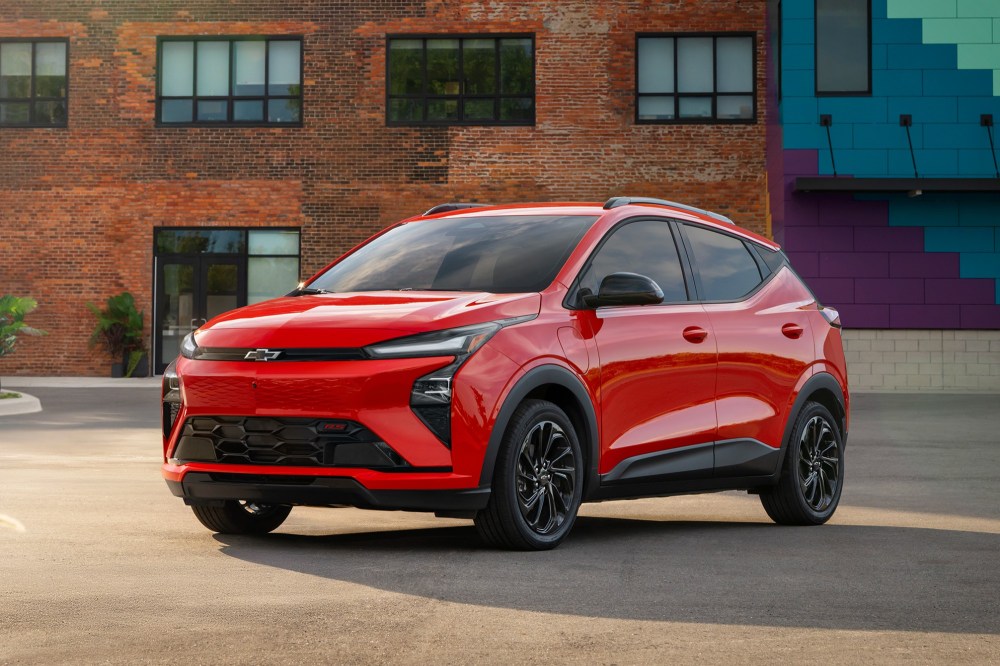
The 2027 Bolt is capable of going 262 miles on a single charge, according to the EPA’s estimates. That’s certainly enough for routine driving and to make the occasional road trip feasible. The Leaf holds a potential edge with its EPA-estimated maximum of 303 miles. However, these two EVs were more closely matched in Edmunds’ standardized real-world range test. Here, the Bolt traveled 290 miles and the Leaf covered 310 miles.
Acceleration is similar — both went from zero to 60 mph in about 7 seconds in Edmunds’ testing — but the Bolt is the EV that Edmunds prefers to drive. The Chevy’s nimble handling makes it ideal for threading tight city streets, while the Leaf feels a little too harsh and bouncy over rough asphalt.
If you’re charging at public fast-charging stations, the Bolt will potentially get you back on the road a bit sooner. In Edmunds’ testing, the Bolt was able to regain range more quickly than the Leaf.
Winner: Bolt
Technology features
Gadget-minded drivers will probably prefer the Leaf. It comes with a 12.3-inch touchscreen, another 12.3-inch display for digital gauges, and an option to upgrade both screens to 14.3 inches. The Leaf also has wireless connectivity for Apple CarPlay and Android Auto smartphone integration, allowing you to easily use many of your smartphone’s apps right on the touchscreen.
The Bolt has dual 11-inch displays but no option to upgrade in size. It also lacks Apple CarPlay and Android Auto functionality and instead uses Google Built-In, an integrated Android-based operating system. Popular apps such as Waze and Apple Music can be downloaded from the Google app store, but overall Edmunds prefers the convenience of having Android Auto and Apple CarPlay.
The Bolt does have one potential advantage with its available Super Cruise feature. When active, Super Cruise enables hands-free driving on highways to help reduce driver fatigue during tedious conditions, such as in slow-moving traffic or on long highway drives. But overall, the Leaf maintains its edge here.
Winner: Leaf
Interior space and utility
The Bolt and Leaf share crossover-style designs with tall roofs, ample cabin space and similar headroom. Rear seat passengers can stretch out more in the Bolt thanks to its additional 7.3 inches of legroom compared to the Bolt. That’s also advantageous if you have small kids and need to install a bulky rear-facing child safety seat.
The Leaf compensates with more cargo space behind its rear seats. It has 20 cubic feet behind the rear seat compared to the Bolt’s 16.2 cubic feet. Nissan also includes a handy underfloor storage system, so you can securely stow valuables or smaller items.
Winner: Leaf
Price and value
The Chevy Bolt LT starts at $28,995, including the destination fee, making it today’s most affordable new EV. Chevy includes the basic convenience features plus plenty of standard advanced driver aids such as adaptive cruise control and blind-spot warning and intervention. Go with the Bolt RS for a few thousand more and you get upgrades such as synthetic leather upholstery, a power-adjustable driver’s seat and a heated steering wheel.
The Leaf S+ trim, starting at $31,535, is also a good deal. It has a similar collection of standard features and advanced driver aids. It also has a standard surround-view camera system, which is helpful for parking in tight spots. But typically you’ll be paying more for a Leaf. A fully loaded Leaf Platinum+ will cost you around $40,000 while a loaded Bolt RS will be around $37,500.
Winner: Bolt
Edmunds says
The Bolt and the Leaf are both solid choices for an affordable EV. In fact, they ended up with the same overall score in Edmunds’ ratings. Choose the Leaf for its longer range, more useful tech and bigger cargo area, or go with the Bolt for its better value for the money and more agile handling around town.
____________
This story was provided to The Associated Press by the automotive website Edmunds.
Dan Frio is a contributor at Edmunds.