People with cardiovascular conditions at risk in heat: Heart and Stroke Foundation

Advertisement

Advertise with us

TORONTO - As a sweltering heat wave blankets much of Central Canada, the Heart and Stroke Foundation says the weather can be especially dangerous for people with cardiovascular conditions. 

Read this article for free:


By clicking the button above, an account will be created and you will begin to receive some of our recommended newsletters. You may opt out of any newsletter by visiting your Email and Communication Preferences page or by clicking "unsubscribe" at the bottom of any email.

or

Already have an account? Log in here »

To continue reading, please subscribe:

Digital Subscription

One year of digital access for only $1.44 a week*

  • Enjoy unlimited reading on winnipegfreepress.com
  • Read the E-Edition, our digital replica newspaper
  • Access News Break, our award-winning app
  • Play interactive puzzles

*Billed as $5.77 plus GST every four weeks. After 52 weeks, price increases to the regular rate of $19.95 plus GST every four weeks. Offer available to new and qualified returning subscribers only. Cancel any time.

To continue reading, please subscribe:

Add Free Press access to your Brandon Sun subscription for only an additional

$1 for the first 4 weeks*

  • Enjoy unlimited reading on winnipegfreepress.com
  • Read the E-Edition, our digital replica newspaper
  • Access News Break, our award-winning app
  • Play interactive puzzles
Start now

*Your next Brandon Sun subscription payment will increase by $1.00 and you will be charged $17.95 plus GST for four weeks. After four weeks, your payment will increase to $24.95 plus GST every four weeks.

TORONTO – As a sweltering heat wave blankets much of Central Canada, the Heart and Stroke Foundation says the weather can be especially dangerous for people with cardiovascular conditions. 

“The heat just generally makes the heart work harder,” said Dr. Mahwash Saeed, a cardiologist at the Winnipeg Health Sciences Centre and St. Boniface Hospital.

Extreme heat causes strain as the body cools itself down through sweating and the heart pumps more blood to the skin’s surface. 

People use umbrellas to shield themselves from the sun as temperatures rise in Toronto, on Monday, July 14, 2026. THE CANADIAN PRESS/Chris Young

“You then become vulnerable to dehydration, and then your blood pressure drops, your heart rate goes up and that’s enough to trigger either a heart attack or an episode of heart failure in patients who have a history of heart disease,” said Saeed, who is also a spokesperson for the Heart and Stroke Foundation. 

People who have had strokes can have symptoms such as seizures or fainting, she said, noting that studies show hospitalizations for both heart disease and stroke increase in extreme heat.  

Staying hydrated is a critical way for people to protect themselves, so Saeed tells her patients to continuously drink water throughout the day and not to just drink a large quantity once. 

The foundation recommends staying out of the sun during the peak hours of 11 a.m. and 3 p.m. and to consider visiting libraries, malls or community cooling spaces if people don’t have air conditioning at home. 

“Even a few hours a day of being in an air-conditioned surrounding can cool your body down significantly,” Saeed said. 

Taking a lukewarm shower can also help people to cool down, she said, but it’s important not to make the shower cold because that can constrict the blood vessels. 

People taking some heart and high blood pressure medications — including diuretics, ACE inhibitors and calcium channel blockers — need to be extra vigilant about staying hydrated.

That’s because some medications can make it harder for people to cool down or to lose more fluid, Saeed said.  

“During times of extreme heat, if they become too dehydrated, it can predispose them to heat exhaustion, heat stroke, heart failure, fainting, kidney problems,” she said. 

“So it can cause a large amount of problems if they don’t stay hydrated enough and stay cool enough.”

But Saeed emphasized that it’s important for people to keep taking their medications and not to make any changes without consulting their primary-care provider.

Signs of dehydration can include thirst, dark yellow urine, tiredness, dizziness or confusion. 

A man cools off in a fountain at Sankofa Square in downtown Toronto amid a heat wave in the city on Tuesday, July 14, 2026. THE CANADIAN PRESS/Cole Burston

“If you do find that you’re feeling unwell, you’re having chest pain, you’re short of breath (or) you’ve fainted, go straight to an emergency room,” she said. 

In addition to people with cardiovascular disease, older adults and those who work outside are particularly vulnerable to heat-related illness, Saeed said. 

“The heat can be dangerous for everyone,” she said. 

One of the most dangerous heat effects for people in general, not just those with cardiovascular disease, is heat stroke — a medical emergency when the body can no longer regulate its temperature. 

Symptoms of heat stroke can include hot, dry skin that isn’t sweaty, confusion or agitation, dizziness or fainting, a fast heart rate, vomiting or diarrhea and headache, the Heart and Stroke Foundation website says.  

If you suspect someone is suffering from heat stroke, call 911 and move them to a cool area.  Drenching the skin with cool water, fanning and ice packs can be useful while waiting for help to arrive. 

The Heart and Stroke Foundation says that despite its name, heat stroke is not the same thing as having a stroke, which is when blood stops flowing to part of the brain. 

This report by The Canadian Press was first published July 14, 2026.

Canadian Press health coverage receives support through a partnership with the Canadian Medical Association. CP is solely responsible for this content.

Report Error Submit a Tip

More Stories

Henderson crosswalk has glaring safety gap, say researchers months after pedestrian killed

Maggie Macintosh 6 minute read Preview

Henderson crosswalk has glaring safety gap, say researchers months after pedestrian killed

Maggie Macintosh 6 minute read Yesterday at 2:00 AM CDT

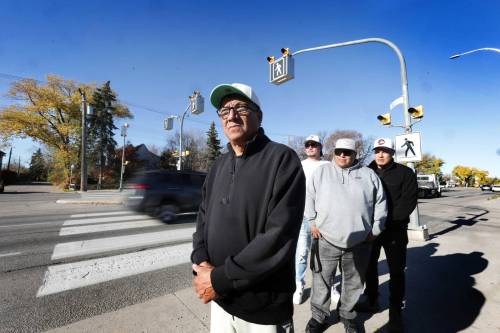
Six months after a fatal collision at a crosswalk on Henderson Highway, two traffic safety researchers question why the intersection remains an outlier that is missing key flashing lights.

The City of Winnipeg is being urged to install “backflashers” to better protect road users moving in all directions at the intersection where a 32-year-old father died in the spring.

“It’s these little, mundane, non-sexy engineering problems that can cause everything right up to fatality,” said Curt Pankratz, an associate professor at the University of Winnipeg who studies traffic engineering and policymaking.

On April 19, shortly before sunrise, Gabe Beardy was struck when he was crossing the six-lane thoroughfare at Neil Avenue.

Read
Yesterday at 2:00 AM CDT

Klein, Gillingham trade jabs over megaproject

Malak Abas 6 minute read Preview

Klein, Gillingham trade jabs over megaproject

Malak Abas 6 minute read Wednesday, Oct. 21, 2026

Two of Winnipeg’s mayoral candidates wasted no time trading barbs over who bears responsibility for the skyrocketing cost of overhauling the North End sewage treatment plant, during a televised debate Wednesday.

Scott Gillingham and Kevin Klein pointed the finger at each other for the rising cost of the massive project, which had a cost estimate of $795 million in 2015 and had ballooned to $3.2 billion as of the latest estimate.

“We need to be able to understand how that amount tripled in that short a time,” Klein said at the event held at CBC’s downtown Winnipeg headquarters. He pointed out the first estimate was given when Gillingham was chairman of the city’s finance committee. He questioned what the incumbent did to garner funding for the project.

Gillingham shot back by noting Klein was Manitoba’s environment minister in 2023. He accused his opponent of failing to make a dent on the cost.

Read
Wednesday, Oct. 21, 2026

Rocky Horror star prepared for a rude reception in all the best ways

Conrad Sweatman 5 minute read Preview

Rocky Horror star prepared for a rude reception in all the best ways

Conrad Sweatman 5 minute read 2:01 AM CDT

While it enjoys the longest theatrical release of any movie in history, The Rocky Horror Picture Show was all but ignored by critics when its revolutionary brand of camp first hit silver screens in 1975.

And before it whipped up a cult following, Rocky was a fringe theatre hit in London whose first run’s final night — which had attracted such luminaries as Mick and Bianca Jagger — was derailed by an unlikely culprit: glitter. According to the late Tim Curry (who died at 80 in August), the shiny stuff ended up where the sun don’t shine.

“Well, Rocky got some glitter down his trunks and it set up an irritation. When we arrived at the theatre, he was standing in the shower and the show couldn’t go on,” he told the press in 1974, after crossing the Atlantic to lead the show’s American theatre debut.

Glitter is one of the things audiences may not throw at the stage at The Rocky Horror Picture Show screening tonight at the Centennial Concert Hall. Unlike in the anarchic midnight screenings at the New York’s Waverly Theater beginning in 1976, where audiences chucked everything but the kitchen sink, a prop bag will be courteously supplied at the door.

Read
2:01 AM CDT

U of W, former professor sued over alleged sex assault

Erik Pindera 4 minute read Preview

U of W, former professor sued over alleged sex assault

Erik Pindera 4 minute read Wednesday, Oct. 21, 2026

A woman who studied and worked at the University of Winnipeg has filed a lawsuit against the post-secondary institution and her former professor — a convicted sex offender — who she alleges drugged and sexually assaulted her.

Read
Wednesday, Oct. 21, 2026

Family history, solo sojourns paved path for celebrated author’s latest novel

Ben Sigurdson 7 minute read Preview

Family history, solo sojourns paved path for celebrated author’s latest novel

Ben Sigurdson 7 minute read 2:01 AM CDT

It’s 1967 and Lee Clarke has just been kicked out of UCLA when he receives his draft letter in the mail. Rather than report for basic training, he hops in a car and sets off across America on an amphetamine-fuelled road trip to bid farewell to his fractured, dysfunctional family before crossing the border into Canada.

Such is the premise for B.C.-born, Portland-based Patrick deWitt’s sixth novel Dodge City, published in September by House of Anansi. He’s in Winnipeg tonight at McNally Robinson Booksellers’ Grant Park location to launch the book.

The 51-year-old deWitt came to prominence with his sophomore novel, 2011’s The Sisters Brothers. The book was a critical and commercial success, winning the author the Governor General’s Literary Award for Fiction, the Rogers Writers’ Trust Fiction Prize and the Stephen Leacock Medal for Humour, and was adapted for the big screen in a film starring John C. Reilly and Joaquin Phoenix.

His 2018 novel French Exit was also adapted for cinema, and his 2023 novel The Librarianist won deWitt the Leacock Medal for the second time. Dodge City is deWitt’s fourth novel to make the Giller Prize long list.

Read
2:01 AM CDT

Chief medical officer quits, cites work environment ‘challenges’

Chris Kitching 6 minute read Preview

Chief medical officer quits, cites work environment ‘challenges’

Chris Kitching 6 minute read Yesterday at 5:47 PM CDT

Manitoba’s provincial chief medical officer is resigning from his position at Shared Health, citing the role’s demands and work environment challenges in an email viewed by the Free Press.

Dr. José François, who’s held the executive position since April 2024, sent an email to provincial medical specialty leads that said his final day will be Jan. 17, 2027, after he submitted his resignation Wednesday. Several other senior leaders have departed the provincial health authority in recent months.

“Serving in this role has been a privilege,” François, a longtime family physician from Ste. Anne, wrote in the email.

He said his “greatest pleasure” was working alongside and supporting an “exceptional group” of provincial medical specialty leads and chief medical officers.

Read
Yesterday at 5:47 PM CDT