Face-to-face with ancient Rome: Exhibition in Hungary brings forgotten faces to life

Advertisement

Advertise with us

BUDAPEST, Hungary (AP) — A blacksmith, a stable boy, a soldier, a slave: The faces and stories of these and other residents of an ancient Roman city in modern Hungary have been brought to life in remarkable fidelity for a new exhibition in Budapest.

Read this article for free:


or

Already have an account? Log in here »

To continue reading, please subscribe:

Subscribe and receive a limited-edition Free Press branded hat or tote.

Digital Subscription

One year of digital access for only $205*

  • Enjoy unlimited reading on winnipegfreepress.com
  • Read the E-Edition, our digital replica newspaper
  • Access News Break, our award-winning app
  • Play interactive puzzles

*First annual payment billed as $205.00 + GST for one year. This annual subscription will automatically renew at $233.00 + GST every 52 weeks (10% off the regular annual price of $259.35). Offer available to new and qualified returning subscribers only. Cancel any time.

To continue reading, please subscribe:

Add Free Press access to your Brandon Sun subscription for only an additional

$1 for the first 4 weeks*

  • Enjoy unlimited reading on winnipegfreepress.com
  • Read the E-Edition, our digital replica newspaper
  • Access News Break, our award-winning app
  • Play interactive puzzles
Start now

*Your next Brandon Sun subscription payment will increase by $1.00 and you will be charged $17.95 plus GST for four weeks. After four weeks, your payment will increase to $24.95 plus GST every four weeks.

BUDAPEST, Hungary (AP) — A blacksmith, a stable boy, a soldier, a slave: The faces and stories of these and other residents of an ancient Roman city in modern Hungary have been brought to life in remarkable fidelity for a new exhibition in Budapest.

The display, which runs until Oct. 31, showcases highly detailed facial reconstructions from over a dozen skulls found in the ancient city of Aquincum, once a bustling Roman settlement on the empire’s Danube frontier.

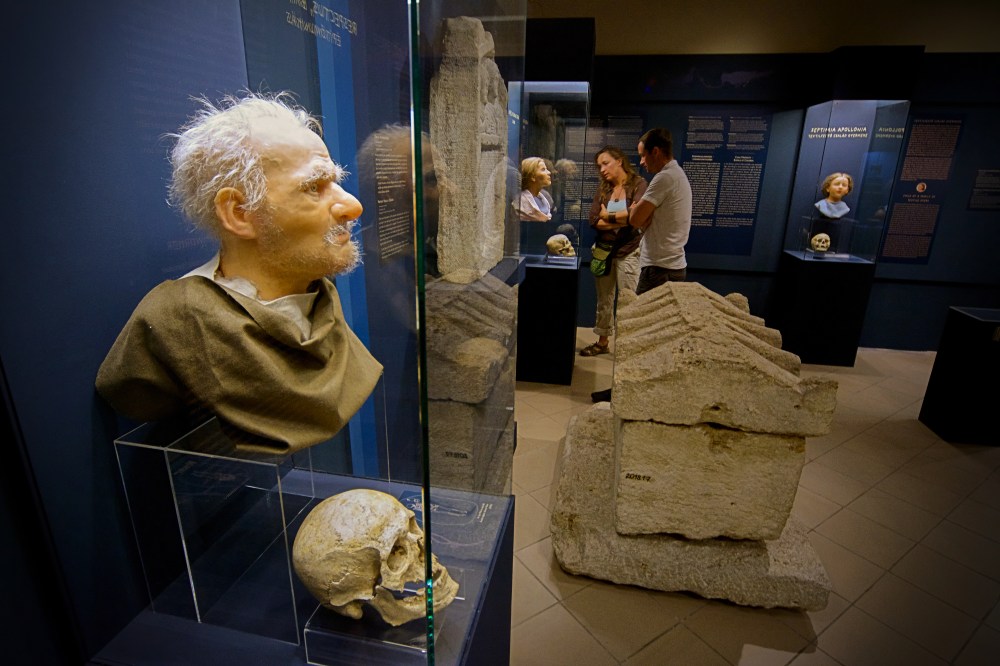
Visitors to the Aquincum Museum come face-to-face with hyperrealistic models of Roman-era individuals, each crafted using DNA analysis and other techniques from fields such as archaeology and anthropology to determine how the people may have looked in life nearly 2,000 years ago.
Visitors look at Roman-era skulls and their facial reconstructions in the Aquincum Museum's exhibition titled
Visitors look at Roman-era skulls and their facial reconstructions in the Aquincum Museum's exhibition titled "Once we were like you" which showcases characters and the fictional life stories of those who once lived in the bustling Roman settlement of Aquincum, in Budapest, Hungary, Tuesday, July 7, 2026. (AP Photo/Bela Szandelszky)

“Our main goal was to bring a few of these individuals closer to the people of today,” said Loránt Vass, an archaeologist and the exhibition’s co-curator.

The title of the exhibition, “Once we were like you,” attempts to answer questions about ordinary people in ancient societies: What did they look like? What were their names? What was their fate?

Experts with the Aquincum Museum used DNA analysis of unearthed bones to reveal skin, hair and eye color and whether the person may have had freckles.

The shape, density and other characteristics of the skull revealed details of the structure of the face as well as the person’s age and whether they had sustained any injuries or suffered from disease.

Based on the findings, curators came up with names, trades and biographical stories for each of the reconstructed faces, giving them new life.

Péter Vámos, another of the exhibit’s co-curators, said the invented details were “based on authentic historical foundations” as well as information gathered from analysis of the skulls, which are displayed under the reconstructions.

“We don’t even know their names, unfortunately, but we tried to incorporate everything that anthropology and genetic studies could tell us about their life history,” he said.

One character, a construction worker they named Respectus, is described as having made his living in Aquincum plastering walls and splitting stone blocks. The exhibit says the work took its toll on his bones, and in a wine-fueled skirmish in a local tavern, his nose was broken and one of his teeth knocked out.

The story and social status of Respectus is typical of many Aquincum residents depicted. Vass said their studies showed that the bones of almost all individuals show a “fairly high degree” of inflammation.

“They were subjected to regular physical labor, and in many cases they were exposed to starvation for a certain period of time,” he said. “Based on this, it can be concluded that most of them belonged to the lower middle class, which is the least remembered segment of Roman society.”

Of the 16 reconstructions, six are silicon moldings that have been painted and meticulously adorned with true-to-life hair, clothing and jewelry.

Emese Gábor, who handcrafted the silicon reconstructions, said that while artificial intelligence also can be used to model ancient faces, “they just appear on a screen.”

“The advantage of this kind of reconstruction is that it can be displayed in a museum, it can be viewed from all angles and is totally life-size,” she said. “I stick to scientific methods and combine classical and modern scientific methods in this work.”

Another valuable piece of information that DNA can reveal is the ethnic origin of the person — quite illuminating in Aquincum’s diverse settlement.

Analyses showed the presence of not only Roman citizens with origins in the heart of the empire in modern-day Italy, but also people from as far away as today’s Scotland and Syria, as well as members of the nomadic Sarmatian tribes of the Eurasian steppes.

Also among Aquincum’s residents were Celts, who inhabited the region in the Iron Age before Roman settlement.

Vass said that during typical excavations of Roman-era skeletons, artifacts are examined, documented and stored, meaning “the bodies have no weight, no life, no soul.”

But by confronting visitors with their ancient predecessors, the museum hopes to forge a connection.

The exhibition’s title “suggests that they were like we are today. They had the same occupations, the same problems,” Vass said.

“They may have had different life conditions, different social status, but people are people,” he said. “I don’t think that has changed much across history.”

Report Error Submit a Tip

More Stories

Mayoral candidates Klein, Vogiatzakis continue to snipe over inducement allegations

Chris Kitching and Joyanne Pursaga 6 minute read Preview

Mayoral candidates Klein, Vogiatzakis continue to snipe over inducement allegations

Chris Kitching and Joyanne Pursaga 6 minute read Updated: Yesterday at 5:50 PM CDT

Winnipeg mayoral candidate Mike Vogiatzakis told reporters Monday he will contact the city clerk to report his allegation that rival Kevin Klein offered him a job to drop out of the race.

Vogiatzakis and Klein both doubled down a day after accusing each other of offering the other a position at city hall, if they were victorious in the Oct. 28 election, in exchange for a withdrawal.

“Do I want to get him charged? Not really. I don’t want to destroy anybody’s life,” Vogiatzakis told reporters.

“Kevin’s a good guy. I thought he was a friend of mine, but he’s not. Kevin uses leverage to get ahead, and he tried to use me as leverage.”

Read
Updated: Yesterday at 5:50 PM CDT

Province looks to seize notorious drug den

Erik Pindera 5 minute read Preview

Province looks to seize notorious drug den

Erik Pindera 5 minute read Saturday, Oct. 3, 2026

Provincial justice officials are trying to seize a Dominion Street drug den that has been the source of trouble in the West End for years.

The owner of 982 Dominion St., 45-year-old Robert Edward Johnson, was most recently arrested in June along with several others after a lengthy Winnipeg Police investigation into thefts and illicit drug sales connected to the house.

“The residence has a reputation within the neighbourhood as being a location where individuals habitually attend for the purpose of purchasing and/or consuming controlled substances,” reads a statement of claim filed by the province’s director of civil forfeiture in the Court of King’s Bench last week.

“For several years, the residence has been associated with criminal activity, violence, and disorder, resulting in numerous police attendances and complaints from members of the surrounding community.”

Read
Saturday, Oct. 3, 2026

Morning-show veteran swaps microphone for macchiatos at new Corydon café

David Sanderson 9 minute read Preview

Morning-show veteran swaps microphone for macchiatos at new Corydon café

David Sanderson 9 minute read Saturday, Oct. 3, 2026

Good news if you were used to having your morning coffee with Terri Gale, who earlier this summer signed off from CTV Your Morning, after 15 years on the job.

Gale, the three-hour program’s longtime weather expert, and her husband Rob Gale, the ex-head soccer coach of Valour FC and co-founder of the Northern Super League’s new Winnipeg franchise, are the owners of Golden Hour Café and Bar at 775 Corydon Ave.

Gale (formerly Apostle) nods when she is asked who would know more about caffeinated beverages than a person who, for the last decade and a half, set her alarm to go off in the wee small hours.

“I do love coffee and take mine black. Except because I hate burning my tongue — not a good thing when you speak for a living — I got into the habit of throwing a couple of ice cubes in my cup, to be on the safe side,” Gale says, seated on the second level of their attractive, 2,100-square-foot premises, which officially opened in mid-September.

Read
Saturday, Oct. 3, 2026

Record number of school trustees win by acclamation

Maggie Macintosh 4 minute read Preview

Record number of school trustees win by acclamation

Maggie Macintosh 4 minute read Yesterday at 6:52 PM CDT

A historic number of school trustees have automatically won their bid to draft classroom budgets and make public education policy in Winnipeg.

Read
Yesterday at 6:52 PM CDT

Bombers on outside looking in after beatdown from Als

Taylor Allen 7 minute read Preview

Bombers on outside looking in after beatdown from Als

Taylor Allen 7 minute read Sunday, Oct. 4, 2026

The visitors’ locker room at Percival Molson Memorial Stadium was eerily quiet late Saturday night.

Many of the Winnipeg Blue Bombers sat in their stalls with dejected looks on their faces, trying to wrap their heads around what had just transpired: a 37-10 beatdown at the hands of the Montreal Alouettes.

“(That game) felt like s—-, honestly,” receiver Tim White told the Free Press postgame.

And the Bombers have plenty of reason to feel that way, especially when looking at the West Division standings.

Read
Sunday, Oct. 4, 2026

Three Manitoba nurses censured for inappropriate behaviour

Morgan Modjeski 3 minute read Yesterday at 8:38 PM CDT

A Manitoba nurse has been disciplined for inappropriate behaviour towards students including what is being described as unwanted touching.

The College of Registered Nurses of Manitoba listed three recent censures of Manitoba nurses. The most recent details a supervising nurse’s unprofessional conduct while he worked as a clinical education facilitator at the University of Manitoba in 2023.

The behaviour, examined by a college complaints committee, included reports from several students of unwanted touching, violating the confidentiality of students in a group chat and failing to properly report a needlestick injury.

The committee made the decision of censure — a discipline record applied to a nurse’s license — on April 9.