Small changes in Hanoi’s streets can mean big disruptions for those who depend on them
Advertisement
Read this article for free:
or
Already have an account? Log in here »
To continue reading, please subscribe:

Digital Subscription
One year of digital access for only $205*
- Enjoy unlimited reading on winnipegfreepress.com
- Read the E-Edition, our digital replica newspaper
- Access News Break, our award-winning app
- Play interactive puzzles
*First annual payment billed as $205.00 + GST for one year. This annual subscription will automatically renew at $233.00 + GST every 52 weeks (10% off the regular annual price of $259.35). Offer available to new and qualified returning subscribers only. Cancel any time.
To continue reading, please subscribe:
Add Free Press access to your Brandon Sun subscription for only an additional
$1 for the first 4 weeks*
- Enjoy unlimited reading on winnipegfreepress.com
- Read the E-Edition, our digital replica newspaper
- Access News Break, our award-winning app
- Play interactive puzzles
*Your next Brandon Sun subscription payment will increase by $1.00 and you will be charged $17.95 plus GST for four weeks. After four weeks, your payment will increase to $24.95 plus GST every four weeks.
Read unlimited articles for free today:
or
Already have an account? Log in here »
HANOI, Vietnam (AP) — The noise is everywhere in Hanoi. The crack of a hydraulic breaker, the groan of excavators, the crunch of brick and concrete being torn apart.
As Vietnam pushes for double-digit economic growth, its capital is pursuing an ultramodern vision for the next 100 years. In the first half of 2026 alone, Hanoi spent $2.4 billion clearing land for nearly 1,500 projects, transforming one of the world’s oldest continuously inhabited capitals.
Authorities say the redevelopment includes flood-controls and measures to reduce air pollution as Hanoi adapts to extreme weather from climate change. Vietnam is among the nations most vulnerable, enduring frequent and intense typhoons, floods and extreme heat. The capital often is enveloped in thick smog as one of the world’s most polluted cities.
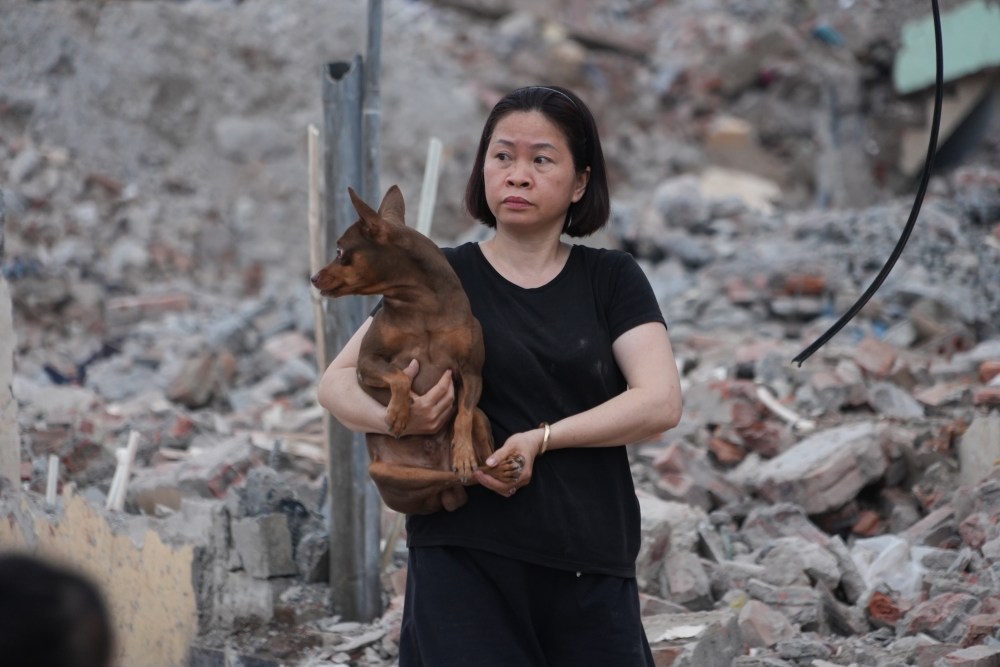
The promise of progress comes at a cost of homes, livelihoods and familiar sites, as dust from demolitions drifts across neighborhoods, settling on rooftops, trees and the few buildings still standing.
Nguyen Thi Nhan used to sell fruit from her 300-square-meter (3,230-square-foot) street front home. It was demolished to make way for a road. She has yet to get compensation for its loss and now rents a home for her family and parents.
“We just have to wait. I don’t know where they will relocate us,” she said.
The building boom carries risks
Big billboards display impressive visions of gleaming towers of steel and glass in new business and industrial districts, broad boulevards, parks and waterfront promenades. The plans call for the demolition of colonial villas, traditional narrow shophouses and densely packed low-rise buildings. The city will have new roads, bridges and transit links to airports and neighboring provinces.
The centerpiece is a $28 billion redevelopment along both banks of the silty Red River that runs through the city. It will cover 11,400 hectares (28,170 acres) — larger than the size of central Paris — and will feature new roads, parks, urban districts and, crucially drainage and other flood controls to contain chronic inundations.
A $35.2 billion Olympic sports area backed by Vietnam’s biggest company Vingroup will be anchored by one of the world’s largest soccer stadiums, shaped like a drum and capable of holding 135,000 fans.
Authorities also plan a major transport overhaul designed to reshape how Hanoi grows, reducing pressure on the city’s historic center by creating multiple transport hubs.
Such modern infrastructure is vital to Vietnam’s efforts to attract foreign investment and create new opportunities for residents and businesses, said Nguyen Khac Giang, a visiting fellow at the ISEAS–Yusof Ishak Institute in Singapore. But he warned the construction boom also risks diverting capital from the high-tech industries Vietnam wants to develop. And it could also raise property prices, leaving banks exposed to bad loans if the market weakens.
Apartment and land prices have risen sharply, making homes in the country’s biggest cities unaffordable for many. Meanwhile many developers are heavily indebted, with debt levels higher than those of peers in countries such as Indonesia and the Philippines, according to a 2025 S&P Global report.
Real estate makes up about 3.5% of Vietnam’s GDP, but accounts for roughly a quarter of bank lending.
“There are huge economic opportunities arising from those projects, but at the same time, there are risks that need to be considered,” Giang said.
Hanoi’s transformation raises fears over what may be lost
As Hanoi races to rebuild itself, residents are grappling with what that means for the communities and memories left behind.
Small changes in Hanoi’s streets can mean big disruptions for those who depend on them, as signs and awnings that have long been part of the city’s street life disappear.
A citywide crackdown since November has been clearing sidewalks of illegal parking, street vendors and commercial encroachments. Police vans roam the Old Quarter in the evenings, using loudspeakers to remind vendors to remove brightly colored plastic stools that spill onto sidewalks.
Thuy, a beef noodle soup seller who gave only one name, said the four stools and tables outside her shop once allowed her to serve four additional customers every hour or so. Now she can’t and is only scraping by. “My profits are already small to begin with,” she said.
In a rare show of public dissent, residents of the Bac Cau community along the Red River hung banners “imploring” city authorities to let thousands of families remain in their homes.
The villagers fear planned roads will eventually wipe out their community.
“We want to continue to live here, we’ve been here for generations,” said Van, a local resident who gave only her first name given risks of trouble with authorities for speaking out.
Questions persist over how the rebuilding is being carried out
Hanoi has set compensation and resettlement rules for land acquired for redevelopment projects, covering damaged structures, relocation costs and support for families moving graves.
But some residents said they had yet to receive any compensation and were uncertain about where they would live or what the future holds.
The challenge is not modernization itself, but its rapid pace and a lack of consultation with residents and experts, said Giang. It would be better, he said, to find ways to preserve the city’s history, street culture and livelihoods as it rebuilds.
Beijing, for instance, tore down most of its centuries-old city walls in the 1960s to make way for its first subway line and what is now a major ring road.
Similar redevelopment drives in China and other Asian cities have sparked disputes as residents were relocated to suburbs that often lacked basic amenities, breaking apart long-established communities.
“Once we depart from the city’s history, it’s very hard to revert or to turn back,” Giang said.
Unlike the past two decades of outward expansion through new urban areas, Hanoi’s current reconstruction is focused on reshaping the existing city, said Linh Nguyen, lead analyst at Control Risks.
This means redeveloping existing neighborhoods and relocating institutions — a far more complex task since it involves residents, property rights and compensation. The key challenge is execution, particularly land acquisition, relocation and coordination across government agencies. It’s also about whether Vietnam’s increasingly centralized state can deliver projects that have been planned for decades but never carried out.
“The last 20 years were about building a bigger Hanoi. The next 20 years will be about rebuilding the Hanoi that already exists. That’s a fundamentally different challenge,” she said.
___
The Associated Press’ climate and environmental coverage receives financial support from multiple private foundations. AP is solely responsible for all content. Find AP’s standards for working with philanthropies, a list of supporters and funded coverage areas at AP.org.