Inside one of the world’s few crash courses in conserving and caring for ancient papyrus manuscripts

Advertisement

Advertise with us

ANN ARBOR, Mich. (AP) — Shijin Jiang pulled the precision binocular headband magnifier over her eyes and hunched down within a few inches of the ancient text resting on a light board.

Read this article for free:


or

Already have an account? Log in here »

To continue reading, please subscribe:

Subscribe and receive a limited-edition Free Press branded hat or tote.

Digital Subscription

One year of digital access for only $205*

  • Enjoy unlimited reading on winnipegfreepress.com
  • Read the E-Edition, our digital replica newspaper
  • Access News Break, our award-winning app
  • Play interactive puzzles

*First annual payment billed as $205.00 + GST for one year. This annual subscription will automatically renew at $233.00 + GST every 52 weeks (10% off the regular annual price of $259.35). Offer available to new and qualified returning subscribers only. Cancel any time.

To continue reading, please subscribe:

Add Free Press access to your Brandon Sun subscription for only an additional

$1 for the first 4 weeks*

  • Enjoy unlimited reading on winnipegfreepress.com
  • Read the E-Edition, our digital replica newspaper
  • Access News Break, our award-winning app
  • Play interactive puzzles
Start now

*Your next Brandon Sun subscription payment will increase by $1.00 and you will be charged $17.95 plus GST for four weeks. After four weeks, your payment will increase to $24.95 plus GST every four weeks.

ANN ARBOR, Mich. (AP) — Shijin Jiang pulled the precision binocular headband magnifier over her eyes and hunched down within a few inches of the ancient text resting on a light board.

Using a pair of hand tools, Shijin carefully inspected the sheet made from the papyrus plant, proceeding with the utmost care. After all, it most likely hadn’t been handled in a century — nor read for thousands of years.

The Papyrus Conservation Summer Seminar at the University of Michigan is the only one of its kind in the Americas, according to the university. And it’s one of the few in the world designed to convey the best practices for conserving papyrus manuscripts, ancient texts written on rolls or sheets made from the papyrus plant.
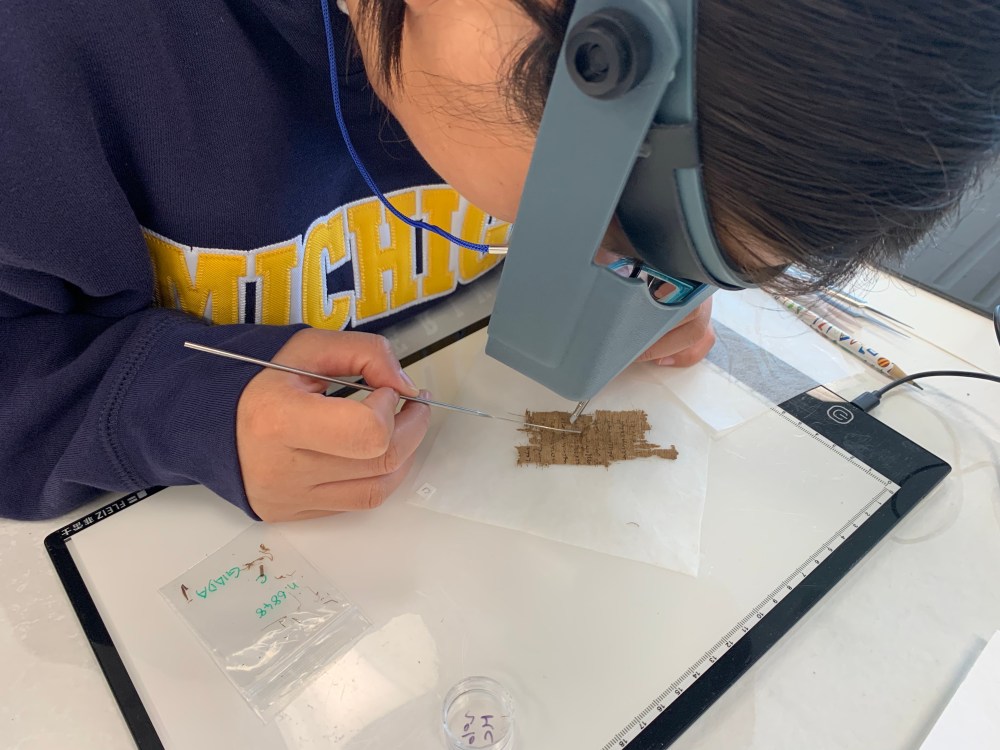
Papyrus Conservation Summer Seminar student Shijin (Giada) Jiang examines a papyrus fragment at the University of Michigan, Thursday, Aug. 6, 2026, in Ann Arbor, Mich. (AP Photo/Mike Householder)

“If you touch this papyrus, you can feel the history,” said Shijin, a native of China who was among nine scholars from across the globe, including Ireland, Italy and the U.S., who took the 10-day course.

Michigan’s Papyrology Collection covers texts and documents from 1000 B.C.E. to 1000 C.E. No institution on this side of the world has more of them, the Ann Arbor school said, giving the researchers access to a vast collection of ancient papyri. There are portions of the Homer epics, “The Odyssey” and “The Iliad,” writings by the philosopher Epicurus and the oldest-known copy of the Epistles of Paul.

“Carrying on this tradition is an incredible responsibility, but it also is incredibly fun and rewarding, because there’s nothing I love more than getting people together from all over the world, sharing ideas, learning from each other,” said Marieka Kaye, who manages library preservation services for physical collections at the University of Michigan Library.

Kaye said she tried to make “things comfortable and not scary, because a lot of people just feel terrified working on these ancient things.”

The seminar introduced the papyrologists and conservators to techniques in the treatment, storage and care of the ancient texts, as well as documentation practices. Papyrus and its ink can crumble, smear or break, so Kaye encouraged the students to carefully remove dirt, sand, salt and debris; use controlled moisture to soften folds and realign fibers; and dry the papyrus slowly under light weight to prevent curling.

The first seminar was held in 2012, and they have been held every two years since, except for the 2020 pandemic year. About 50 students total have taken part.

“If we don’t train the next generations of conservators, this is a craft that is going to be lost,” said Giuliano Sidro, curator of Michigan’s Papyrology Collection.

Michigan has so many papyrus manuscripts on hand that its researchers haven’t gone through them all. Some of the items were acquired, while others were excavated, during university expeditions to the ancient site of Karanis, Egypt, from 1924-35. Francis Willey Kelsey, a Latin professor who died in 1927, was the driving force behind the establishment of the Papyrology Collection. He believed Michigan students studying the ancient world needed access not only to books, but to the tangible remains of antiquity. Today, the Kelsey Museum of Archaeology is a fixture on the Michigan campus. Its collection represents one of the finest compilations of daily-life objects from Greco-Roman Egypt located outside of Cairo.

“This is a place where you make discoveries, potentially every day, if you just go into the vault, pick out a box and open something up, and you start reading,” Sidro said.

Of course, to make sense of it, one needs to be able to decipher Arabic, ancient Greek or Latin, and even Egyptian, one of the earliest known written languages that is now extinct. A few of the seminar participants were able to read the papyri, including Arzak Mohamed, who reads Arabic, and Mauro Castiello, a papyrology doctoral student in Milan, who can translate ancient Greek and Latin.

Kaye said she always tries to include a student from Egypt among the seminar participants.

Mohamed, a postdoctoral fellow at Macquarie University in Sydney, had heard about the papyrus seminar for years and always wanted to attend. The 42-year-old mother of three is from Fayoum, Egypt, not far from Karanis.

“Now, I can transfer this information from Michigan to Egypt and even in Australia,” she said. “I will be like the chain, connecting between the three countries.”

“By saving this information, we can transfer the knowledge to the next generation,” she added.
Report Error Submit a Tip

More Stories

‘In Normandy, we remember’

Aaron Epp 4 minute read Preview

‘In Normandy, we remember’

Aaron Epp 4 minute read Saturday, Sep. 26, 2026

Travelling nearly 7,000 km from his home in France to Winnipeg gave Gabriel Zaranski a new perspective on warfare.

“It’s very different to speak about war in school (than) to speak with real people who (have fought) in a war,” he said. “We can feel the emotion when they speak … The testimony has more impact when it’s real soldiers.”

Zaranski is one of 14 Grade 12 students from Bayeux, a town in France’s Normandy region, in Winnipeg this week for a learning tour.

The students, who attend Lycée Arcisse de Caumont high school, met on Saturday with veterans from the Queen’s Own Cameron Highlanders of Canada, a local military regiment, to discuss their studies and the regiment’s role in the Second World War.

Read
Saturday, Sep. 26, 2026

Restaurants ‘under pressure’

Gabrielle Piché 5 minute read Preview

Restaurants ‘under pressure’

Gabrielle Piché 5 minute read Friday, Sep. 25, 2026

Happy hour outings are on Jackie Piggott’s calendar — but even those are fewer.

She and her husband might visit a restaurant once a month. It’s a change over the past year: earlier, they may go twice, thrice or weekly.

“It’s something that we’ve talked about, my husband and myself, just because the pricing is so expensive,” Piggott said, stopping during a grocery run in St. Vital. “It’s also better for our health.”

She’s in the majority: a new Restaurants Canada report found 80 per cent of Canadians are eating out less frequently because of higher living costs, up from 75 per cent in 2025.

Read
Friday, Sep. 25, 2026

Is another goalie on Jets’ wish list?

Ken Wiebe 7 minute read Preview

Is another goalie on Jets’ wish list?

Ken Wiebe 7 minute read Yesterday at 6:59 PM CDT

Kevin Cheveldayoff and company are down to the short strokes.

With the opening-day roster due on Monday afternoon, the Winnipeg Jets took steps on the weekend to get down to the final number.

As it stood on Sunday, the Jets were down to 24 healthy players in training camp after centre Danny Zhilkin and defenceman Henry Thrun were placed on waivers.

With a maximum of 23 spots available, the only things left to determine are whether the Jets are interested in claiming a more experienced goalie to serve as the backup to Stuart Skinner and if centre Brayden Yager will break camp with the big club.

Read
Yesterday at 6:59 PM CDT

Bombers let another one slip away and face pivotal issue

Taylor Allen 7 minute read Preview

Bombers let another one slip away and face pivotal issue

Taylor Allen 7 minute read Saturday, Sep. 26, 2026

Mike O’Shea summed it up best.

“That one doesn’t feel very good.”

Nor should it.

The Winnipeg Blue Bombers started out hot Friday night, only to run out of gas down the stretch and allow the visiting Toronto Argonauts to steal a 30-28 victory.

Read
Saturday, Sep. 26, 2026

Province invests $3.8M in culinary arts training facility for francophone high school students

Kelly-Anne Riess 3 minute read Preview

Province invests $3.8M in culinary arts training facility for francophone high school students

Kelly-Anne Riess 3 minute read Yesterday at 12:10 PM CDT

A new dedicated culinary arts training facility will give francophone high school students a place to learn the trade in French.

The Manitoba government announced this week that it is providing $3.8 million toward the purchase of a property at 170 Marion St. and beginning design work for its renovation.

The facility will be the first dedicated vocational education site operated by Division scolaire franco-manitobaine, and the first fully French-language culinary arts program for Grade 11 and 12 students, preparing them for work in the restaurant and service sector.

“French-language education is a fundamental part of Manitoba’s identity and strength,” Education Minister Tracy Schmidt said in a news release. “It is an exciting step that will help strengthen both the francophone community and our skilled workforce.”

Read
Yesterday at 12:10 PM CDT

Respectful separation: an obvious oxymoron

Judy Waytiuk 6 minute read Preview

Respectful separation: an obvious oxymoron

Judy Waytiuk 6 minute read 2:00 AM CDT

“We want a fair and respectful relationship with Canada,” Alberta separatist leader Keith Wilson told the CBC commentator. He paused. Briefly. “On our terms.”

He followed up with a poorly-veiled threat. Trade goods moving east or west across Canada, especially to and from Vancouver, must pass through Alberta, he mused, so…

Wilson and his ilk are blackmailing Canada. If they win this referendum vote, he intends — with Alberta Premier Danielle Smith’s acquiescence — to pull the pin on a genuine separation referendum grenade. The separatists’ transition plan has been largely anonymously authored — much like Trump’s blueprint Project 2025.

Smith claims Albertans will vote against separation. She’s bluffing. Her precarious personal political survival tightrope as she tries to balance atop the UCP could easily carry Canada down a potentially disastrous road. All it will take is for separatists to turn out en masse (about 25 per cent of Albertans, if you believe the polls), and those supporting Canada to stay home because they think it’s in the bag for them.

Read
2:00 AM CDT