Finding a job after prison comes with extra challenges. Here are ways to overcome them
Advertisement
Read this article for free:
or
Already have an account? Log in here »
To continue reading, please subscribe:
Digital Subscription
One year of digital access for only $1.44 a week*
- Enjoy unlimited reading on winnipegfreepress.com
- Read the E-Edition, our digital replica newspaper
- Access News Break, our award-winning app
- Play interactive puzzles
*Billed as $5.77 plus GST every four weeks. After 52 weeks, price increases to the regular rate of $19.95 plus GST every four weeks. Offer available to new and qualified returning subscribers only. Cancel any time.
To continue reading, please subscribe:
Add Free Press access to your Brandon Sun subscription for only an additional
$1 for the first 4 weeks*
- Enjoy unlimited reading on winnipegfreepress.com
- Read the E-Edition, our digital replica newspaper
- Access News Break, our award-winning app
- Play interactive puzzles
*Your next Brandon Sun subscription payment will increase by $1.00 and you will be charged $17.95 plus GST for four weeks. After four weeks, your payment will increase to $24.95 plus GST every four weeks.
Read unlimited articles for free today:
or
Already have an account? Log in here »
NEW YORK (AP) — Don Christian had never held a regular job when he left prison. A conviction at age 19 for selling drugs kept him confined through young adulthood and into his early 40s.
When he got out after serving 23 years and started looking for work, “I had to start from the bottom. The very, very bottom,” Christian said. “I was willing to work anywhere. I just wanted to change my life.”
Having a criminal record, as an estimated 1 in 3 American adults do, creates hurdles for people seeking employment, especially in fields that require licenses, according to the Vera Institute of Justice, a nonprofit that aims to end mass incarceration. Meeting with parole officers, a need to secure stable housing and other conditions of release, along with discrimination, compound the typical challenges of job hunting.
“Even when they come home with skills and credentials, they see fewer job opportunities and they earn less money than people who don’t have convictions,” Ruth Delaney, who directs a higher education initiative at the Vera Institute, said.
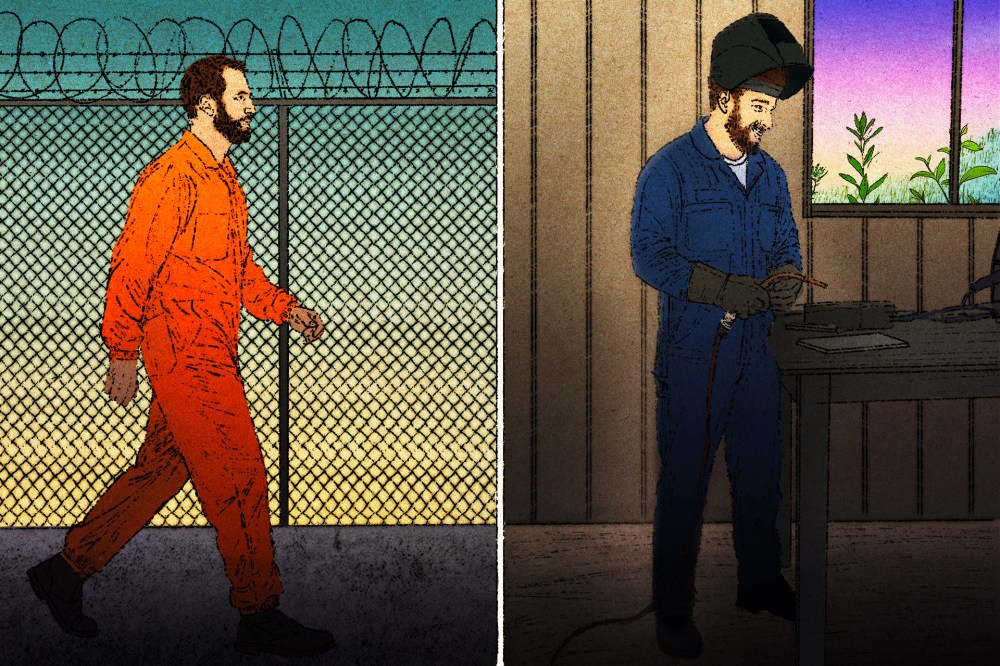
After Christian’s release, his parole officer suggested applying for a job at Toyotetsu, an auto parts manufacturer. The company hires former inmates through a second-chance program. Christian, now 53, got a welding job there and began rebuilding his life.
“I had to learn on the go, on the fly,” he said nine years later. “I already had my mind set — I wasn’t going to fail.”
Here are strategies shared by former inmates and reentry specialists for finding work after incarceration.
Develop skills before and after entering the workforce
People incarcerated in prisons with educational programs can build job skills by taking college-level courses or pursuing a professional certification.
Inmates interested in seeking a degree from an eligible college or university can apply for a federal Pell Grant to help cover the cost. The grants were unavailable to incarcerated students for decades, but the Vera Institute and other groups persuaded Congress to restore access.
Incarcerated people who pursue college programs have 48% lower odds of returning to prison than those who do not, according to Vera Institute research. “People who go home and are able to get living-wage jobs do better during reentry,” Delaney said. “They’re able to get jobs that can support themselves and their families.”
Ryan Cuellar, who went to jail at age 18, received federal financial aid after his release to learn paralegal skills, which he then used to get his record sealed. He eventually earned a master’s degree and now works as a sales consultant for a tutoring company.
“I can’t drive home enough how much determination you need to have for yourself,” Cuellar said.
Prison work experience is another way to gain skills that are worth including on a resume. You don’t have to spell out that your employer was a correctional institution, according to Laura Rivero, an instructor at Leap for Ladies, a nonprofit that teaches employment, entrepreneurship and life skills to women in prison.
Someone who worked in the kitchen of a Florida prison, for example, could list “State of Florida” as the employer and describe the experience as “operated commercial dishwashing machines” or “prepared and served foods in a high-volume dining facility,” Rivero said.
Christian took up welding in prison, which helped him land his first job at Toyotetsu. He still is at the company, where he mentors new employees. He is taking social work classes with the goal of earning an associate degree and helping other former inmates transition into working life.
Seek out employers with second-chance hiring programs
A number of U.S. companies, including large employers like JP Morgan Chase and Virgin Atlantic, work intentionally to hire people with criminal records. The Business Roundtable, a nonprofit association of American CEOs, and the U.S. Chamber of Commerce have promoted “ second-chance hiring” as a policy that can help address labor shortages as baby boomers retire in large numbers.
Some types of businesses, such as restaurants and warehouses, have established track records for hiring former inmates. Manufacturing jobs and technical positions in health care are growing opportunities as well, Delaney said.
Before a release date, think about who might be able to help you find a job — cousins, former coworkers, teachers or a former boss, Rivero said.
“Some of my students have a lot of shame about their conviction, and they say, ‘I don’t want to reach out to someone because I’m ashamed of where I am,’” she said. “Maybe they don’t respond. Maybe they do. And you don’t know until you try.”
Be prepared to talk about your past
After Joe Anderson left prison and completed house arrest, a friend who worked at a welding plant said the plant needed a dock manager to handle deliveries.
Anderson went there, asked to speak to a manager, and said, “I got out of prison, I really need a job, and I will show up for work because I need this job to stay out of jail.”
The manager appreciated his honesty; Anderson got the job and held it for four years.
“I’ve never really tried to hide anything from anybody because there’s no real point in it with technology these days,” he said. “Anybody can find out anything about you.”
Parole officers showed up at the plant three or four times, Anderson said.
“It’s embarrassing, but at the same time, it got done and they’d show up, just see that I was working and then just wander off,” he said.
Anderson, 34, now earns a salary as a commercial plumber, a job that provides insurance, a pension and a 401(k). “None of that would have been possible if I wasn’t honest about what happened and if I just didn’t get up and try,” he said.
Rivero advises her Leap for Ladies students to disclose a prior conviction during job interviews. She suggested starting with a brief description of your strengths and skills, mentioning that a rough time in your life landed you in prison, and pivoting back to all your positive qualities.
“I tell them, ‘Look, you’re not your conviction, you’re not the worst day of your life,’” Rivero said. “You can frame the narrative if you bring it up.”
Prepare for success by making lifestyle changes
Getting a job is an important step. Keeping it and succeeding require their own strategies.
Christian said his first job required 12-hour shifts five or six days per week, with a schedule that alternated between day and night shifts.
“It won’t just be 8-hour jobs,” he said. “You’ve got to learn how to shift your sleep patterns. … You’ve got to get proper rest.”

After Cuellar started working, he noticed habits he had acquired while incarcerated and needed to break. “I developed a slang that I had to unlearn,” he recalled. “I didn’t realize it was a survival mechanism.”
The change was a big adjustment for Anderson, who before prison was out drinking at parties and raves every night. These days he wakes up around 4 a.m. to get to work on time.
“It is 100% harder to get up every single day to go to work, bust your body, but it’s lot more rewarding at the end of the day,” Anderson said. “My children are very proud of me. My family’s proud of me again.”
___
Share your stories and questions about workplace wellness at cbussewitz@ap.org. Follow AP’s Be Well coverage, focusing on wellness, fitness, diet and mental health at https://apnews.com/hub/be-well