Prehistoric Yukon ‘cheetahs’ were fish eaters, not really cheetahs at all: study

Advertisement

Advertise with us

Slender, agile cheetahs that roamed the Yukon 30,000 years ago were not technically cheetahs at all, but relatives of the puma that adapted to mostly eat fish instead of antelopes in a harsh northern climate, new research shows.

Read this article for free:


or

Already have an account? Log in here »

To continue reading, please subscribe:

Subscribe and receive a limited-edition Free Press branded hat or tote.

Digital Subscription

One year of digital access for only $205*

  • Enjoy unlimited reading on winnipegfreepress.com
  • Read the E-Edition, our digital replica newspaper
  • Access News Break, our award-winning app
  • Play interactive puzzles

*First annual payment billed as $205.00 + GST for one year. This annual subscription will automatically renew at $233.00 + GST every 52 weeks (10% off the regular annual price of $259.35). Offer available to new and qualified returning subscribers only. Cancel any time.

To continue reading, please subscribe:

Add Free Press access to your Brandon Sun subscription for only an additional

$1 for the first 4 weeks*

  • Enjoy unlimited reading on winnipegfreepress.com
  • Read the E-Edition, our digital replica newspaper
  • Access News Break, our award-winning app
  • Play interactive puzzles
Start now

*Your next Brandon Sun subscription payment will increase by $1.00 and you will be charged $17.95 plus GST for four weeks. After four weeks, your payment will increase to $24.95 plus GST every four weeks.

Slender, agile cheetahs that roamed the Yukon 30,000 years ago were not technically cheetahs at all, but relatives of the puma that adapted to mostly eat fish instead of antelopes in a harsh northern climate, new research shows.

A study published in the journal Current Biology analyzed fossils found in the Yukon and Wyoming in the United States belonging to Miracinonyx trumani, also known as the “American cheetah.”

With their gracefully slim bodies and long legs, the now-extinct cats appeared to resemble African cheetahs.
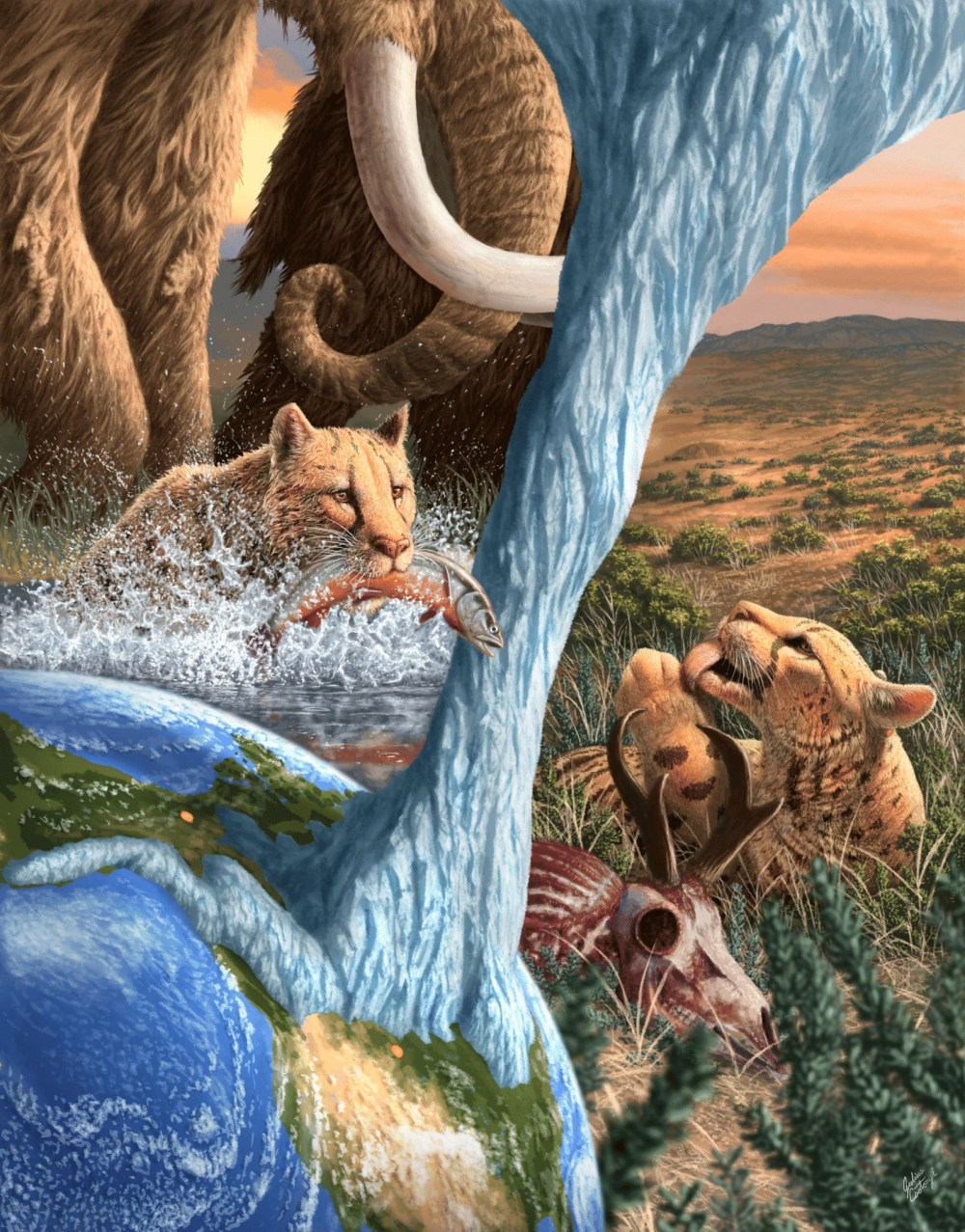
Two Miracinonyx hunt in this artistic rendering. A new study says the cheetah-like species which roamed the Yukon 30,000 years ago developed a unique fish diet to survive. (Julius Csotonyi via The Canadian Press)

But the researchers found the cats were actually closer relatives of the puma, having diverged from the puma lineage around 2.6 million years ago as growing grasslands and cooling temperatures drove diversification in many North American mammals.

Grant Zazula, a paleontologist for the Yukon government and one of the study’s co-authors, said the species’ identification in the territory was interesting because the pronghorn antelope hunted by their southern counterparts never existed there.

The researchers wanted to find out what the Yukon cats were eating instead, so they sent the fossils for analysis. The results showed a chemical signature that matched other fish-eating predators like grizzly bears, Zazula said.

In fact, the Yukon cats adapted to eat mostly fish, a unique preference compared to the more diverse diet favoured by their southern kin.

“We’ve never seen a cat behave like this before,” Zazula said in an interview Thursday.

He said the cats likely made the change to adapt to their new environment after travelling farther north into a Yukon that was vastly different 30,000 years ago.

Gone were the boreal forests with their spruce trees and animals such as moose found in modern-day Yukon. Instead, the cats would have faced tree-barren grasslands and walked alongside woolly mammoths, wild horses, bison and other large mammals.

“Because there were so many of these big herbivorous animals on the landscape, we had lots of carnivores that were eating them,” Zazula said. The other predators included lions, sabretooth cats, wolves and grizzly bears.

The Yukon cheetahs would have had to find their niche in a competitive and unforgiving environment, Zazula added.

Luckily, the region’s rivers were rich with salmon and the cats could eat fish carcasses along the banks or have their pick from fish-packed spawning grounds.

Their distinct diet was likely key to their survival in the north, Zazula said.

“In order to live and be successful in the Yukon during the Ice Age, it had to figure out its way to live. And that fishing niche wasn’t occupied,” he said.

The Yukon environment also had an impact on the cats’ genetics, the researchers found. Two of the genes that regulate circadian rhythm — essentially the body’s internal alarm clock that reacts to changes in brightness — were non-functional in the cats.

It could be because the animals had to adapt to seasonal extremes of sunlight and darkness because of their high-altitude homes, or the cats could have been nocturnal.

The cats eventually went extinct after they couldn’t adapt to ecosystem changes at the end of the Ice Age.

But Zazula said their hardiness in adapting to their Yukon environment had parallels to the people who now live there.

“Everybody that moves to the Yukon has to figure out a different way to live if you’re not from here,” he said. “(The cats) made their way, they figured it out by adapting to new resources and new environmental conditions. It became something unique — the Yukon cheetah.”

This report by The Canadian Press was first published Sept. 4, 2026.

Report Error Submit a Tip

More Stories

Brandonmeat packer thriving on its own

Abiola Odutola 3 minute read Preview

Brandonmeat packer thriving on its own

Abiola Odutola 3 minute read Yesterday at 2:01 AM CDT

BRANDON — Canada Packers has strengthened its business and laid the foundation for future growth during its first year as an independent company, its president says.

The Brandon-based pork producer, separated from Maple Leaf Foods in October 2025, established its own leadership, strategy, systems, culture and identity while continuing operations across its hog production farms and regional hog barns in southern and eastern Manitoba.

The company’s first year was focused on building a successful standalone business while continuing to serve customers, communities and shareholders, president Dennis Organ said.

“Market conditions over the past year have been more challenging than we anticipated when we became a separate entity,” he said in an email. “Despite that, we continued to execute against our priorities, including increasing processing volumes, maintaining disciplined operations and strengthening the business.”

Read
Yesterday at 2:01 AM CDT

Puzzles Palace

1 minute read Monday, Jul. 27, 2026

To solve our puzzles, please subscribe with this special offer: |

Living the dream

Ken Wiebe 7 minute read Preview

Living the dream

Ken Wiebe 7 minute read Yesterday at 4:48 PM CDT

DETROIT – As Tyrel Bauer took a left turn out of the tunnel from the Winnipeg Jets dressing room and into the stands, he was met with a hearty round of applause from the 25 friends and family members who had made the trek from various points around North America.

Bauer had just realized a childhood dream and the significance of the moment was not lost on some of his biggest supporters.

“It was a special walk, for sure. A special walk,” Bauer said on Saturday afternoon before the Jets departed for a two-game road trip that begins on Sunday in Detroit against the Red Wings. “Those people who came – and many more that weren’t there and were cheering on from afar – they’ve always been there.

“I wanted that for my family, maybe even more than I wanted it for me. They’ve been through thick and thin. I’ve stressed mom out quite a bit over the years doing my job. That meant a lot for them and I’m really happy they could be there for it.”

Read
Yesterday at 4:48 PM CDT

Board game company charts winning path

Aaron Epp 5 minute read Preview

Board game company charts winning path

Aaron Epp 5 minute read Friday, Oct. 2, 2026

Dennis Northcott has launched a game without frontiers.

The Winnipeg entrepreneur is the co-designer of Galactic Cruise, a board game published last year by Kinson Key Games LLC, the business he co-founded. Since its release, Galactic Cruise has been translated into 11 languages and sold around 50,000 copies worldwide.

It’s also one of three finalists for this year’s Deutsche Spiele Preis, a prestigious community-voted board game award. Northcott will travel to Essen, Germany, later this month, where the winner will be announced at Spiel Essen, an annual board game trade fair.

“It’s been amazing,” Northcott said of the response to Galactic Cruise during an interview in his Island Lakes neighbourhood home earlier this week. “The sales have been great, but it’s also been amazing in terms of people giving their reviews.”

Read
Friday, Oct. 2, 2026

Record participation, funds raised in 2026 breast cancer awareness race

Maggie Macintosh 4 minute read Preview

Record participation, funds raised in 2026 breast cancer awareness race

Maggie Macintosh 4 minute read Updated: 7:08 PM CDT

It’s become a tradition for the West End Legends to gather, get dressed up in hot pink and gab about their late girlfriend on the first Sunday of Breast Cancer Awareness Month.

“Mary was a beauty, a brain, an athlete and a friend,” said Linda Opalko, a 67-year-old member of the fundraising team founded in honour of Mary Stawychny.

Stawychny’s last breath was taken the same day the group — made up of friends the career teacher maintained since she grew up on Ingersoll Street more than 50 years ago — got together for the 2022 CIBC Run for the Cure.

“We were walking as she was leaving us four years ago,” Opalko said as she and fellow fundraisers strolled down Wellington Crescent on Sunday morning.

Read
Updated: 7:08 PM CDT

A day on the campaign trail: Winnipeg's mayor, seeking a second term, does double duty

Malak Abas 12 minute read Preview

A day on the campaign trail: Winnipeg's mayor, seeking a second term, does double duty

Malak Abas 12 minute read Friday, Oct. 2, 2026

In the weeks leading up to the civic election, Scott Gillingham has been performing a juggling act: he’s running to be Winnipeg’s 45th mayor, while still serving as its 44th.

“If someone asks me about the campaign, I’m going to answer them. But I think for most people, I’m the mayor of Winnipeg, even if I’m showing up as a candidate,” Gillingham, 58, says. “I try to do all I can to maintain that distinction.”

The Free Press joined Gillingham on a recent rainy September Saturday on the campaign trail, where he served in both roles during an event-laden day. City council’s final meeting before the Oct. 28 election was days earlier.

In Winnipeg, it’s rare for an incumbent to be defeated. But Gillingham knows his win in 2022 wasn’t exactly a landslide — he won with 27.5 per cent of the vote — and he’s been thinking about his second term ever since.

Read
Friday, Oct. 2, 2026