For New York’s Haitian community, annual West Indian Day Parade means more in trying times

Advertisement

Advertise with us

NEW YORK (AP) — Steel drums, flag-draped floats, and the smell of jerk chicken filled Brooklyn’s Eastern Parkway on Monday, as hundreds of thousands turned out for the West Indian Day Parade, one of the largest celebrations of Caribbean culture in the country.

Read this article for free:


or

Already have an account? Log in here »

To continue reading, please subscribe:

Subscribe and receive a limited-edition Free Press branded hat or tote.

Digital Subscription

One year of digital access for only $205*

  • Enjoy unlimited reading on winnipegfreepress.com
  • Read the E-Edition, our digital replica newspaper
  • Access News Break, our award-winning app
  • Play interactive puzzles

*First annual payment billed as $205.00 + GST for one year. This annual subscription will automatically renew at $233.00 + GST every 52 weeks (10% off the regular annual price of $259.35). Offer available to new and qualified returning subscribers only. Cancel any time.

To continue reading, please subscribe:

Add Free Press access to your Brandon Sun subscription for only an additional

$1 for the first 4 weeks*

  • Enjoy unlimited reading on winnipegfreepress.com
  • Read the E-Edition, our digital replica newspaper
  • Access News Break, our award-winning app
  • Play interactive puzzles
Start now

*Your next Brandon Sun subscription payment will increase by $1.00 and you will be charged $17.95 plus GST for four weeks. After four weeks, your payment will increase to $24.95 plus GST every four weeks.

NEW YORK (AP) — Steel drums, flag-draped floats, and the smell of jerk chicken filled Brooklyn’s Eastern Parkway on Monday, as hundreds of thousands turned out for the West Indian Day Parade, one of the largest celebrations of Caribbean culture in the country.

This year, Haitians marched under more solemn circumstances than in prior years. Federal immigration enforcement has intensified against Caribbean and other Black immigrant communities over the past year, and Haitians have lost a key protection — temporary protected status. Known as TPS, it let hundreds of thousands remain in the U.S. legally.

Organizers say the parade has become both a defiant assertion of pride and a rare bright spot in a traumatic year.
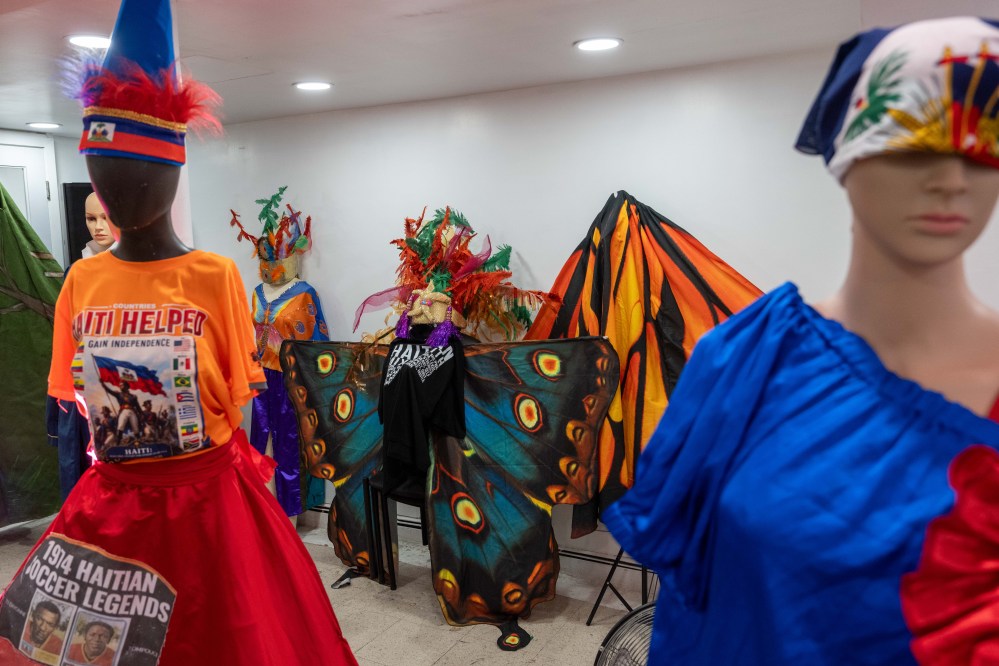
Haitian costumes for Lespri Ayiti Mas Camp are displayed ahead of the West Indian Day Parade, Thursday, Sept. 3, 2026, in the Brooklyn borough of New York. (AP Photo/Adam Gray)

“There’s a somber cloud over it with everything that has happened from last year to this year with TPS … what’s happening in detention centers, and those who are being sent back with no valid way of living or supporting themselves,” said Natalie Lafontant, a Brooklyn native who organizes Lespri Ayiti, or “Spirit of Haiti,” the largest Haitian “mas” — short for masquerade — or marching community in Monday’s parade.

Still, she said, the response to hardship is not surrender.

“But if you know anything about the Caribbean, especially about Haiti, we use music, dance, art to continue to strive and push through,” Lafontant said while taking stock of parade costumes at a community center.

Keeping parade plans alive amid anti-immigrant policies

In June, the U.S. Supreme Court ruled 6-3 in Mullin v. Doe that federal courts cannot review the Trump administration’s decision to end temporary protected status for Haitian and Syrian immigrants, clearing the way for roughly 350,000 Haitians to lose the protection. A federal judge finalized the order in early August, and work permits tied to Haitian TPS expired July 27.

Lafontant’s group, comprising about 180 artists, designers, musicians and residents, is marching in the parade for the second year. The group struggled to find float sponsors this year.

“All the insurances that we’ve got to cover, the people who walk, you’ve got to take care of them, the costumes, the designers. You add that all up, it’s a very hefty bill. But we continue to do it because we love our country,” Lafontant said.

Haitians’ history with New York goes back decades

Lafontant is part of a Haitian community that numbers roughly 163,000 in the New York metropolitan area, according to the Migration Policy Institute — the second-largest Haitian population in the U.S. after the Miami metropolitan area.

Most Haitian migrants settled in Brooklyn neighborhoods, including Flatbush, East Flatbush and Crown Heights.

Haitians arrived in New York in waves beginning under the dictatorship of Jean-Claude “Baby Doc” Duvalier, whose regime’s repression and economic collapse drove many to leave the island in the 1970s and 1980s. The migration continued after his 1986 ouster.

Haiti’s history of resistance runs deeper still, back to the Haitian Revolution, when enslaved and free Black people overthrew French colonial rule in what is widely regarded as the only successful slave revolt in modern history, culminating in the 1803 Battle of Vertières. The victory paved the way for Haiti’s independence the following year.

That history of resistance remains a source of pride for Haitians far beyond the country’s shores, even among generations who have built new lives abroad.
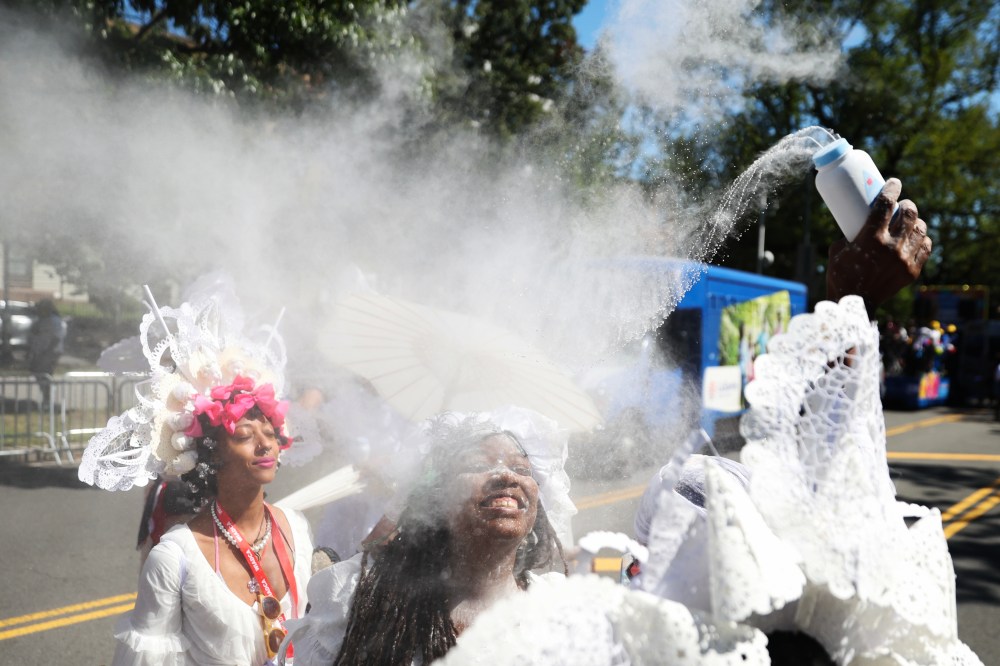
Members of the Belmont Baby Dolls throw baby powder as they wait for the start of the West Indian Day Parade on Monday, Sept. 7, 2026, in the Brooklyn borough of New York. (AP Photo/Heather Khalifa)

Edwina Paul, founder of SPM, or “Fanm Se Poto Mitan” — “Women Are the Pillar of Society” — left Haiti in 1993 to start a new life with her husband in the Brooklyn neighborhood of Canarsie. Paul, whose coalition of Haitian women leaders and organizers marched Monday, said conditions in Haiti are what pushed people to leave.

“It’s not safe there. Coming here is like an umbrella for us to be safe from that,” she said of those fleeing the country’s gang violence and instability. “We don’t come here to sin. We don’t come here to kill. We come here to work, to have a better education.”

An electrifying lineup of Haitian pop, fashion

SPM’s resilience was stitched into its costumes this year. Clara Poteau, a fashion designer and an alumna of the Fashion Institute of Technology, designed royal-blue emperor robes in the image of Jean-Jacques Dessalines, a lieutenant and leader of the Haitian Revolution and the first leader of an independent Haiti.

A total of six designers and one painter spent a month hand-painting costumes that commemorate Haitian achievements, working through the weekend before the parade: dresses covered in miniature Haitian flags, skirts bearing the faces of Duckens Nazon and Emmanuel Sanon, the national football players who hold Haiti’s international scoring records.

One orange T-shirt, dubbed the “Freedom” tee, carries the flags of nations Haitian revolutionary leaders helped liberate with shelter, money, weapons, and troops, including Venezuela, Colombia, Ecuador, Peru, Bolivia, Panama, Mexico and Greece.

Parade attendees first experienced Haitian energy through the sound of the mas before seeing the musicians, led by Jesus Luc, a Harlem native and Lespri Ayiti’s band manager. Luc coordinated a lineup built around Raboday, a popular genre of contemporary Haitian and Caribbean sounds, and Kompa, Haiti’s signature native dance music.

Headlining was DJ Comix of the band Team Madada, described by Luc as “probably the most popular group in Haiti,” part of a new generation of sound defining the country’s youth.

“It’s electrifying. It’s music that will touch your soul. Between the music and the costumes … it’s the heart of the people that’s going to be there.”

Report Error Submit a Tip

More Stories

Morning-show veteran swaps microphone for macchiatos at new Corydon café

David Sanderson 9 minute read Preview

Morning-show veteran swaps microphone for macchiatos at new Corydon café

David Sanderson 9 minute read Yesterday at 2:00 AM CDT

Good news if you were used to having your morning coffee with Terri Gale, who earlier this summer signed off from CTV Your Morning, after 15 years on the job.

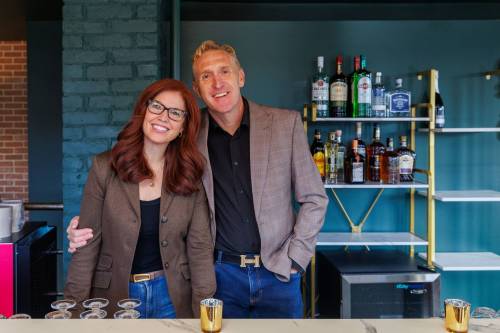
Gale, the three-hour program’s longtime weather expert, and her husband Rob Gale, the ex-head soccer coach of Valour FC and co-founder of the Northern Super League’s new Winnipeg franchise, are the owners of Golden Hour Café and Bar at 775 Corydon Ave.

Gale (formerly Apostle) nods when she is asked who would know more about caffeinated beverages than a person who, for the last decade and a half, set her alarm to go off in the wee small hours.

“I do love coffee and take mine black. Except because I hate burning my tongue — not a good thing when you speak for a living — I got into the habit of throwing a couple of ice cubes in my cup, to be on the safe side,” Gale says, seated on the second level of their attractive, 2,100-square-foot premises, which officially opened in mid-September.

Read
Yesterday at 2:00 AM CDT

Mayoral candidate Vogiatzakis criticized for living outside Winnipeg

Malak Abas 4 minute read Preview

Mayoral candidate Vogiatzakis criticized for living outside Winnipeg

Malak Abas 4 minute read Friday, Oct. 2, 2026

A mayoral hopeful took heat from other candidates Friday for living outside Winnipeg while running in the civic election.

Mike Vogiatzakis’s primary residence is in the Rural Municipality of St. Andrews, about 25 kilometres north of Winnipeg — a community with its own mayor and councillors.

But the funeral director said he owns a home in Winnipeg where he divides his time, and he would move to the city full-time if elected mayor.

“It doesn’t matter where a person lives. Why are we dividing St. Andrews and Manitoba and Winnipeg? I’ve met the criteria to run for mayor,” Vogiatzakis said Friday morning.

Read
Friday, Oct. 2, 2026

’Disgusting’ posters being investigated by police

Morgan Modjeski 4 minute read Yesterday at 2:22 PM CDT

The Winnipeg Police Service major crimes unit is investigating what some have labelled offensive and hateful posters on full-display at a Winnipeg home.

One of the people irked by the display is Gracie Garrett. She’s has lived on Ashburn Street in Winnipeg’s Minto neighbourhood for almost ten years. She’s never felt unsafe in the neighbourhood before, but now, a set of posters plastered on a nearby house are making her feel uneasy.

The five signs, posted facing the street prominently on a front window, contain a slur, refer to Nazis as “heroes” and call Muslims, Christians and other groups “evil.”

Learning of the signs Friday, Garrett said she’ll be reporting the posters to police, as she worries they incite and promote violence.

Blown lead spoils Jets opener

Mike McIntyre 7 minute read Preview

Blown lead spoils Jets opener

Mike McIntyre 7 minute read Friday, Oct. 2, 2026

Younger. Faster. Stronger.

They may still be a long ways from a finished product, but it’s safe to say the new-look Winnipeg Jets made a mostly favourable first impression on Friday night in front of a sold-out crowd at Canada Life Centre.

Sure, a 4-3 overtime loss to a hard-nosed Boston Bruins outfit is going to sting a little, especially since the home team was just 98 seconds away from a regulation victory.

But if the Jets can bottle up this kind of energy and effort, they should enjoy plenty of success over the course of the 84-game campaign.

Read
Friday, Oct. 2, 2026

Letters, Oct. 3

7 minute read Yesterday at 2:01 AM CDT

A morning in the life …

My very first lesson does not start when I walk into that lecture hall, oh no — it starts long before. It begins when I walk to my car, check the estimated arrival time to the University of Manitoba and hope that Winnipeg traffic agrees with it.

A drive that appears completely manageable changes almost immediately when I’m greeted by a tsunami of orange pylons and a line of cars that appears to go on forever. Traffic moves by the inch, lanes magically disappear and the detour I took yesterday now has a detour of its own. These factors make me do a calculation that I have become all too familiar with. How late can I arrive and still find parking, run to my class across campus and get to class with enough time left to make it worth it?

I have grown used to people saying, “Why not just leave earlier?” I do. But when I’m already leaving for my 8:30 a.m. class at 7 a.m., there’s only so much I can do. This drive that some would think is relaxing is one that feels like an assignment that I didn’t know I had to complete and is due at 8:30 a.m.

Manitoba’s own Summer Howell takes on biggest role yet as Stephen King’s telekinetic teen Carrie

Randall King 7 minute read Preview

Manitoba’s own Summer Howell takes on biggest role yet as Stephen King’s telekinetic teen Carrie

Randall King 7 minute read Friday, Oct. 2, 2026

From the tender age of eight, actress Summer Howell has made her presence known in a series of horror films shot in her home province of Manitoba.

Her first film was Curse of Chucky (2013), director Don Mancini’s continuation of the venerable killer doll series he started (as a screenwriter) in 1988 with Child’s Play.

“Even then, it was obvious she was very talented, intelligent and delightful,” Mancini said of Howell.

Though she has worked in other genres, Howell gravitated to horror repeatedly, with credits in Shawn Linden’s harrowing Hunter Hunter (2020) and the 2023 possession thriller All Fun and Games. Earlier this year, she shot the horror film Sundown in Winnipeg with director Rebekah McKendry, which premièred last week at Beyond Fest in Los Angeles and is headed for a streaming berth on Shudder.

Read
Friday, Oct. 2, 2026