From the Lockerbie bombing to 9/11: How attacks on flights defined US air travel
Advertisement
Read this article for free:
or
Already have an account? Log in here »
To continue reading, please subscribe:

Digital Subscription
One year of digital access for only $205*
- Enjoy unlimited reading on winnipegfreepress.com
- Read the E-Edition, our digital replica newspaper
- Access News Break, our award-winning app
- Play interactive puzzles
*First annual payment billed as $205.00 + GST for one year. This annual subscription will automatically renew at $233.00 + GST every 52 weeks (10% off the regular annual price of $259.35). Offer available to new and qualified returning subscribers only. Cancel any time.
To continue reading, please subscribe:
Add Free Press access to your Brandon Sun subscription for only an additional
$1 for the first 4 weeks*
- Enjoy unlimited reading on winnipegfreepress.com
- Read the E-Edition, our digital replica newspaper
- Access News Break, our award-winning app
- Play interactive puzzles
*Your next Brandon Sun subscription payment will increase by $1.00 and you will be charged $17.95 plus GST for four weeks. After four weeks, your payment will increase to $24.95 plus GST every four weeks.
Read unlimited articles for free today:
or
Already have an account? Log in here »
Taking a commercial flight from a U.S. airport generally requires security screening controlled by the federal government, a boarding pass or prior authorization to get anywhere near a gate, and careful attention to the contents of carry-on bags.
It wasn’t always this way. Travelers once passed through security checkpoints staffed by private contractors selected by airlines. Full-sized bottles of shampoo and cans of shaving cream didn’t get tossed for exceeding liquid limits. Friends and relatives didn’t need advance clearance to exchange goodbye hugs with departing passengers just before boarding time.
The procedures air travelers follow today were built layer by layer, often after attacks or attempted attacks exposed new safety vulnerabilities and threats — from bombs hidden in luggage to hijackers who turned airplanes into weapons.
“Attacks on aviation have an impact much greater than attacks on anything else because aviation commands the attention of the world as the thing that links the world,” said Mary Schiavo, a pilot and aviation disaster attorney.
As the 25th anniversary of 9/11 nears, here’s how those attacks, the earlier bombing of Pan Am Flight 103 and subsequent plots helped shape airline and airport security.
9/11 requires authorities to consider aircraft hijackings in new ways
No single day changed air travel more dramatically than Sept. 11, 2001, when 19 al-Qaida hijackers commandeered four commercial airplanes, crashed two into New York’s World Trade Center, one into the Pentagon and another in a Pennsylvania field.
Before then, authorities presumed aircraft hijackers would seek to negotiate, not deliberately crash a plane as part of an attack, according to Schiavo, who served as the U.S. Department of Transportation’s inspector general from 1990 to 1996.
“The focus at the time, generally, was not on suicide attackers,” she said.
U.S. officials introduced changes before the 9/11 Commission identified systemic failures and missed warning signs that allowed the plot to proceed.
The Federal Aviation Administration immediately restricted gate access at airports to ticketed passengers and banned knives and box cutters from carry-on bags. The hijackers used small knives to threaten passengers, attack crew members and seize the planes.
Congress created the Transportation Security Administration, shifting airport screening responsibility to government workers. Lawmakers The same law required reinforced cockpit doors, more federal air marshals on flights and 100% of checked luggage to undergo screening for explosives.
With screening times and lines getting longer, TSA looked for ways to move pre-vetted travelers through more efficiently, said Sheldon Jacobson, a University of Illinois professor whose research contributed to the design of TSA PreCheck.
TSA increasingly used watchlist checks, voluntary background investigations and other information to sort passengers based on assessed risk. Travelers selected for additional scrutiny faced more intensive checks. Civil liberties advocates warned that opaque selection criteria and inaccurate watch lists would encourage discriminatory profiling based on race or religion.
The range of security flaws that 9/11 bared came after authorities and the aviation industry spent more than a decade trying to address gaps that earlier attacks brought to light.
A bombing high above Scotland puts a spotlight on checked bags and hidden explosives
Almost 13 years before 9/11, a bomb destroyed a jumbo jet operated by a U.S. airline as it flew at 31,000 feet over Lockerbie, Scotland, killing all 259 people aboard and 11 people on the ground. Investigators determined an explosive device hidden in a radio-cassette player had been inside a suitcase that was checked in Malta and ultimately transferred to Pan Am Flight 103 without an accompanying passenger.
The Dec. 21, 1988, attack on the London-to-New York flight “stimulated the most significant changes in aviation security since the early 1970s,” former FAA Administrator Jane Garvey told the 9/11 Commission in 2003.
The FAA ordered U.S. carriers at airports in Europe and the Middle East to X-ray or physically search all checked baggage, to conduct additional random checks, and to confirm that checked bags belonged to flying passengers.
Acting on a presidential commission’s recommendations and orders from Congress, the FAA elevated security as an agency priority, established intelligence-sharing agreements, instituted tighter cargo controls, developed training standards for private screeners and researched explosives-detection technology.
The FAA also covertly tested airport and airline security systems by assigning a team “to simulate the criminal and terrorist attacker modus operandi,” Garvey testified. On Sept. 10, 2001, the agency saw attacks with explosive devices as the most dangerous threat to an airliner and the people on it, she told the 9/11 Commission.
“The challenge is not formulating attack scenarios,” Garvey said. “The challenge is figuring out how best to allocate finite resources in an environment of uncertainty.”
Footwear and beverage bottles emerge as security concerns in the wake of foiled bomb plots
Three months and 11 days after 9/11, Richard Reid boarded American Airlines Flight 63 from Paris to Miami with explosives hidden in his shoes. The British man tried to ignite them midflight but struggled to light the fuse before other passengers and crew members subdued him.
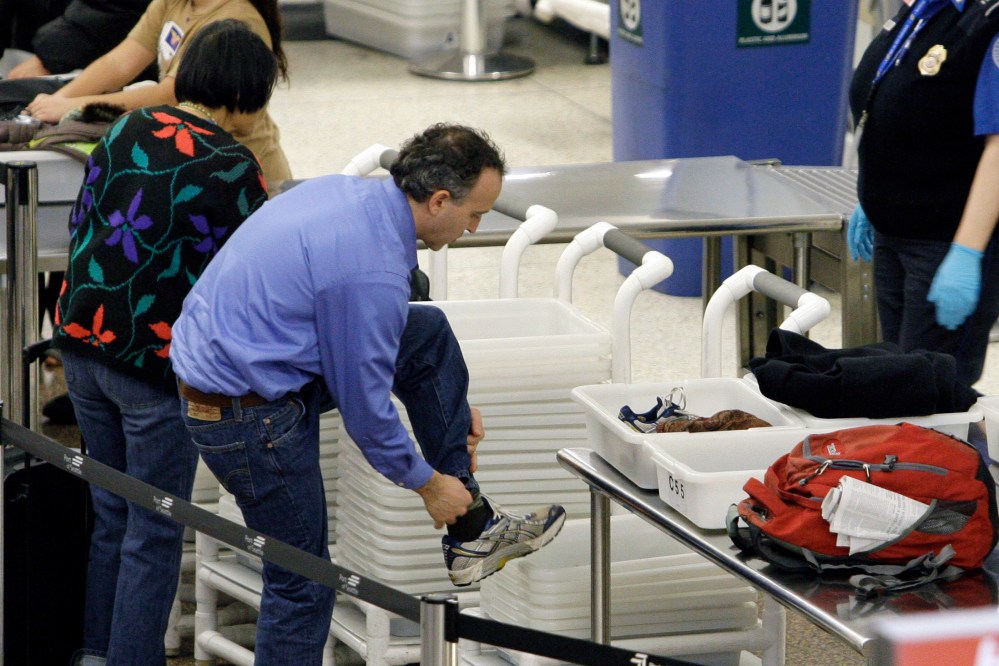
TSA and airlines asked passengers after the Dec. 22, 2001, incident to remove their shoes voluntarily during security screening. Shoe removal became mandatory less than five years later, when TSA also restricted outside liquids and gels on commercial planes.
The changes came after British authorities announced they had disrupted a plot to use liquid explosives concealed in beverage bottles to destroy seven transatlantic airliners. Authorities alleged the plotters planned to assemble and detonate devices in suicide attacks. Six men ultimately were convicted.
TSA immediately banned nearly all liquids, gels and aerosols from remaining with travelers beyond security screening. The agency soon replaced the prohibition with the “3-1-1” rule that limits passengers to containers of 3.4 ounces or less that must fit in a single quart-sized, clear plastic bag.
In July 2025, the Trump administration ended the shoe screening requirement that sent passengers shuffling through security barefoot or in socks.
The so-called “underwear bomber” accelerates the rollout of body scanners
On Christmas Day 2009, a passenger on Northwest Airlines Flight 253 tried to detonate explosives hidden in his underwear as the plane approached Detroit. The device failed and the young man — who identified himself as a Yemen-trained member of al-Qaida — was severely burned. Umar Farouk Abdulmutallab, later pleaded guilty to attempting to destroy the aircraft.
The checkpoint metal detectors used at the time could not detect the plastic explosives under Abdulmutallab’s clothes. TSA already was testing full-body scanners at some airports, and the averted disaster persuaded authorities to fast-track the technology.

The radio wave scanners check for a range of prohibited items. Stepping inside one with feet apart and arms raised has become a familiar ritual for most travelers.
Aviation security continues to evolve with new technology and equipment
Security screening still is evolving. TSA launched a program thismonth at 13 airports allowing PreCheck members who apply in advance to meet arriving friends and family or to see them off at the gate.
TSA has also been expanding facial recognition technology to verify passengers’ identities. And as of last month, newly manufactured passenger airplanes must have a retractable security gate between the cabin and flight deck to protect the cockpit when its reinforced main door is open.
“Any one layer of security can be breached,” Jacobson said, “but collectively, when you put them on top of each other, what you end up with is a very resilient system.”