These bulbs have evolved to avoid being eaten. You can take advantage of that

Advertisement

Advertise with us

There’s little worse in a gardener’s mind than watching their careful planning and hard work go up in a cloud of teeth, thanks to every four-legged freeloader within chewing distance.

Read this article for free:


or

Already have an account? Log in here »

To continue reading, please subscribe:

Subscribe and receive a limited-edition Free Press branded hat or tote.

Digital Subscription

One year of digital access for only $205*

  • Enjoy unlimited reading on winnipegfreepress.com
  • Read the E-Edition, our digital replica newspaper
  • Access News Break, our award-winning app
  • Play interactive puzzles

*First annual payment billed as $205.00 + GST for one year. This annual subscription will automatically renew at $233.00 + GST every 52 weeks (10% off the regular annual price of $259.35). Offer available to new and qualified returning subscribers only. Cancel any time.

To continue reading, please subscribe:

Add Free Press access to your Brandon Sun subscription for only an additional

$1 for the first 4 weeks*

  • Enjoy unlimited reading on winnipegfreepress.com
  • Read the E-Edition, our digital replica newspaper
  • Access News Break, our award-winning app
  • Play interactive puzzles
Start now

*Your next Brandon Sun subscription payment will increase by $1.00 and you will be charged $17.95 plus GST for four weeks. After four weeks, your payment will increase to $24.95 plus GST every four weeks.

There’s little worse in a gardener’s mind than watching their careful planning and hard work go up in a cloud of teeth, thanks to every four-legged freeloader within chewing distance.

So if you’re planting bulbs this fall, select the rights to avoid planting dinner.

Although no plant is 100% animal-proof, some spring-blooming bulbs have toxic or unpalatable self-defenses that deer, rabbits and rodents tend to avoid.
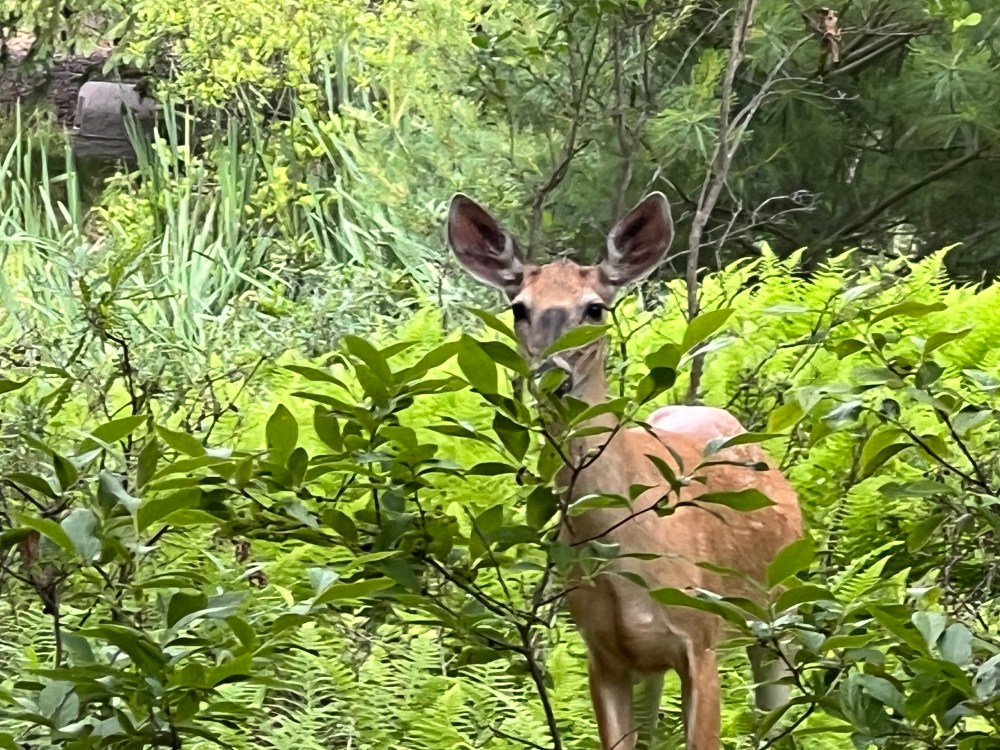
A deer appears in Hawley, Pa., on June 25, 2023. (Jessica Damiano via AP)

Pet owners and parents, however, should exercise caution when deciding to grow these within reach of children or furry family members.

Let’s start with the most offensive bulbs

Crown imperials aren’t referred to as “stink lilies” for nothing. One whiff of the malodorous, tufted, downward-facing, bell-shaped flowers will transport you to a skunk sanctuary — or a sweaty locker room. No self-respecting living thing would deliberately sniff, let alone eat, any part of the plant, which also contains highly toxic steroidal alkaloids.

But don’t let that dissuade you from planting them. The striking plants not only keep rodents away, but they attract pollinators and are exceptionally eye-catching in the spring garden. Just don’t plant them near the front walk.

Alliums are related to onions, and their bulbs’ scent makes no secret of it, so they’re typically left undisturbed. Their flowers have a similar, although milder, fragrance. If rabbits are particularly hungry, they might attempt a nibble, but the bitter sulfur compounds in the bulbs, leaves and stems will send them running. The plants are also toxic.

Similarly, all types of daffodils — from demure jonquils to giant trumpet types — contain bitter, toxic properties that most critters know to avoid.

These bulbs aren’t as offensive but they are off-putting

Although nicely scented to us humans, the strong, sweet perfume emanating from Dutch hyacinth flowers is off-putting to many animals, as is the fruity scent of the unrelated grape hyacinth, which deer and rabbits perceive as musky. Neither is as offensive as pungent alliums, but both hyacinths also contain toxic compounds that cause mouth irritation and stomach upset if bitten or ingested.

Spanish bluebells contain saponins, which smell and taste like soap, as well as poisonous cardiac glycosides.

Snowdrops, Siberian squill, anemone, glory of the snow, winter aconite and star of Bethlehem are smaller, so-called “minor” bulbs with flowers that bloom earlier than the larger bulbs above. But they pack a punch in deterring wildlife browsing, thanks to their unpalatable smell, bitter taste and/or toxic compounds.

Because they have strong defenses, multiply readily and are not kept under control by animals, some of these plants, particularly Siberian squill, Spanish bluebells and star of Bethlehem, can quickly become invasive, so plant with caution.

Mix the offensive bulbs with other bulbs that animals love

All of these plants have spent generations using their natural defenses to avoid being eaten, and you can take advantage of that, too.

If you’d like to plant bulbs that animals love to eat, such as tulips or crocuses, try surrounding them with unpalatable ones. As they exude odors and chemicals to protect themselves, some of those defenses will extend to their bedmates.

___

Jessica Damiano writes weekly gardening columns for The Associated Press. She publishes the Weekly Dirt Newsletter. Sign up here for weekly gardening tips and advice.

___

For more AP gardening stories, go to https://apnews.com/hub/gardening.

Report Error Submit a Tip

More Stories

The first day of school is a promise

Ann Evangelista 6 minute read Preview

The first day of school is a promise

Ann Evangelista 6 minute read 2:00 AM CDT

This week, thousands of Manitoba students will walk through school doors carrying backpacks filled with new supplies, new hopes and, for some, new worries.

For parents and caregivers, this may be a familiar September routine — shopping for school supplies, adjusting schedules, preparing lunches and getting children ready for another year of learning.

For educators and school staff, it is the beginning of another demanding year.

But for Manitoba, this week should mean something more. It should be a renewal of our promise to every child.

Read
2:00 AM CDT

Dynacare labs quickly reach capacity ahead of strike

Nicole Buffie 5 minute read Preview

Dynacare labs quickly reach capacity ahead of strike

Nicole Buffie 5 minute read Saturday, Sep. 5, 2026

Patients were being turned away from several Dynacare locations Saturday morning as people packed the labs in hopes of getting their blood collection done before workers strike.

By 10:30 a.m. the lobby at the Dynacare at 1581 Regent Ave. was standing-room only and walk-up patients were being turned away as the wait time for those lucky enough to get in creeped past two hours.

One woman got in right before workers cut off walk-ins at 10 a.m. after travelling to two other locations.

“I was driving by at 7:15 this morning and there was already a line-up to the road, so I was like ‘nope, not going there’ so I went to the one on Sterling Lyon (Parkway) and it was closed, and then I went to the one at St. Vital Mall and there had a line zig-zagging all the way through the corridors so I gave up and came back,” said Joanna, who declined to give her last name.

Read
Saturday, Sep. 5, 2026

These bulbs have evolved to avoid being eaten. You can take advantage of that

Jessica Damiano, The Associated Press 3 minute read Preview

These bulbs have evolved to avoid being eaten. You can take advantage of that

Jessica Damiano, The Associated Press 3 minute read 9:30 AM CDT

There’s little worse in a gardener’s mind than watching their careful planning and hard work go up in a cloud of teeth, thanks to every four-legged freeloader within chewing distance.

So if you’re planting bulbs this fall, select the rights to avoid planting dinner.

Although no plant is 100% animal-proof, some spring-blooming bulbs have toxic or unpalatable self-defenses that deer, rabbits and rodents tend to avoid.

Pet owners and parents, however, should exercise caution when deciding to grow these within reach of children or furry family members.

Read
9:30 AM CDT

Feeding hope’s flame: Sisters support annual ovarian cancer event on mom’s behalf

Tiago Resko 4 minute read Preview

Feeding hope’s flame: Sisters support annual ovarian cancer event on mom’s behalf

Tiago Resko 4 minute read Updated: Yesterday at 7:42 PM CDT

When Christa Slatnik and Cindy Sanchez lost their mother to ovarian cancer in 2000, it was devastating.

But when the twin sisters got the opportunity to volunteer for Winnipeg’s first-ever Ovarian Cancer Walk of Hope in 2004, it allowed them to honour their mother and continue her legacy.

“Although losing her was the hardest thing we’ve ever gone through, especially when we were only 23 years old, to try to take such a negative thing and turn it around and help other people makes her loss feel like it’s improving the world by increasing awareness,” said Slatnik.

The walk of hope on Sept. 27 will mark 22 years of the sisters volunteering with Ovarian Cancer Canada to bring the walk of hope to Winnipeg.

Read
Updated: Yesterday at 7:42 PM CDT

‘We belong… and we are giving back”: Sikh celebration enlivens downtown Winnipeg

Melissa Martin 3 minute read Preview

‘We belong… and we are giving back”: Sikh celebration enlivens downtown Winnipeg

Melissa Martin 3 minute read Sunday, Sep. 6, 2026

Downtown Winnipeg came alive with vibrant sights, sounds, and scents on Sunday, as Manitoba’s Sikh community flocked to Memorial Park to celebrate its annual Nagar Kirtan procession and festival.

This year marked the 422nd anniversary of the completion of the Guru Granth Sahib, the holy scripture central to the Sikh faith. Shortly after 1 p.m., a palanquin bearing a copy of the scripture was led in parade through downtown Winnipeg, with musical accompaniment.

“This is a chance to tell the public and the whole community where we come from and who we are,” said volunteer Prabh Grewal shortly before the procession got underway. “In a community there are people from every race and every country, and our main objective is to have everybody live in peace and harmony together.”

Before, during, and after the procession, the park hummed with life. As many as 55,000 people converged on the site, with the majority dressed in festive traditional attire. Near the height of the day’s 30 C heat, families relaxed in patches of shade, enjoying plates of Punjabi cuisine dished out for free at dozens of tents sponsored by local businesses.

Read
Sunday, Sep. 6, 2026

Parts of River Heights hammered by storm

Melissa Martin 5 minute read Preview

Parts of River Heights hammered by storm

Melissa Martin 5 minute read Yesterday at 5:54 PM CDT

A powerful storm cut a swath of destruction through River Heights on Sunday, leaving much of the area without power.

Nobody was hurt in the storm.

By the time it subsided, parts of the quiet neighbourhood, especially Borebank and Lindsay streets between Grant and Taylor, had been ravaged: power lines downed, Manitoba Hydro poles toppled, trees splintered and crashed down on vehicles and homes.

In one case, a vehicle was flipped into a yard and sat under a partially downed tree. Shingles were stripped from roofs. Some residents described looking out during the storm and seeing power lines ablaze and the blue glow of electricity arcing over their backyards.

Read
Yesterday at 5:54 PM CDT