How Jewish mindfulness meditation became a mainstay in High Holiday services and beyond
Advertisement
Read this article for free:
or
Already have an account? Log in here »
To continue reading, please subscribe:

Digital Subscription
One year of digital access for only $205*
- Enjoy unlimited reading on winnipegfreepress.com
- Read the E-Edition, our digital replica newspaper
- Access News Break, our award-winning app
- Play interactive puzzles
*First annual payment billed as $205.00 + GST for one year. This annual subscription will automatically renew at $233.00 + GST every 52 weeks (10% off the regular annual price of $259.35). Offer available to new and qualified returning subscribers only. Cancel any time.
To continue reading, please subscribe:
Add Free Press access to your Brandon Sun subscription for only an additional
$1 for the first 4 weeks*
- Enjoy unlimited reading on winnipegfreepress.com
- Read the E-Edition, our digital replica newspaper
- Access News Break, our award-winning app
- Play interactive puzzles
*Your next Brandon Sun subscription payment will increase by $1.00 and you will be charged $17.95 plus GST for four weeks. After four weeks, your payment will increase to $24.95 plus GST every four weeks.
Read unlimited articles for free today:
or
Already have an account? Log in here »
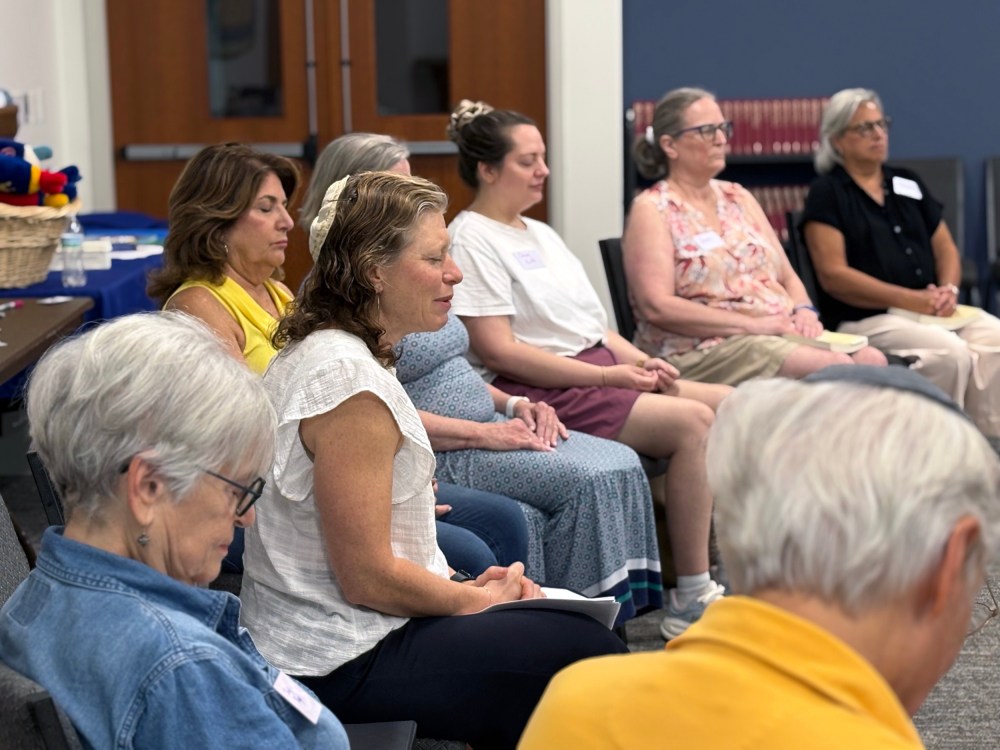
RALEIGH, N.C. (RNS) — At an afternoon class on spiritual ethics this week, Rabbi Jenny Solomon began, as she always does, with a few minutes of guided mindfulness meditation.
“I invite you to find as comfortable a seat as possible in this moment,” Solomon intoned, pausing for a few seconds after each sentence. “I invite you to close your eyes … Allow your hands to rest on your lap or on your body. Any way that feels really loving and supportive … Take a couple of deep breaths as we arrive here, not only in body but in spirit.”
This 10-minute opening ritual is familiar to the participants, members of Beth Meyer Synagogue, a Conservative congregation of 500 families in North Raleigh. Solomon, who co-leads the synagogue with her husband, also a rabbi, has taught numerous classes on Jewish mindfulness meditation here. She routinely launches into a few moments of guided breathing even in the midst of traditional prayer services in the sanctuary. The synagogue offers a monthly Shabbat morning yoga class and annual beach retreats to which congregants bring their cushions and their mats.
“We’re part of a larger zeitgeist in this country that’s incorporating Eastern practices, but in our case, really wrapping them in Jewish language, in Jewish thought, in Jewish text, Jewish theology, so that it really feels like it belongs to us,” Solomon said.
___
This content is written and produced by Religion News Service and distributed by The Associated Press. RNS and AP partner on some religion news content. RNS is solely responsible for this story.
___
Beth Meyer is no outlier. Across the country, Jewish congregations, schools and nonprofit organizations have embraced mindfulness meditation with a zeal of the recently converted. The practice of sitting in silence, paying attention to the breath and focusing on the present moment has become pervasive across all the Jewish religious movements, even among the Orthodox. In fact, many Jews heading to services on Yom Kippur, the holiest day of the Jewish year, may find themselves engaging in mindfulness meditation, if not during the main service then in the afternoon break before the closing service.
Jewish engagement with Buddhism, of which mindfulness meditation is a core element, has been going on for more than a century but really took off in the 1960s, when a host of American Jews began practicing Zen, Insight or Tibetan meditation. Some became prominent teachers and leaders in those movements and became known as “JewBus” or “BuJews.”
Today’s practices owe much more to the Mindfulness Based Stress Reduction method developed by Jon Kabat-Zinn, who stripped mindfulness meditation of its Buddhist elements and repackaged it as a secular tool for stress reduction and pain relief. Its popularity has skyrocketed in hospitals, schools, Silicon Valley tech companies, even the military.
But since the early aughts, American and Israeli Jews have built distinctly Jewish scaffolding on that model. Jewish mindfulness meditation is now touted as a tool for growing awareness, setting intentions and experiencing God in the present moment.
“I think this is really a critical part of modern Judaism for all of us who are looking for an authentic way to live meaningful and in-depth Jewish lives,” said Rabbi Rick Jacobs, president of the Union for Reform Judaism, the largest Jewish movement in North America with some 800 member congregations.
As a pulpit rabbi, Jacobs said he taught mindfulness meditation to boys and girls before their confirmation ceremony. As president of the Reform movement, he is including it, for example, as one of the sessions in the upcoming four-day biennial meeting of the Union for Reform Judaism when thousands of lay and clergy gather this December in Philadelphia.
The Institute for Jewish Spirituality is one of two organizations that have built up a corps of Jewish professionals — mostly rabbis and cantors — trained in Jewish mindfulness. (The other is called Or HaLev). The IJS clergy leadership program has more than 600 alumni, among them Jacobs, as well as Rabbi Angela Buchdahl of New York’s Central Synagogue and now Rabbi Elliott Tepperman, who begins in October as president and CEO of the Reconstructing Judaism, a smaller liberal movement.
The IJS’s vast offerings include a daily 45-minute Zoom meditation, a weekly yoga session — also on Zoom — and a series of popular podcasts.
For many U.S. Jews like Harris Sokoloff, a retired university administrator and adjunct education professor, Jewish mindfulness has become a regular practice. Each day at 12:30 p.m. he logs on to the IJS’s Zoom for a short guided mediation followed by a short Jewish text study, a practice he’s been following since 2019.
“I spent a lot of time in my head, and meditation helped me get connected to my heart,” said Sokoloff, 77, from Philadelphia.
While older Jews are a mainstay of the daily sit, as the IJS calls its Zoom meditation sessions of nearly 200 people, the organization has also created in-person groups that attract younger Jewish mindfulness meditators in their 20s and 30s in cities such as San Francisco; Brooklyn, New York; and Cambridge, Massachusetts. The groups are called “Shevet” from the Hebrew, to sit.
Rebecca Schisler, the 34-year-old director of young adult programs for the IJS, started meditating in college and said the experience revived a love of Judaism that had been growing stale.
“Judaism was a very intellectual practice,” she said. “It was mostly something to think about and a lot of words to memorize. And there was family and culture, for sure. But I didn’t feel so spiritually connected to the tradition until I encountered Jewish mindfulness.”
In mindfulness, there’s no requirement for accepting a set of theological beliefs; it’s about experiencing them in the moment, she said.
Richard Jaffe, a professor of religious studies at Duke University who studies Japanese Buddhism, said he understands that.
“There’s all these different elements to it that are psychological and physical that one can actually experience quite directly, and I think that’s very powerful,” Jaffe said.
Today’s Jewish mindfulness meditation is drawing a lot on the faith’s more mystical Hasidic tradition, which made physical embodiment in song, dance and chants a key element of Jewish practice.
Mindfulness meditation, said Josh Feigelson, president and CEO of the IJS, “has very close relatives within the Jewish mystical tradition, and especially in Hasidism. The Hasidic masters are talking about very similar things. They use the (Hebrew) word ‘da’at’ which is often translated as intelligence, but the way they’re talking about it is really, awareness.”
The project is not without its critics. Some Buddhists and scholars have criticized the co-opting of Buddhist mindfulness meditation for other uses, as though it’s a neutral tool, free of a particular Buddhist religious and ethical framework.
“The very fact that religious people feel the need to borrow it suggests that there’s something spiritually or religiously not connecting in their own practices and traditions,” said Candy Gunther Brown, a professor religious studies at Indiana University Bloomington, who has written critically about the use of yoga and mindfulness in the public schools.
Feigelson said he has not encountered accusations of cultural appropriation. On the contrary, he said, Buddhist practitioners want more people to use their methods.

For many rabbis, the meditative practices have been a boon. They have seen higher participation and more vibrant and dynamic prayer as a result of its use.
Tepperman, rabbi of Bnai Keshet in Montclair, New Jersey, holds a Wednesday morning mindfulness minyan, or service. At least two Shabbat services are dedicated to mindfulness yearly. And this summer he held his second four-day silent retreat for his congregants. On Yom Kippur, he will lead a 20-minute walking meditation. (He begins his new role as head of Reconstructing Judaism on Oct. 1).
“When you find something that works and helps people to feel God and feel a sense of centeredness and be able to go inward and notice that they have a soul and a spiritual life, you just grab it,” said Tepperman. “You work with it. You do it. And yes, make it Jewish, for sure. It’s too good of an option to let it stay peripheral. I’m very interested in making it more and more central.”
___
This story was produced with funding from the Templeton Religion Trust.
The Free Press acknowledges the financial support it receives from members of the city’s faith community, which makes our coverage of religion possible.