McDonald’s sued over AI tool that recommends prices to US franchisees
Advertisement
Read this article for free:
or
Already have an account? Log in here »
To continue reading, please subscribe:

Digital Subscription
One year of digital access for only $205*
- Enjoy unlimited reading on winnipegfreepress.com
- Read the E-Edition, our digital replica newspaper
- Access News Break, our award-winning app
- Play interactive puzzles
*First annual payment billed as $205.00 + GST for one year. This annual subscription will automatically renew at $233.00 + GST every 52 weeks (10% off the regular annual price of $259.35). Offer available to new and qualified returning subscribers only. Cancel any time.
To continue reading, please subscribe:
Add Free Press access to your Brandon Sun subscription for only an additional
$1 for the first 4 weeks*
- Enjoy unlimited reading on winnipegfreepress.com
- Read the E-Edition, our digital replica newspaper
- Access News Break, our award-winning app
- Play interactive puzzles
*Your next Brandon Sun subscription payment will increase by $1.00 and you will be charged $17.95 plus GST for four weeks. After four weeks, your payment will increase to $24.95 plus GST every four weeks.
Read unlimited articles for free today:
or
Already have an account? Log in here »
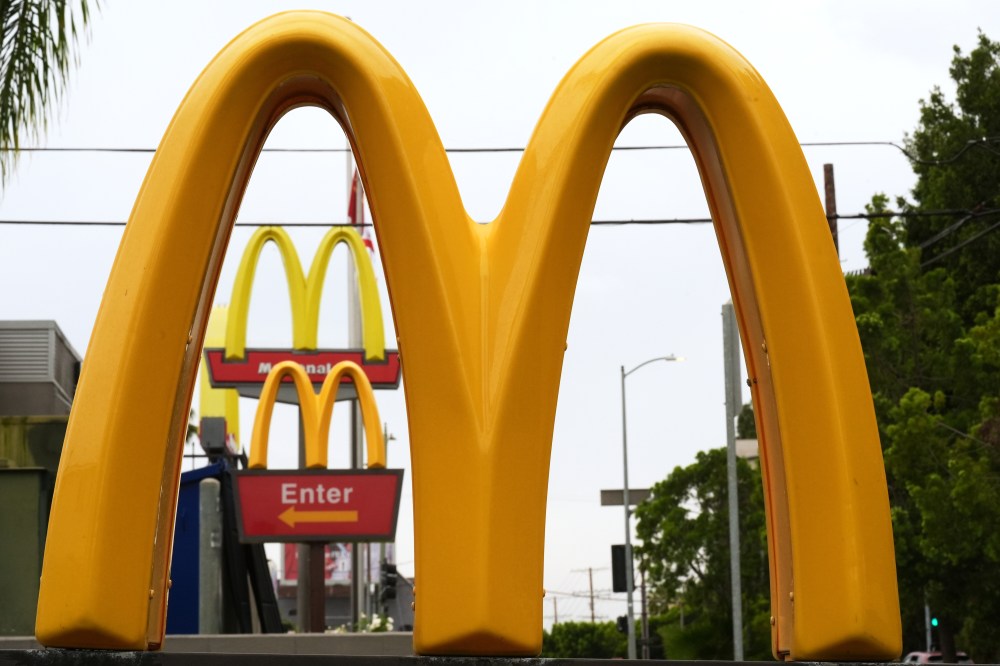
McDonald’s is facing a federal lawsuit that alleges its AI-enhanced pricing tool violates antitrust laws because it shares nonpublic data with franchisees who might be competing in the same market.
The lawsuit, which was filed Friday in Illinois, said McDonald’s pricing tool uses artificial intelligence to collect data that competing franchises wouldn’t normally share, like store-level sales. The Chicago-based burger giant has said it makes the tool available to U.S. franchisees to help them set prices at their individual restaurants.
The lawsuit also blames the pricing system for raising McDonald’s U.S. prices.
“McDonald’s has built and for years deployed its own information-sharing pricing platform, which draws on data from its millions of daily transactions to set menu prices across thousands of U.S. restaurants,” the lawsuit states. “The result is algorithmic price-fixing aimed at customers who are already stretched thin.”
McDonald’s said Tuesday that the lawsuit is “filled with inaccuracies” and it would vigorously defend itself.
“AI does not set menu prices at McDonald’s restaurants – McDonald’s franchisees do,” the company said in a statement. “Optional tools are available to franchisees to help them make the best decisions for their businesses and customers, but these tools do not automate, coordinate or fix pricing in any way.”
The lawsuit was filed on behalf of a consumer, Michael Thomas, of DeKalb, Illinois. According to the lawsuit, Thomas frequently visits McDonald’s and orders a Quarter Pounder with cheese, french fries and a Coke. The lawsuit said Thomas noticed price differences between McDonald’s stores near his home.
McDonald’s said it has used an AI-enhanced pricing tool for more than a decade. The program determines the optimal price for menu items based on a store’s sales, location and other factors, including competitors’ prices.
McDonald’s said that long before adopting the AI-enhanced tool, it collected data and recommended prices to its franchisees, who own and operate 95% of McDonald’s 14,000 U.S. stores.
“All we do is provide the context of what’s going on,” a McDonald’s spokesman told The Associated Press. “We don’t have any way to affect the menu pricing in a restaurant.”
But the lawsuit said McDonald’s has “significant leverage over its franchisees” and can pressure them to follow its pricing recommendations.
The Associated Press left a message Tuesday with the National Owners Association, which represents McDonald’s franchisees.
McDonald’s has been experimenting with various value strategies in the U.S. and other markets for several years as it tries to win back lower-income consumers, whose visits to fast-food chains have dropped.
But franchisees don’t always follow its guidance. During a conference call with investors in August, McDonald’s Chairman and CEO Chris Kempczinski said only 60% of its U.S. restaurants were offering McDonald’s proposed menu of 10 items for under $3.
“As you know, in our system, that’s not something that we just flip the switch on,” Kempczinski said. “It requires conversations with franchisees.”
The lawsuit asks the judge to certify the case as a class action and to require McDonald’s to pay damages to the class. It also seeks to prevent McDonald’s from enforcing agreements that restrict competition.