4 tips on teaching emotional, social skills through craft
Advertisement
Read this article for free:
or
Already have an account? Log in here »
To continue reading, please subscribe:

Digital Subscription
One year of digital access for only $205*
- Enjoy unlimited reading on winnipegfreepress.com
- Read the E-Edition, our digital replica newspaper
- Access News Break, our award-winning app
- Play interactive puzzles
*First annual payment billed as $205.00 + GST for one year. This annual subscription will automatically renew at $233.00 + GST every 52 weeks (10% off the regular annual price of $259.35). Offer available to new and qualified returning subscribers only. Cancel any time.
To continue reading, please subscribe:
Add Free Press access to your Brandon Sun subscription for only an additional
$1 for the first 4 weeks*
- Enjoy unlimited reading on winnipegfreepress.com
- Read the E-Edition, our digital replica newspaper
- Access News Break, our award-winning app
- Play interactive puzzles
*Your next Brandon Sun subscription payment will increase by $1.00 and you will be charged $17.95 plus GST for four weeks. After four weeks, your payment will increase to $24.95 plus GST every four weeks.
Read unlimited articles for free today:
or
Already have an account? Log in here »
Hey there, time traveller!
This article was published 22/01/2019 (2741 days ago), so information in it may no longer be current.
Teaching kids social and emotional skills is getting renewed attention, and arts and crafts are a good way to do that, at home as well as at school.
“Anxiety and depression are on the rise for young people,” says Melissa Schlinger, a vice-president at the Chicago-based Collaborative for Academic, Social, and Emotional Learning, an advocacy and research organization that tries to make social and emotional learning a priority in education.
Jacqueline Jodl, executive director of the Aspen Institute’s National Commission on Social, Emotional, and Academic Development, concurs. “Families and parents are requesting help with social and emotional learning,” she says. “Teachers also are really starting to express demand for it, and the business community continues to express demand for students with a broader cross-section of skills.”
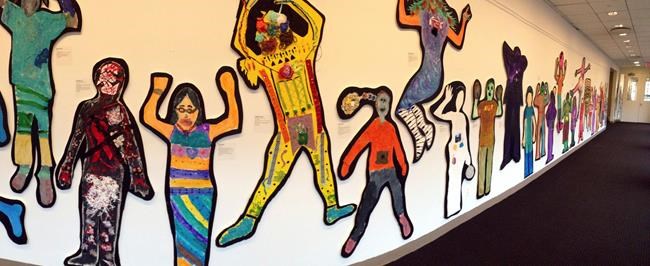
Why does art help?
“Because there is a lot of invention and also trials and tribulations that get worked out in the creative process, a child can learn how to manage frustration,” says Marygrace Berberian, a licensed art therapist and clinical social worker. “They’re also learning to connect to more emotional aspects of themselves that are not necessarily encouraged in other aspects of their lives.”
Four ways to more intentionally integrate social and emotional learning into youth art projects, at home, school or anywhere:
CONSIDER THE SPECIFIC NEEDS OF THE CHILD WHEN SELECTING MATERIALS.
“Art materials range from being controlled to very expressive,” Berberian says. A child seeking control might benefit from beading or pencil drawing, for example, whereas a child who needs to let go and be more expressive might learn more from working with paints or clay, which encourage spontaneity.
GIVE KIDS AGENCY OVER THEIR PROJECTS.
Give students the freedom to “interpret a project or prompt through their own experience and perspectives,” says Christian Ortiz, senior manager of studio programs at Marwen, a visual-arts organization for youth in Chicago. For example, Marwen hosted a printmaking class in which students were asked to create small patches depicting what was important to them, he says.

Berberian advises parents not to dictate how a child should do an art project at home. Rather, they should be “affirming the child’s process” through dialogue: Ask kids about their creations, the decisions they made and why.
CREATE A LESSON ALONG WITH A PROJECT.
Melissa Mellor, a spokeswoman for Jodl’s commission at the Aspen Institute, recalls an art project that her first-grade son did in school that focused on learning from mistakes. The class read a book about a girl who made a mistake on a project and turned it into something beautiful. Then, each student received a piece of paper with marks already on it and, using permanent marker, was tasked with turning it into a new piece of art. The goal was to teach flexibility, problem solving, creativity and the ability to grow from mistakes.
MAKE ART TOGETHER.
“When people make art together or engage in creative processes together, it’s a natural form of empathy-building because you’re doing something together, mirroring each other and celebrating each other’s artistic practice,” says Berberian.