AI researcher, Soviet historian among winners of $100K Killam Prize
Advertisement
Read this article for free:
or
Already have an account? Log in here »
To continue reading, please subscribe:

Digital Subscription
One year of digital access for only $205*
- Enjoy unlimited reading on winnipegfreepress.com
- Read the E-Edition, our digital replica newspaper
- Access News Break, our award-winning app
- Play interactive puzzles
*First annual payment billed as $205.00 + GST for one year. This annual subscription will automatically renew at $233.00 + GST every 52 weeks (10% off the regular annual price of $259.35). Offer available to new and qualified returning subscribers only. Cancel any time.
To continue reading, please subscribe:
Add Free Press access to your Brandon Sun subscription for only an additional
$1 for the first 4 weeks*
- Enjoy unlimited reading on winnipegfreepress.com
- Read the E-Edition, our digital replica newspaper
- Access News Break, our award-winning app
- Play interactive puzzles
*Your next Brandon Sun subscription payment will increase by $1.00 and you will be charged $17.95 plus GST for four weeks. After four weeks, your payment will increase to $24.95 plus GST every four weeks.
Read unlimited articles for free today:
or
Already have an account? Log in here »
Hey there, time traveller!
This article was published 25/04/2019 (2654 days ago), so information in it may no longer be current.
OTTAWA – Five of Canada’s leading scholars in fields ranging from artificial intelligence to Soviet history are being honoured with the $100,000 Killam Prize.
The Canada Council for the Arts recognized academics from across the country Thursday for outstanding contributions to the humanities, social sciences, natural sciences, health sciences and engineering.
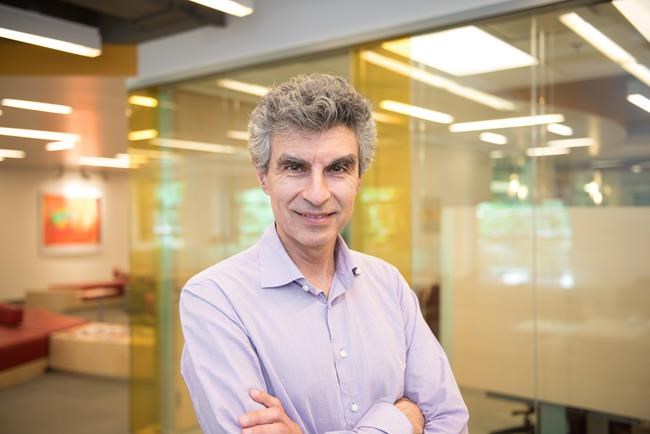
Winners included Universite de Montreal professors Andre Blais, an expert in electoral studies whose project examined the behaviour of voters and parties in 25 elections across five countries, and Yoshua Bengio, whose expertise in artificial intelligence has also earned him the A.M. Turing Award, known as the “Nobel Prize for Computer Science.”
Dr. Stephen Scherer of the University of Toronto was commended for research that has shaped our understanding of the human genome and founding a database used in thousands of clinical diagnoses per day.
Fellow University of Toronto professor Lynne Viola, a specialist in the history of the Soviet Union, and University of Waterloo systems design engineer Keith W. Hipel were also among the honourees.
Winners are chosen by a committee of their peers. Previous winners include Victoria Kaspi, the late Mark Wainberg, and Nobel Prize winner Arthur McDonald.

The Killam program also announced recipients of its research fellowships, which dole out $840,000 over two years to six scholars for independent research projects.
This year’s group includes: Matt Dobbs of McGill University for a project called “Unveiling the Cosmos with a New Paradigm Digital Radio Telescope”; Dennis Hall of University of Alberta for “A Green Chemistry Blueprint for Direct Catalytic Functionalization of Feedstock Alcohols”; Catherine Sulem of University of Toronto for “Nonlinear Partial Differential Equations: Wave Propagation in Fluids, Optics, and Plasmas”; Marten van Kerkwijk of University of Toronto for “Probing Extreme (Astro)Physics with Neutron Stars”; and Xiao Yu Wu of University of Toronto for “Smart Nanomedicine Combo for Treatment and Diagnosis of Diseases in the Brain.”