Alberta researchers combine X-rays, virtual reality for new medical treatments
Advertisement
Read this article for free:
or
Already have an account? Log in here »
To continue reading, please subscribe:

Digital Subscription
One year of digital access for only $205*
- Enjoy unlimited reading on winnipegfreepress.com
- Read the E-Edition, our digital replica newspaper
- Access News Break, our award-winning app
- Play interactive puzzles
*First annual payment billed as $205.00 + GST for one year. This annual subscription will automatically renew at $233.00 + GST every 52 weeks (10% off the regular annual price of $259.35). Offer available to new and qualified returning subscribers only. Cancel any time.
To continue reading, please subscribe:
Add Free Press access to your Brandon Sun subscription for only an additional
$1 for the first 4 weeks*
- Enjoy unlimited reading on winnipegfreepress.com
- Read the E-Edition, our digital replica newspaper
- Access News Break, our award-winning app
- Play interactive puzzles
*Your next Brandon Sun subscription payment will increase by $1.00 and you will be charged $17.95 plus GST for four weeks. After four weeks, your payment will increase to $24.95 plus GST every four weeks.
Read unlimited articles for free today:
or
Already have an account? Log in here »
Hey there, time traveller!
This article was published 07/03/2019 (2737 days ago), so information in it may no longer be current.
EDMONTON – No, they’re not X-ray specs.
But a University of Alberta team has come up with a way to combine medical imaging with virtual reality to help clinicians locate and understand what’s happening inside their patients’ bodies as they treat them.
“One of the classic problems you always hear about when clinicians are training is that you treat the person, not the X-ray,” said Greg Kawchuk, a professor in the University of Alberta’s physical therapy department. “Here’s a way to unite those two domains.”
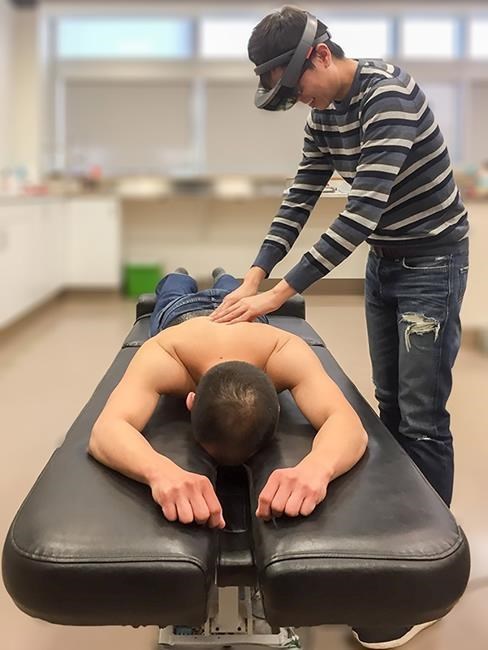
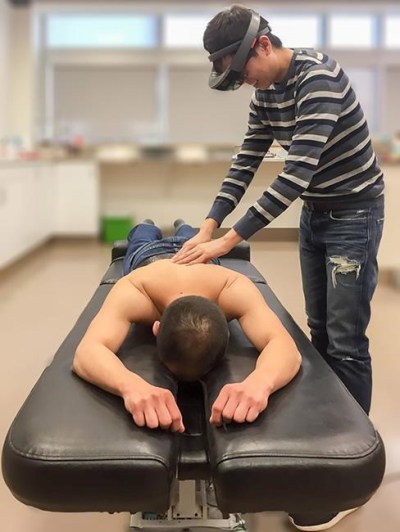
Kawchuk and his colleagues have figured out how to use a commercially available set of virtual reality goggles to help doctors or other professionals view an X-ray superimposed on a patient’s body. They can align the image with the patient in front of them.
That not only allows clinicians to get a more precise idea of where the problem is and what it might be, it also allows them to bring the patient into the equation.
“The problem with X-rays has always been you take this thing (and) read it in a different room completely separated from the patient and their experiences,” Kawchuk said.
“(A patient) is more than just their image. There’s stories to be listened to. There’s context.”
Kawchuk imagines how a conversation might go with a doctor using the goggles:
“Where does it hurt? Here? OK, now I see it in the image that goes along with it when I poke you here.”
The goggles take advantage of recent innovations in virtual reality that allow a wearer to see the virtual world and the actual world at the same time.
“You see what you normally see and (the goggles) add stuff into there.”
It sounds like a simple matter to make the added “stuff” an X-ray. But it wasn’t.
Bodies aren’t flat. To accurately map an image onto the curves in a person’s back or chest, Kawchuk and his co-workers had to figure out how to distort the flat X-ray to account for them.

They’ve managed to get the image to within eight millimetres of the exact location. That’s not close enough for surgical applications, but it is for many medical purposes, including teaching.
New, higher-resolution goggles are hitting the market all the time, Kawchuk added. And artificial intelligence programs may help users more closely line up image with reality.
Eventually, he said, the technique might be available as an app using a generic X-ray that may not match a patient’s body exactly, but is still useful.
“It’s early days,” said Kawchuk. “It think it’s going to be pretty ubiquitous as the years go by.”
— Follow Bob Weber on Twitter at @row1960