Walmart experiments with AI to monitor stores in real time

Advertisement

Advertise with us

LEVITTOWN, N.Y. - Who's minding the store? In the not-too-distant future it could be cameras and sensors that can tell almost instantly when bruised bananas need to be swapped for fresh ones and more cash registers need to open before lines get too long.

Read this article for free:

or

Already have an account? Log in here »

To continue reading, please subscribe:

Subscribe and receive a limited-edition Free Press branded hat or tote.

Digital Subscription

One year of digital access for only $205*

  • Enjoy unlimited reading on winnipegfreepress.com
  • Read the E-Edition, our digital replica newspaper
  • Access News Break, our award-winning app
  • Play interactive puzzles

*First annual payment billed as $205.00 + GST for one year. This annual subscription will automatically renew at $233.00 + GST every 52 weeks (10% off the regular annual price of $259.35). Offer available to new and qualified returning subscribers only. Cancel any time.

To continue reading, please subscribe:

Add Free Press access to your Brandon Sun subscription for only an additional

$1 for the first 4 weeks*

  • Enjoy unlimited reading on winnipegfreepress.com
  • Read the E-Edition, our digital replica newspaper
  • Access News Break, our award-winning app
  • Play interactive puzzles
Start now

*Your next Brandon Sun subscription payment will increase by $1.00 and you will be charged $17.95 plus GST for four weeks. After four weeks, your payment will increase to $24.95 plus GST every four weeks.

Hey there, time traveller!
This article was published 24/04/2019 (2655 days ago), so information in it may no longer be current.

LEVITTOWN, N.Y. – Who’s minding the store? In the not-too-distant future it could be cameras and sensors that can tell almost instantly when bruised bananas need to be swapped for fresh ones and more cash registers need to open before lines get too long.

Walmart, which faces fierce competition from Amazon and other online retailers, is experimenting with digitizing its physical stores to manage them more efficiently, keep costs under control and make the shopping experience more pleasant. On Thursday, the retail giant officially opens its Intelligent Retail Lab inside a 50,000-square-foot Neighborhood Market grocery store on Long Island.

Thousands of cameras suspended from the ceiling, combined with other technology like sensors on shelves, will monitor the store in real time so workers can quickly replenish products or fix other problems.
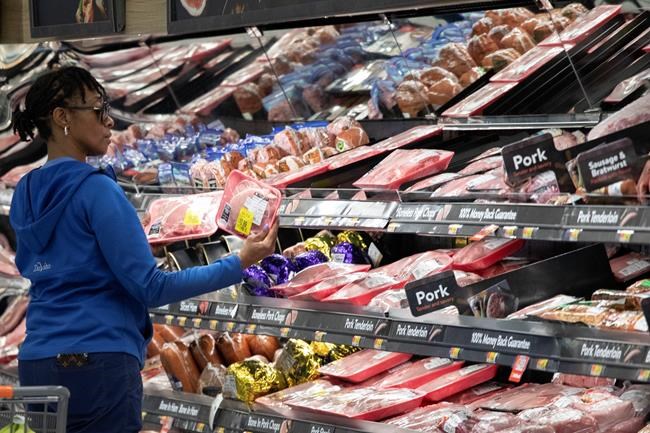
A customer shops at the meat counter at a Walmart Neighborhood Market, Wednesday, April 24, 2019, in Levittown, N.Y. Walmart can rely on thousands of cameras hanging from the ceiling that track when products are running low or when produce or meat start to lose their freshness. (AP Photo/Mark Lennihan)

The technology, shown first to The Associated Press, will also be able to spot spills, track when shelves need to be restocked and know when shopping carts are running low. Cameras, for example, can determine how ripe bananas are from their colour, and workers will get an alert on their phone if they need to be replaced.

Walmart’s deep dive into artificial intelligence in its physical store comes as Amazon raised the stakes in the grocery business with its purchase of Whole Foods Market nearly two years ago.

That’s put more pressure on Walmart and other traditional retailers like Kroger and Albertsons to pour money into technology in their stores. At the same time, they’re trying to keep food prices down and manage expenses. Amazon has been rolling out cashier-less Amazon Go stores , which have shelf sensors that track the 1,000 products on their shelves.

Walmart’s online U.S. sales are still a fraction of Amazon’s online global merchandise empire, which reached $122.98 billion last year. But Walmart says more than 140 million U.S. shoppers visit a store in person or online per week, creating a treasure trove of data. In its latest fiscal year ended Jan. 31, Walmart generated more than $500 billion in overall sales globally.

Walmart hopes to start scaling some of the new technology at other stores in the next six months, with an eye toward lower costs and thus lower prices. As the shopping experience improves, the retailer expects to see higher sales.

“We really like to think of this store as an artificial intelligence factory, a place where we are building these products, experiences, where we are testing and learning,” said Mike Hanrahan, CEO of Walmart’s Intelligent Retail Lab and co-founder of Jet.com, purchased by Walmart three years ago.

Hanrahan says the cameras are programmed to focus primarily on the products and shelves right now. Sensors embedded in shelves will give the store extra information because they know what’s at the back of the shelves that the cameras can’t see.

Cameras do not recognize faces, determine the ethnicity of a person picking up a product or track the movement of shoppers, he says.
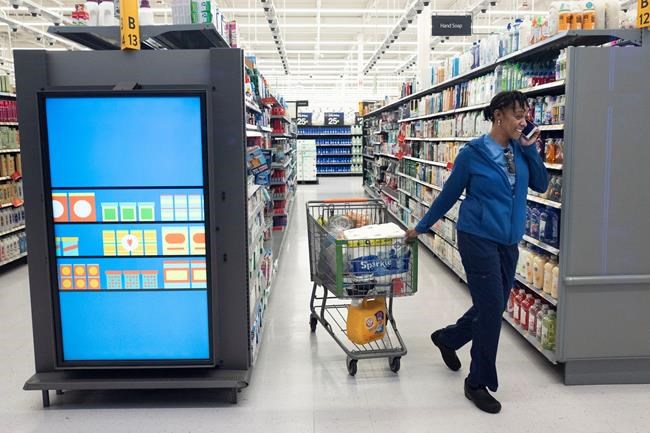
A customer pulls her shopping cart past an information kiosk at a Walmart Neighborhood Market, Wednesday, April 24, 2019, in Levittown, N.Y. Kiosks and signs throughout the store keep customers informed that they are shopping in an artificial intelligence factory. (AP Photo/Mark Lennihan)

Some other companies have recently started experimenting with store shelf cameras that try to guess shoppers’ ages, genders and moods.

There are signs throughout the Neighborhood Market educating shoppers about how it is being used as a lab. Still, the cameras could raise privacy concerns.

“Machine learning fundamentally finds and matches patterns,” says Steven M. Bellovin, a computer science professor at Columbia University and a privacy expert, who hasn’t seen the new Walmart AI Lab. But he says companies run into trouble when they start to match behaviour to a specific customer.

Hanrahan says Walmart has made sure to protect shoppers’ privacy and emphasized that there are no cameras at the pharmacy, in front of the rest rooms or in employee breakrooms.

The lab is Walmart’s second in a physical store. Last year, Walmart’s Sam’s Club opened a 32,000 square foot lab store, a quarter of the size of a typical Sam’s Club. The lab is testing new features surrounding the Scan & Go App, which lets customers scan items as they shop and then buy from their phones, skipping the checkout line.

The retail lab is the third project from Walmart’s new incubation arm, created after the Jet.com acquisition as a way for the discounter to shape the future of retail.

It follows the launch of Jetblack, a shopping by text service aimed at affluent shoppers in New York. Walmart’s second incubation project was Spatial&, a VR tech company. As part of the launch, it’s bringing tractor-trailers to some of Walmart parking lots so customers can experience DreamWorks Animation’s “How to Train Your Dragon” through virtual reality.

Hanrahan says the company is embracing the labs in stores to better understand the real ways that technology affects customers and workers. It also wants to educate shoppers. Walmart has made a point to not hide the technology, and small educational kiosks are set up throughout the Neighborhood Market. Shoppers can peer through a glass enclosed data centre at the back of the store. It houses nine cooling towers, 100 servers and other computer equipment that processes all the data.
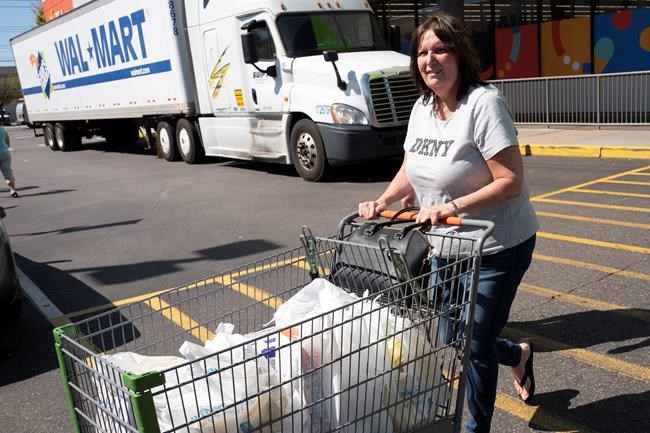
A customer pushes her cart into the parking lot after shopping at a Walmart Neighborhood Market, Wednesday, April 24, 2019, in Levittown, N.Y. The company has made the market into an artificial intelligence lab. (AP Photo/Mark Lennihan)

Despite the signs and visible cameras, many shoppers, including Marcy Seinberg from Wantagh, New York, didn’t seem to notice or care.

“I am not bothered by it,” Seinberg said. “If technology saves me money, I would be interested.”

___

Follow Anne D’Innocenzio: http://twitter.com/ADInnocenzio

Report Error Submit a Tip

More Stories

Saying goodbye to a friend I never met

Pam Frampton 5 minute read Preview

Saying goodbye to a friend I never met

Pam Frampton 5 minute read Yesterday at 2:00 AM CDT

Hedie Epp and I first connected over a column I wrote in October 2023 about my mother’s dementia. Now I find myself awash in sadness for the loss of this person I will never get to meet.

Read
Yesterday at 2:00 AM CDT

Preserving past, pondering future of 142-year-old downtown church

Chris Kitching 6 minute read Preview

Preserving past, pondering future of 142-year-old downtown church

Chris Kitching 6 minute read Yesterday at 6:55 PM CDT

A 142-year-old church in downtown Winnipeg needs about $7.7 million for upgrades and related costs, while an ongoing heritage renewal project aims to create a blueprint for its future.

Potential options include selling Holy Trinity Anglican Church and leasing it back for a decades-long term, or building an apartment or office tower on an existing surface parking lot to generate revenue, officials said Wednesday.

“I think that is part of the negotiation and ensuring we have the right partners, but it is hard to put down on paper precisely every aspect of the future of a place of worship,” project manager Stephen Borys said of the potential duration of a sale and leaseback agreement to ensure the church still exists generations from now.

Similar agreements with 50- or 100-year leases exist elsewhere in Canada, he said, noting the option has been on the table for Holy Trinity for a year.

Read
Yesterday at 6:55 PM CDT

Giant Tiger to close downtown, area residents bemoan dwindling grocery options

Nicole Buffie 4 minute read Preview

Giant Tiger to close downtown, area residents bemoan dwindling grocery options

Nicole Buffie 4 minute read 6:34 PM CDT

One of the only remaining grocery-store options for people living downtown and in the Exchange District is closing its doors.

Red notices on the windows at Giant Tiger’s Donald Street and Ellice Avenue location advised passersby the store will close on Nov. 7.

Chain spokesperson Jessica Charbonneau said in an email the decision to shutter stores is “not taken lightly and is made with careful consideration and thorough analysis.”

The store was busy Thursday afternoon.

Read
6:34 PM CDT

Decision on corridor for Trans-Canada twinning near Ontario border expected this fall, province says

Chris Kitching 4 minute read Preview

Decision on corridor for Trans-Canada twinning near Ontario border expected this fall, province says

Chris Kitching 4 minute read Updated: Yesterday at 5:24 PM CDT

The Manitoba government is taking more time to evaluate and select a preferred corridor for the twinning of a 16-kilometre section of the Trans-Canada Highway near the Ontario boundary.

An earlier timeline indicated Manitoba Transportation and Infrastructure expected to choose an alignment by the fall of 2025. A provincial spokesperson told the Free Press on Monday a decision is expected this winter, but a different spokesperson said Wednesday a decision is expected this fall.

“The department continues to evaluate corridor alternatives and will undertake additional geotechnical, environmental and design work as part of the (functional design study) to support the selection of a preferred corridor,” the spokesperson said in a statement.

The study, which will include Crown-Indigenous and public consultation, is expected to be completed in late 2027, with a detailed design to follow.

Read
Updated: Yesterday at 5:24 PM CDT

Rested Sea Bears ready for post-season press

Joshua Frey-Sam 7 minute read Preview

Rested Sea Bears ready for post-season press

Joshua Frey-Sam 7 minute read 5:17 PM CDT

Isiah Osborne acknowledged that the effort — and the results — have been disappointing at times recently.

He also knows it’s not too late to change that.

The Winnipeg Sea Bears were afforded some time this week to reflect on the recent shortcomings as a group. With six days separating the last game and the next game, members of the club took a couple of days away from basketball before returning to the court for their last full week of practice, which was appreciated for a tired group that finished its busiest stretch of the Canadian Elite Basketball League campaign last weekend.

“We think we’re the best team in the league, obviously,” said Osborne. “A couple bad games, but that’s just off some mistakes. On some plays, if we’re not on that 100 per cent effort, little things happen, and we’ve lost a couple games by two, by four, and that happens. Just a couple mishaps on defence, stuff like that, and I mean, you just gotta lock in on those.”

Read
5:17 PM CDT

Province orders mosquito fogging owing to increased risk of West Nile virus

Malak Abas 3 minute read Preview

Province orders mosquito fogging owing to increased risk of West Nile virus

Malak Abas 3 minute read 6:01 PM CDT

Parts of Winnipeg and several rural communities will be sprayed for mosquitoes in the coming days as the heat wave across southern Manitoba has created a higher risk of exposure to West Nile virus.

The province has issued a fogging order under the Environment Act in response to a high number of Culex tarsalis mosquitoes — the primary transmitter of West Nile virus — in Manitoba.

Surveillance data from last week showed evidence of the West Nile virus.

“High temperatures across southern Manitoba have shortened the time required for West Nile virus to develop within infected Culex tarsalis mosquitoes and be transmitted to humans,” the province’s first bulletin on West Nile virus this summer, published Thursday afternoon, reads.

Read
6:01 PM CDT