WEATHER ALERT

Apple Watch may spot heart problem but more research needed

Advertisement

Advertise with us

WASHINGTON - A huge study suggests the Apple Watch can detect a worrisome irregular heartbeat at least sometimes — but experts say more work is needed to tell if using wearable technology to screen for heart problems really helps.

Read this article for free:

or

Already have an account? Log in here »

To continue reading, please subscribe:

Subscribe and receive a limited-edition Free Press branded hat or tote.

Digital Subscription

One year of digital access for only $205*

  • Enjoy unlimited reading on winnipegfreepress.com
  • Read the E-Edition, our digital replica newspaper
  • Access News Break, our award-winning app
  • Play interactive puzzles

*First annual payment billed as $205.00 + GST for one year. This annual subscription will automatically renew at $233.00 + GST every 52 weeks (10% off the regular annual price of $259.35). Offer available to new and qualified returning subscribers only. Cancel any time.

To continue reading, please subscribe:

Add Free Press access to your Brandon Sun subscription for only an additional

$1 for the first 4 weeks*

  • Enjoy unlimited reading on winnipegfreepress.com
  • Read the E-Edition, our digital replica newspaper
  • Access News Break, our award-winning app
  • Play interactive puzzles
Start now

*Your next Brandon Sun subscription payment will increase by $1.00 and you will be charged $17.95 plus GST for four weeks. After four weeks, your payment will increase to $24.95 plus GST every four weeks.

Hey there, time traveller!
This article was published 16/03/2019 (2690 days ago), so information in it may no longer be current.

WASHINGTON – A huge study suggests the Apple Watch can detect a worrisome irregular heartbeat at least sometimes — but experts say more work is needed to tell if using wearable technology to screen for heart problems really helps.

More than 419,000 Apple Watch users signed up for the unusual study, making it the largest ever to explore screening seemingly healthy people for atrial fibrillation, a condition that if untreated eventually can trigger strokes.

Stanford University researchers reported Saturday that the watch didn’t panic flocks of people, warning just half a per cent of participants — about 2,100 — that they might have a problem.
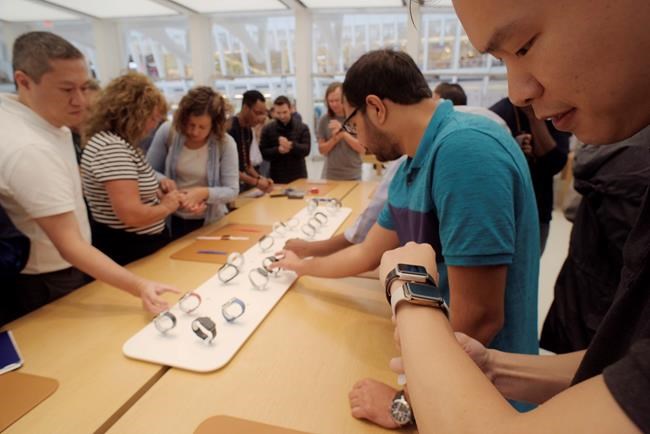
FILE- In this Sept. 21, 2018 file photo customers look at Apple Watches at an Apple store in New York. A huge study suggests the Apple Watch sometimes can detect a worrisome irregular heartbeat. But experts say more work is needed to tell if using wearable technology to screen for heart problems really helps. (AP Photo/Patrick Sison, File)

But even among those flagged, “it’s not perfect,” cautioned Dr. Richard Kovacs of the American College of Cardiology, who wasn’t involved with the study.

People who received an alert were supposed to consult a study doctor via telemedicine and then wear an EKG patch measuring cardiac activity for the next week to determine the watch’s accuracy. Some skipped the virtual check-up to consult their own doctors; overall, about 57 per cent sought medical attention.

Among those who got EKG monitoring through the study, a third had atrial fibrillation, according to preliminary results being presented at an American College of Cardiology conference in New Orleans.

A-fib tends to come and go, and a week of monitoring might have missed some cases, said Stanford lead researcher Dr. Mintu Turakhia. But if the watch detected another irregular heartbeat while someone was wearing the EKG patch, 84 per cent of the time it really was a-fib, he said.

“This study we believe provides very encouraging evidence that a device, the Apple Watch, can be used to detect a-fib and to point out to people when additional monitoring or testing may be needed,” said Dr. Lloyd Minor, Stanford’s dean of medicine.

Other cardiac experts said the study, which was funded by Apple, suggests screening with wearable technology might be technically feasible eventually, but needs lots more research.

“I would not advise this to the overall general population,” said Dr. Valentin Fuster, director of Mount Sinai Heart in New York and a former American Heart Association president, who wasn’t involved with the study. Instead, he’d like to see it tested in seniors with risk factors like high blood pressure.

WHAT IS ATRIAL FIBRILLATION?

A-fib occurs when the heart’s top chambers, called the atria, get out of sync with the bottom chambers’ pumping action. Sometimes patients feel a flutter or a racing heart but many times they’re not aware of an episode.

Sometimes the heart gets back into rhythm on its own. Other patients get an electric shock to get back into rhythm, or are prescribed blood thinners to counter the stroke-causing blood clots that untreated a-fib can spur. A-fib causes 130,000 deaths and 750,000 hospitalizations a year in the U.S.

HOW DO DOCTORS CHECK FOR IT?

A-fib is most common in older adults, and other risks include high blood pressure or a family history of arrhythmias. But routine screening isn’t recommended for people without symptoms. Studies haven’t yet proved that early detection from screening would prevent enough strokes to outweigh risks from unnecessary testing or overtreatment.

HOW DOES THE APPLE WATCH CHECK FOR IT?

A mobile app uses the optical sensor on certain versions of the watch to analyze pulse rate data. If it detects enough variation from beat to beat over a 48-hour period, the user receives a warning of an irregular heart rhythm.

The latest version of the Apple Watch also allows wearers to push a button to take an EKG and share the reading with doctors. Saturday’s study didn’t include watches with that capability.

DOES THE NEW STUDY SHOW MASS SCREENING IS A GOOD IDEA?

No. The study was designed to tell how the watch compared to a week of standard EKG monitoring — not if the wearer’s health improved because the screening uncovered the arrhythmia. To prove if detecting a-fib early lowers risk of stroke would require years of study.

And since the study didn’t have a comparison group getting routine EKGs, there’s no way to know if the watch missed heartbeat problems, giving a false sense of security, Kovacs said.

The puzzling low numbers of alarms might be because most participants were young or middle-aged, not the seniors who are most at risk for a-fib, he said.

___

The Associated Press Health & Science Department receives support from the Howard Hughes Medical Institute’s Department of Science Education. The AP is solely responsible for all content.

Report Error Submit a Tip

More Stories

Take care of them; there is enough

David Driedger 5 minute read 2:01 AM CDT

THE PARABLE of the Good Samaritan is one of those stories that has endured far beyond its original context, far beyond religion itself. Someone is robbed, assaulted and left for dead.

The parable names names. The equivalent of political and community leaders, who should know better, pass by on the other side of the street. A Samaritan, someone of questionable standing in the community, stops and helps. The only person who isn’t identified is the one beaten. He could be any of us. It is a powerful call to compassion and not turning away.

Something that is rarely, if ever, mentioned is that the Samaritan brings the person along with him to an inn where they stay the night. In the morning, the Samaritan must be on his way and so says to the innkeeper, “Take care of him and when I come back, I will repay you whatever more you spend.”

I know many who try to live out the Samaritan ethic. We roll down our windows at an intersection with some spare change. We hand out water during a heat wave.

Vacant Bay store on road to redevelopment, St. Vital Centre owner says

Gabrielle Piche 6 minute read Preview

Vacant Bay store on road to redevelopment, St. Vital Centre owner says

Gabrielle Piche 6 minute read Friday, Jul. 24, 2026

Entertainment attractions are coming to fill the former Hudson’s Bay space in St. Vital Centre.

Montreal-based real estate firm Leyad, the south Winnipeg mall’s owner, says it is finalizing an agreement for the vacant property. Further details should appear in the next couple months, said president Henry Zavriyev.

“We’re looking at what other types of experiences we can bring to the mall that aren’t just typical retail,” he said during a visit to Winnipeg this week.

“We want to create an experience where you can just come to the mall, hang out here for hours, no matter if you’re a kid, an adult, a retiree.”

Read
Friday, Jul. 24, 2026

For unique Menno-centric take on Free Press, satirist mines her jibes between the lines

David Sanderson 8 minute read Preview

For unique Menno-centric take on Free Press, satirist mines her jibes between the lines

David Sanderson 8 minute read Saturday, Jul. 25, 2026

Free Press readers of a certain vintage may remember when tuning into a local radio station to hear a pair of disc jockeys perusing a section of the Saturday edition was appointment listening.

On Sunday mornings from 1962 until the mid-1980s, CKRC 630 personalities Bob Washington and Tom Ashmore — better known as Wash and Ash — entertained Winnipeggers of all ages by impersonating the likes of Dennis the Menace, Beetle Bailey and Archie Andrews, as they lent their voices to that weekend’s multi-page, colour comic insert.

In a 1984 interview, Washington, who died in 2016 at the age of 82, attributed the weekly program’s longevity to audiences enjoying the antics of “two middle-aged guys in 24 dialects, giving their version of what Dagwood is saying to Blondie, or what Hägar the Horrible is bragging about.”

More than 40 years later, another Winnipegger is turning to the Free Press for her material. Only instead of reading the paper’s funnies, Lori Klassen, a mother of three and grandmother of two, is funnily reading the paper.

Read
Saturday, Jul. 25, 2026

Bombers’ offence, defence, and special teams fail to show up against Stampeders

Taylor Allen 6 minute read Preview

Bombers’ offence, defence, and special teams fail to show up against Stampeders

Taylor Allen 6 minute read Saturday, Jul. 25, 2026

The Winnipeg Blue Bombers constantly preach the importance of playing three-phase football.

On Friday night, they went 0-for-3.

Their offence, defence, and special teams all played a significant role in losing 52-30 to the visiting Calgary Stampeders.

The team that erased a 17-point deficit to beat Ottawa last Sunday was nowhere to be found.

Read
Saturday, Jul. 25, 2026

Apple Watch may spot heart problem but more research needed

Lauran Neergaard, The Associated Press 5 minute read Preview

Apple Watch may spot heart problem but more research needed

Lauran Neergaard, The Associated Press 5 minute read Saturday, Mar. 16, 2019

WASHINGTON - A huge study suggests the Apple Watch can detect a worrisome irregular heartbeat at least sometimes — but experts say more work is needed to tell if using wearable technology to screen for heart problems really helps.

More than 419,000 Apple Watch users signed up for the unusual study, making it the largest ever to explore screening seemingly healthy people for atrial fibrillation, a condition that if untreated eventually can trigger strokes.

Stanford University researchers reported Saturday that the watch didn't panic flocks of people, warning just half a per cent of participants — about 2,100 — that they might have a problem.

But even among those flagged, "it's not perfect," cautioned Dr. Richard Kovacs of the American College of Cardiology, who wasn't involved with the study.

Read
Saturday, Mar. 16, 2019

Exclusive: In a Ukrainian bomb shelter, Laura Loomer explains shift on Russia’s war

Illia Novikov, Volodymr Yurchuk And Jill Colvin, The Associated Press 6 minute read Preview

Exclusive: In a Ukrainian bomb shelter, Laura Loomer explains shift on Russia’s war

Illia Novikov, Volodymr Yurchuk And Jill Colvin, The Associated Press 6 minute read Updated: Yesterday at 5:36 PM CDT

KYIV, Ukraine (AP) — Laura Loomer became infamous for spreading conspiracy theories online. Now, as she travels across Ukraine to see the damage inflicted by Russia in its yearslong war, she wants to admit that she fell for some falsehoods of her own.

A close ally of President Donald Trump, Loomer has completely reversed her longtime criticism of Ukraine and is urging fellow conservatives to be wary of Moscow's propaganda, which she blames for duping large swaths of the American right.

“You don’t need to listen to a podcaster and let them influence your opinion about a country. You can look at those facts yourself,” she told The Associated Press in Kyiv shortly after returning from a trip close to the front line in Ukraine's east. The interview was supposed to take place in Loomer's hotel, but it had to be moved to the building's underground bomb shelter as the city faced another ballistic missile attack.

Loomer has remained influential with Trump despite not having an official role, and she said they spoke over the phone after she sat down with Ukrainian President Volodymyr Zelenskyy. She also said that she expects to meet with Trump after returning from her trip.

Read
Updated: Yesterday at 5:36 PM CDT