Auschwitz Museum protests death camp images on skirts, bags
Advertisement
Read this article for free:
or
Already have an account? Log in here »
To continue reading, please subscribe:

Digital Subscription
One year of digital access for only $205*
- Enjoy unlimited reading on winnipegfreepress.com
- Read the E-Edition, our digital replica newspaper
- Access News Break, our award-winning app
- Play interactive puzzles
*First annual payment billed as $205.00 + GST for one year. This annual subscription will automatically renew at $233.00 + GST every 52 weeks (10% off the regular annual price of $259.35). Offer available to new and qualified returning subscribers only. Cancel any time.
To continue reading, please subscribe:
Add Free Press access to your Brandon Sun subscription for only an additional
$1 for the first 4 weeks*
- Enjoy unlimited reading on winnipegfreepress.com
- Read the E-Edition, our digital replica newspaper
- Access News Break, our award-winning app
- Play interactive puzzles
*Your next Brandon Sun subscription payment will increase by $1.00 and you will be charged $17.95 plus GST for four weeks. After four weeks, your payment will increase to $24.95 plus GST every four weeks.
Read unlimited articles for free today:
or
Already have an account? Log in here »
Hey there, time traveller!
This article was published 08/05/2019 (2641 days ago), so information in it may no longer be current.
WARSAW, Poland – The Auschwitz Memorial and Museum has complained to an e-commerce site that was selling miniskirts, tote bags and other items printed with photos of the former Nazi German death camp where around 1.1 million people were killed during World War II.
The museum in Poland learned about the products offered on Australian e-commerce site Redbubble from people who saw them online, spokesman Bartosz Bartyzel said Wednesday. Employees were “shocked and outraged” over what they considered blatant dishonouring of Holocaust victims, he said.
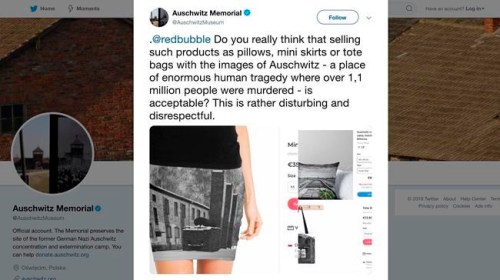
The items that caused offence were created by various designers and carried black-and-white post-war images of Auschwitz and the railway tracks leading into the Birkenau extermination camp and its gas chambers. A tote bag with a German-language warning sign at Auschwitz was being sold for 13.90 euros, a skirt with an Auschwitz image for 35 euros, and a pillow for 40.29 euros.
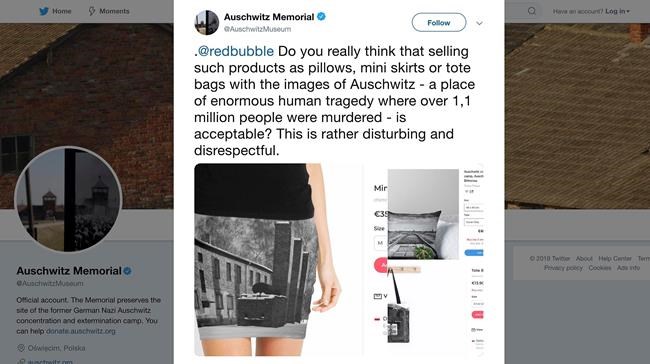
“Do you really think that selling such products as pillows, miniskirts or tote bags with the images of Auschwitz – a place of enormous human tragedy where over 1.1 million people were murdered – is acceptable? This is rather disturbing and disrespectful,” read a tweet sent Tuesday from the Auschwitz Memorial account to Redbubble’s customer service feed on Twitter.
Redbubble allows artists to create designs for T-shirts and other items made from fabric and to sell them directly to the public online. In response to the museum’s protest, Redbubble tweeted “the nature of this content is not acceptable” and that it was taking “immediate action to remove these and similar works available on these product types.”
“Redbubble takes a strong stance against racism and violence, including the atrocities committed in Nazi concentration camps,” the company said in a separate statement.
Bartyzel blamed the commercialization of the Holocaust and improper use of death camp imagery on a “lack of sensitivity, thoughtlessness, maybe sometimes a form of provocation.” Constant educating about Auschwitz-Birkenau and reacting quickly are the best prevention, he said.
“Luckily, the company that had made them available reacted in the right way, and we saw the items being removed from the offer,” Bartyzel said of the products on Redbubble.
Auschwitz Memorial tweeted to thank Redbubble for their message and reaction.
From 1940-45, around 1.1 million people, mostly Jews, but also Poles, Gypsies, Russian prisoners of war and others, were killed in the gas chambers or died of starvation, hard labour and disease at Auschwitz-Birkenau, the complex of concentration, forced labour and death camps Nazi Germany operated in occupied Poland.
Last year, over 2.1 million people visited the museum.
Last week, around 10,000 Jewish youths from around the world were joined by Holocaust survivors and politicians in the annual 3-kilometre (1.8-mile) March of the Living from Auschwitz to Birkenau in memory of the 6 million Jews killed during the war.