

A really si-lent Knight
Willys-Knight remembered for its ultraquiet engine
Advertisement
Read this article for free:
or
Already have an account? Log in here »
To continue reading, please subscribe:
Monthly Digital Subscription
$0 for the first 4 weeks*
- Enjoy unlimited reading on winnipegfreepress.com
- Read the E-Edition, our digital replica newspaper
- Access News Break, our award-winning app
- Play interactive puzzles
*No charge for 4 weeks then price increases to the regular rate of $19.00 plus GST every four weeks. Offer available to new and qualified returning subscribers only. Cancel any time.
Monthly Digital Subscription
$4.75/week*
- Enjoy unlimited reading on winnipegfreepress.com
- Read the E-Edition, our digital replica newspaper
- Access News Break, our award-winning app
- Play interactive puzzles
*Billed as $19 plus GST every four weeks. Cancel any time.
To continue reading, please subscribe:
Add Free Press access to your Brandon Sun subscription for only an additional
$1 for the first 4 weeks*
*Your next subscription payment will increase by $1.00 and you will be charged $16.99 plus GST for four weeks. After four weeks, your payment will increase to $23.99 plus GST every four weeks.
Read unlimited articles for free today:
or
Already have an account? Log in here »
Hey there, time traveller!
This article was published 19/06/2009 (6024 days ago), so information in it may no longer be current.
TORONTO — The Willys-Knight, built by Willys-Overland of Toledo, Ohio, from 1914 to1932 is remembered for its ultraquiet Knight sleeve-valve engine. Although it was also used in European luxury cars and the Canadian Russell car, it was the Willys-Knight that really popularized the engine.
Charles Yale Knight of Chicago became dissatisfied with the valves in his personal cars, which were opened mechanically and closed by a spring. They were noisy and prone to burning and leakage. Familiar with the sliding valves used in steam engines, he invented the Knight sleeve-valve gasoline engine to replace the noisy poppet valve. For his efforts, he received a British patent in 1908 and one from the United States two years later.
Knight’s design used two concentric cast-iron sleeves, or tubes, interposed between the pistons and cylinder block, with the pistons sliding on the inner one. These sleeves were reciprocated by short connecting rods operated by a crankshaft-rotated eccentric shaft much like a camshaft.
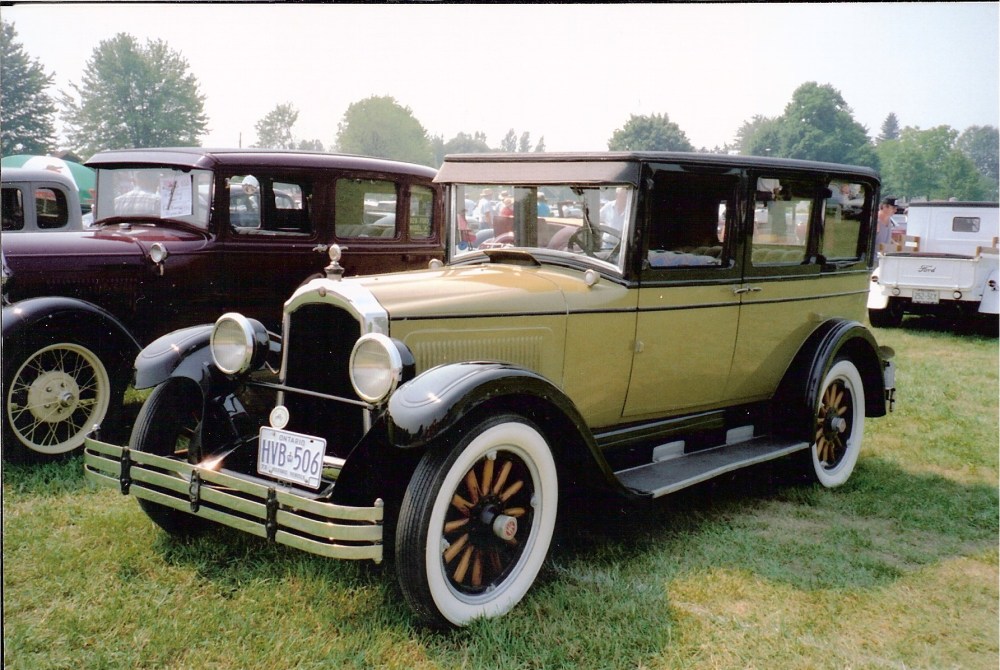
The sleeves were about three millimetres thick, with a stroke of about 25 mm. Slots at the tops of the sleeves lined up with intake and exhaust ports to flow the gases in and out of the cylinder. Although pistons and sleeves all sliding up and down at once sounds quite complicated, it worked very well.
Sleeve valves had several advantages. Their fully lubricated sliding motions made them extremely quiet compared with the impact clatter of poppet valves.
Positive opening and closing eliminated valve bounce and float. Combustion chambers could be the ideal hemispherical shape with a central spark plug, with no valve adjustments or decarbonizing required (a little carbon accumulation made them more efficient).
Disadvantages were that sleeve valves were more expensive to manufacture and were subject to higher oil consumption. Also, the added reciprocating mass and extra friction made the engine harder to turn over for starting.
Finding little enthusiasm for sleeve valves among auto manufacturers in the United States, Knight headed for Europe. There, he approached luxury automakers with his reasoning that quieter sleeve valves would be more highly valued.
By 1913, Knight customers included Daimler of England (used in its V12 "Double Six"), France’s Panhard et Levassor, Peugeot and Mors, Mercedes of Germany and Minerva of Belgium. French automakers pursued the development of the engine most vigourously.
Knight returned to the United States to try again, this time with more success. Among others, the Stearns Co. of Cleveland, Stoddard-Dayton of Dayton, Ohio, Columbia of Hartford, Conn., Edwards of New York and Russell of Toronto contracted for Knight licences.
John North Willys and the Knight engine crossed paths in 1913 when Willys purchased the Edwards Motor Co. for its Willys-Overland (W-O) company. The purchase included a sleeve-valve licence.
Armed with the licence, Willys plunged into sleeve valves with his customary enthusiasm. He introduced the new four-cylinder, sleeve-valve Willys-Knight car in 1914. The Willys-Knight would also be built in Toronto for the Canadian market and for export.
With the Willys-Knight, the company brought sleeve valve silence into the affordable price range, and it would ultimately produce more Knight-engined cars than all other users combined.
After a flurry of models, the Willys-Knight was almost lost in a glut of models from W-O, but, by 1919, the company consolidated to three lines.
These were the low-priced Overland, the medium-priced Willys-Knight and a new Willys Six that was under development.
Many buyers liked the ultraquiet operation of the sleeve-valve engine, and Willys-Knight became a successful mid-priced car with annual sales as high as 50,000. The four-cylinder was soon joined by the sleeve-valve six and a V8 (the latter in 1917 for a three-year stay). Willys-Knight went to sixes exclusively in 1926.
W-O did well through the 1920s, but, in the early 1930s, it was hurt by the Depression. Although the company made it through the ’30s, the Willys-Knight was allowed to die in 1932.
Advances in metallurgy and lubrication and the development of hydraulic valve lifters gradually made the poppet valve quiet and reliable. Sleeve valves lost their advantage and, although they would continue to be used for several years — especially in aircraft applications where the Burt-McCollum single-sleeve design was favoured (James McCollum was a University of Toronto engineering professor) — they disappeared from cars.
The Willys-Knight and other Knight-engined cars are fondly remembered as quiet voices among the clatter.
— Canwest News Service