2009 NISSAN ALTIMA HYBRID: Hybrid needs better breeding
Altima gas-electric sedan rough around the edges
Advertisement
Read this article for free:
or
Already have an account? Log in here »
To continue reading, please subscribe:

Digital Subscription
One year of digital access for only $205*
- Enjoy unlimited reading on winnipegfreepress.com
- Read the E-Edition, our digital replica newspaper
- Access News Break, our award-winning app
- Play interactive puzzles
*First annual payment billed as $205.00 + GST for one year. This annual subscription will automatically renew at $233.00 + GST every 52 weeks (10% off the regular annual price of $259.35). Offer available to new and qualified returning subscribers only. Cancel any time.
To continue reading, please subscribe:
Add Free Press access to your Brandon Sun subscription for only an additional
$1 for the first 4 weeks*
- Enjoy unlimited reading on winnipegfreepress.com
- Read the E-Edition, our digital replica newspaper
- Access News Break, our award-winning app
- Play interactive puzzles
*Your next Brandon Sun subscription payment will increase by $1.00 and you will be charged $17.95 plus GST for four weeks. After four weeks, your payment will increase to $24.95 plus GST every four weeks.
Read unlimited articles for free today:
or
Already have an account? Log in here »
Hey there, time traveller!
This article was published 18/12/2009 (6109 days ago), so information in it may no longer be current.
The Altima Hybrid is a model Nissan didn’t intend to build.
The Japanese automaker had spurned the notion of getting into hybrids. In fact, corporate boss Carlos Ghosn repeatedly said his company’s focus would be pure electric vehicles, not the gas/electric combinations. True to that goal, Nissan has just unveiled the production version of its all-electric Leaf sedan, which goes on sale to the public in 2012.
Meanwhile, consumers were developing a growing interest in green family sedans, and Nissan didn’t have a competitive product. Although it does have prototypes using its own technology, Nissan needed an immediate solution, so it turned to Toyota, acquiring its hybrid technology and applying it to its popular, five-passenger mid-size Altima.
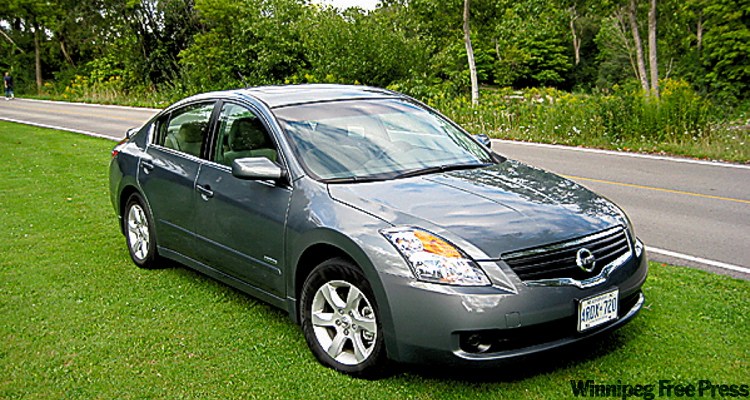
Although the system is well proven and meshes effectively with Nissan’s 2.5-litre four-cylinder gas engine and continuously variable transmission, it’s apparent this is not the latest technology. Compared with current-generation hybrid systems in Toyota products, or even the impressive powertrain in the Ford Fusion Hybrid, the Altima Hybrid is a bit rough around the edges. While the latest models have truly seamless transitions between gas and electric modes, you won’t need a gauge or indicator light on the Altima’s instrument panel to tell you when its fossil-fuelled four-banger kicks in — the switch is noisy and obvious.
Still, it’s a true hybrid, using a parallel setup that can switch between gas and electric power, or combine both as power demands dictate. It uses the electric motor to get rolling, with the gas engine kicking in to reach cruising speed. The system’s computers decide which power source is most efficient — gas, electric or a combined effort.
The result is a level of performance that meets most drivers’ needs, with decent acceleration and passing power. On the highway, the Altima sailed along seemingly effortlessly in cruising mode and I had no problem finding extra push for overtaking slower vehicles. Around town, it functioned at least as well as its conventionally powered kin, despite the fact the electric motor and battery pack add 126 kilograms to the car’s curb weight.
The Altima also delivers the fuel efficiency one expects from a hybrid — it’s rated at 5.7 litres per 100 kilometres in the city and 5.9 on the highway. I posted a combined average of 7.0 L/100 km during a 1,660-km span. (A base Altima with the 2.5-litre four-cylinder and CVT is rated at 8.9 city and 6.3 highway.) With its 76-litre fuel tank, the Hybrid has a range of more than 1,300 km.
Nissan has avoided the electronic gizmos and flashy displays other manufacturers incorporate into their hybrids. A simple analog gauge, replacing the tachometer in the main instrument cluster, indicates how the powertrain’s systems are functioning — no sprouting green leaves, glitzy graphs or animated graphics.
Otherwise, it’s difficult to differentiate between an Altima Hybrid and its conventionally powered sibling. It shares the same new platform introduced with the fourth-generation Altima, a stiffer chassis that forms a firm foundation for four-corner independent suspension, with struts and coils up front and a multi-link system in the rear. The result is a firm but comfortable ride with a bit of a performance edge in the handling department — typically Nissan. The smooth ride and low amount of road noise transmitted into the cabin make highway cruising a delight.
The braking system — four-wheel discs — has a solid feel, despite the regenerative function that sometimes spoils the firmness in competitive hybrids. An anti-lock braking system is standard, along with brake assist and electronic brake-force distribution.
The Altima Hybrid is also equipped with an electric power-steering system, which delivers decent feedback to the leather-wrapped steering wheel. With more than a foot in height difference between my spouse and me, we found the manual tilt and telescopic column, combined with the standard eight-way power adjustability of the driver’s seat, made the task of finding a comfortable driving position a breeze.
Both front seats are heated, with good support to ease back strain on long runs. The rear bench seat, too, is comfy, even for three adults, with plenty of legroom. The seatback, however, does not fold down because the hybrid’s battery pack is tucked behind. In fact, the space required for the battery also compromises available trunk space. The decent volume found in the conventional Altima (15.3 cubic feet) is reduced to just 10.1 cu. ft., making packing for a family outing somewhat of a challenge.

There are few changes for the 2010 model year other than a $400 price increase. The most notable addition is a leather tech package ($4,900) that includes an upgraded Bose audio system, navigation and leather trim. The front fascia has been tweaked, the alloy wheels have a new look and the side mirrors now include integrated turn signals. The gauge cluster illumination has changed from white to amber and the standard beige cloth interior is a brighter hue.
Though the Altima Hybrid gives Nissan shoppers a green alternative, if you’re looking for a fuel-efficient family car, I’d opt for the conventional 2.5 sedan with the CVT. Its fuel economy is nearly as good and it’s $8,300 less expensive.
— Canwest News Service
THE SPECS
Type of vehicle: Front-wheel-drive mid-size sedan
Engine: 2.5L DOHC four-cylinder / 650-volt, permanent magnet AC synchronous motor
Power: 158 hp@5,200 r.p.m.; 162 ft.-lb. of torque@2,800 r.p.m. / 40 hp; 199 lb.-ft. of torque
Transmission: Continuously variable
Brakes: Four-wheel disc with ABS
Tires: P215/60R16 all-season
Price: Base/as tested: $33,398/same (2010)
Destination charge: $1,400
Transport Canada fuel economy (L/100 km): 5.7 city, 5.9 hwy.
Standard features: Auto headlights, rear spoiler, power-heated folding side mirrors, heated seats, eight-way power-adjustable driver’s seat, active front head restraints, AM/FM/CD audio system with six speakers, leather-wrapped steering wheel and shifter knob, automatic dual-zone climate control with microfilter, sunroof, 16-inch alloy wheels, vehicle stability and traction-control systems, trip computer, hybrid power meter, cruise control, power windows with auto up/down, power door locks, remote keyless entry.