

PREVIEW: CHEVROLET VOLT
GM's hybrid delivers the goods electrically
Advertisement
Read this article for free:
or
Already have an account? Log in here »
To continue reading, please subscribe:
Digital Subscription
One year of digital access for only $75*
- Enjoy unlimited reading on winnipegfreepress.com
- Read the E-Edition, our digital replica newspaper
- Access News Break, our award-winning app
- Play interactive puzzles
*Billed as $5.77 plus GST every four weeks. After 52 weeks, price increases to the regular rate of $19.95 plus GST every four weeks. Offer available to new and qualified returning subscribers only. Cancel any time.
Monthly Digital Subscription
$4.99/week*
- Enjoy unlimited reading on winnipegfreepress.com
- Read the E-Edition, our digital replica newspaper
- Access News Break, our award-winning app
- Play interactive puzzles
*Billed as $19.95 plus GST every four weeks. Cancel any time.
To continue reading, please subscribe:
Add Free Press access to your Brandon Sun subscription for only an additional
$1 for the first 4 weeks*
- Enjoy unlimited reading on winnipegfreepress.com
- Read the E-Edition, our digital replica newspaper
- Access News Break, our award-winning app
- Play interactive puzzles
*Your next Brandon Sun subscription payment will increase by $1.00 and you will be charged $17.95 plus GST for four weeks. After four weeks, your payment will increase to $24.95 plus GST every four weeks.
Read unlimited articles for free today:
or
Already have an account? Log in here »
Hey there, time traveller!
This article was published 02/01/2010 (5981 days ago), so information in it may no longer be current.
It accelerates with a big, husky twist of its electric motor. Actually, you can even chirp the front tires if you push the go-button hard enough — very unlike a golf cart. It corners confidently and brakes crisply and, if it’s no Ferrari, it certainly won’t embarrass itself on the freeway.
It’s comfortable, practical and — graded on the curve of five-seat family hatchbacks — reasonably attractive. Think German-made-dishwasher pretty.
But the question remains: Will the Chevrolet Volt — General Motors’ radical electric vehicle with a range-extending gas generator on board, due in November 2010 — really work? Will it help GM leapfrog Toyota, currently experiencing its own woes, as a grandmaster of green-car technology? Will it help win back legions of disaffected customers? Will it wow EV enthusiasts who still haven’t forgiven GM for building the Hummer H2 or forgotten the murder of its charismatic little electric car of the 1990s, the EV1?
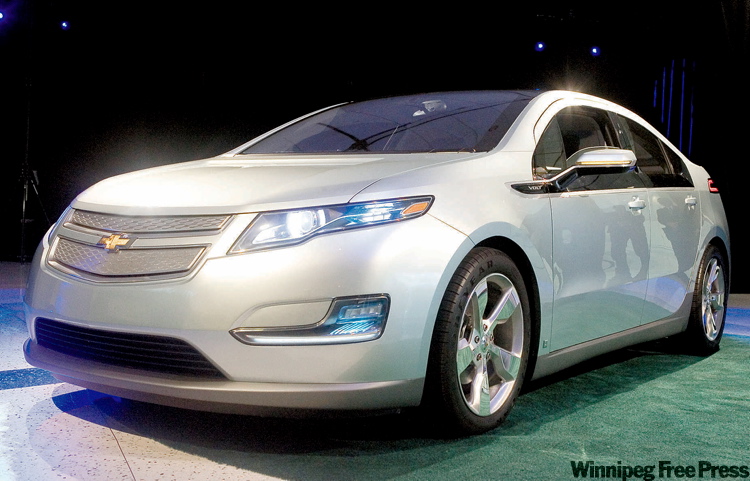
The high-tech, Earth-friendly Volt could provide a bridgehead for GM in California, where the company’s sales have plummeted about 50 per cent from September 2008. And by the way, while the Volt is saving GM, will it save gasoline? "Absolutely," says Andrew Farah, the Volt’s chief engineer. "It’s going to work, and work better than people realize… I’m proud as hell of this thing."
The Volt is a series hybrid EV that is propelled by a 120-kilowatt (160-horsepower) electric motor. Drawing on energy stored in its 16-kilowatt-hour lithium ion battery, the Volt has an all-electric range of about 65 kilometres. If the battery is depleted, a 1.4-litre four-cylinder generator kicks in to supply electricity to the traction motor.
The advantage of this design is that if drivers don’t exceed 65 kilometres of driving daily (and most don’t), and if they plug in at night, they won’t use any gas at all.
The Volt splits the difference between the greenness of an EV and the freedom of a gas-powered car. It will be the first such car to come to market.
GM hasn’t announced pricing, but it’s widely speculated the car will sell for less than US$40,000. U.S. buyers will get a $7,500 tax credit on the car, for a net cost of US$32,500 or less. That would still make the Volt thousands more expensive than a Toyota Prius or Honda Insight hybrid.
It would be hard to overstate the importance of the Volt to the image of GM, not least because GM, battered by bankruptcy and a lingering reputation as the Darth Vader of fuel economy, has been trumpeting the car in advertising for well over a year. That strategy carries its own risks.
"GM likely feels the massive pre-intro hype for the Volt is probably more valuable than any post-intro disappointment it may yield," said Karl Brauer, editor of Edmunds.com, the consumer auto research website. "The company is well into its second year of cashing in on the car’s promise of near-zero emissions and 200-plus miles per gallon. Will there be a year-plus of scolding by the press if the car ultimately bombs? No, a few weeks at most."
Farah was in Los Angeles recently taking a hand-built Volt prototype on a goodwill tour of sorts, visiting Jay Leno’s garage and car-enthusiast events. The tour included a stop at Dodger Stadium, where journalists had a chance to drive the car.
I spent 45 minutes behind the wheel, weaving through a four-tenths-mile course marked off by cones in one of the parking lots. This was one of the first opportunities for anyone outside of GM engineering to test the car.
The Volt — a four-door sedan with a hatchback, about the same size as a Toyota Prius — is filled with cheery, next-generation textures: the Mac-computerlike finish on the touch-sensitive centre console, a bright, animated information panel with readouts for battery life and fuel consumption.
As with all electric cars, the sensation of hard acceleration feels slightly empty because there’s no accompanying pitch of a snarling internal-combustion engine. The absence of engine noise tends to amplify other sounds, such as the squealing of the special low-rolling-resistance tires.
The Volt has a sport mode that boosts battery/motor output by 27 horsepower. In sport mode, the Volt acceleration feels well within the reported eight seconds to 60 miles an hour, perhaps a little better.
The critical moment arrives when the Volt exhausts its supply of onboard electrons and the range-extending gas generator kicks in. During my test drive, this moment came and went without much of a mechanical inflection. The output of the electric motor, and therefore the performance, remains the same. The engine noise is distant and muted.
If the car encounters a steep uphill grade, or the driver really floors it, the gas generator does rev up to keep up with the electrical demand, sounding much like a conventional car. The engine noise is still too noticeable, according to Farah. The complex power-management software will be evolving until the day the car goes to market.
Still, even in this rough prototype, the Volt vibe is spacious, comfortable and lively. The whole car seems lit from within by the ambitions of its builders.
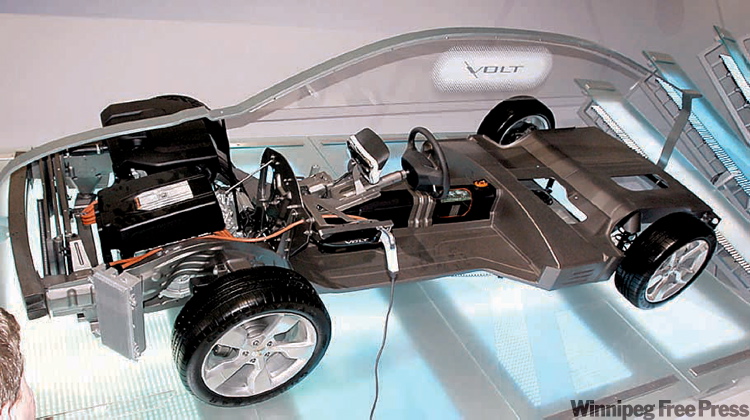
The Volt will not be an easy sell. Because it is, in Farah’s words, a "discontinuous product" — which is to say, unlike anything else on the market — the public is still unsure how the Volt works or how it differs from a hybrid or a pure electric vehicle. "People hear what their brain tells them they already know."
For example: Unlike electric cars like Nissan’s Leaf, due late next year, the Volt has essentially unlimited range, as it can run on gasoline.
And yet many people fret that the Volt will leave them stranded with a dead battery. So-called range anxiety is one of the big obstacles facing battery-electric vehicles in the U.S. "One message we’re trying to get out is that there’s life after 40 (miles)," Farah said.
Another challenge: Not everyone will have a place to plug the car in. Apartment dwellers need not apply.
The Volt’s technical approach has won fans in the environmental community.
"Combining battery-electric drive with an internal-combustion range extender is an elegant solution that provides enough electric-only range for most people, while offering unlimited hybrid range when required," said Ron Cogan, publisher of Green Car Journal and editor of GreenCar.com.
Some industry observers, however, are taking a wait-and-see attitude.
"It’s a new kind of technology and an unknown quantity," says Michael Omotoso, director of powertrain forecasting for J.D. Power and Associates.
— Los Angeles Times